Department of Infectious Diseases, National Center for Children's Health, Beijing Children's Hospital Capital Medical University, Beijing, China.
Department of Infectious Diseases, National Center for Children's Health, Beijing Children's Hospital Capital Medical University, Beijing, China
BMJ Open. 2022 Mar 16;12(3):e049840. doi: 10.1136/bmjopen-2021-049840.
To date, there is no standard diagnostic practice to identify the underlying disease-causing mechanism for paediatric patients suffering from chronic fever without any specific diagnosis, which is one of the leading causes of death in paediatric patients. Therefore, we aimed this retrospective study to analyse medical records of paediatric patients with fever of unknown origin (FUO) to provide a preliminary basis for improving the diagnostic categories and facilitate the treatment outcomes.
A retrospective study.
Beijing Children's Hospital.
Clinical data were collected from 1288 children between 1 month and 18 years of age diagnosed with FUO at Beijing Children's Hospital between January 2010 and December 2017.
According to the aetiological composition, age, duration of fever and laboratory examination results, the diagnostic strategies were analysed and formulated.
The statistical analyses were carried out using SPSS V.24.0 platform along with the χ test and analysis of variance (p<0.05).
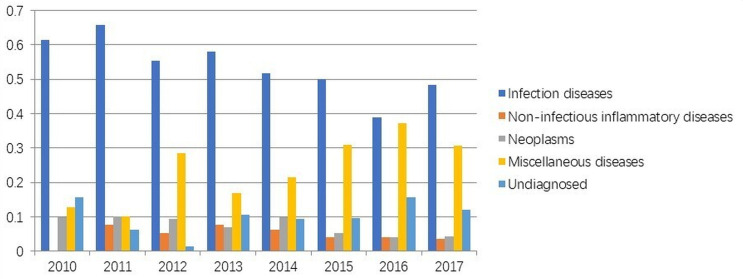
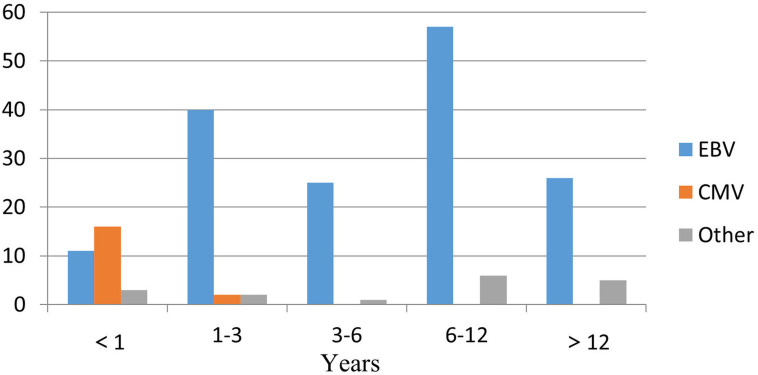
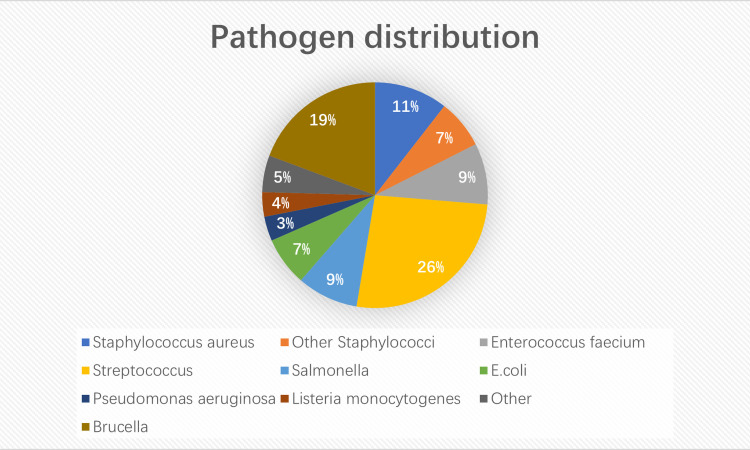
The duration of fever ranged from 2 weeks to 2 years, with an average of 6 weeks. There were 656 cases (50.9%) of infectious diseases, 63 cases (4.9%) of non-infectious inflammatory diseases (NIIDs), 86 cases (6.7%) of neoplastic diseases, 343 cases (26.6%) caused by miscellaneous diseases and 140 cases (10.9%) were undiagnosed. With increasing age, the proportion of FUO from infectious diseases gradually decreased from 73.53% to 44.21%. NIID was more common in children over 3 years old, and neoplastic diseases mainly occurred from 1 to 6 years of age. Among miscellaneous diseases, the age distribution was mainly in school-aged children over 6 years. Respiratory tract infection was the most common cause of FUO in children, followed by bloodstream infections. Bacterial infection was the most common cause in children with less than 1 year old, while the virus was the main pathogen in children over 1 year old.
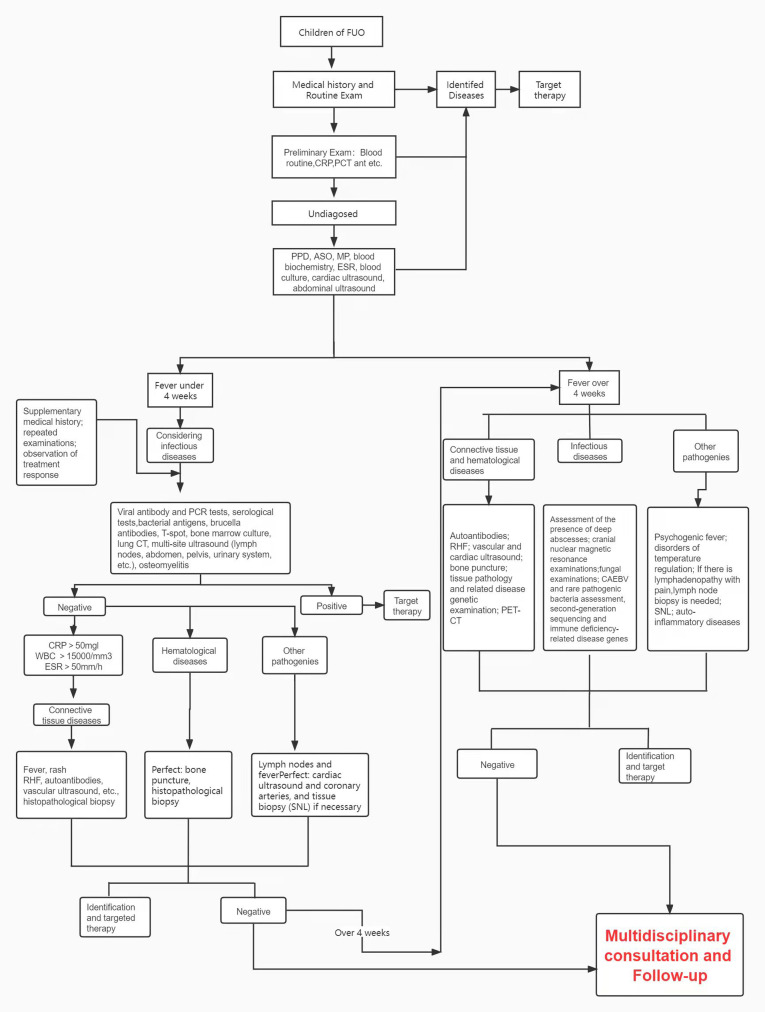
The diagnosis of neoplastic diseases and miscellaneous diseases-related diseases still depends mainly on invasive examination. According to our clinical experience, the diagnostic process was formulated based on fever duration and the type of disease. This process can provide a guide for the diagnosis and treatment of paediatric FUO in the future.
目前,对于无明确诊断的儿童慢性发热患者,尚无标准的诊断方法来确定其潜在的致病机制,此类患者是导致儿童死亡的主要原因之一。因此,本回顾性研究旨在分析发热原因不明(FUO)患儿的病历,为提高诊断类别和改善治疗效果提供初步依据。
回顾性研究。
北京儿童医院。
收集 2010 年 1 月至 2017 年 12 月在北京儿童医院诊断为 FUO 的 1288 例 1 个月至 18 岁儿童的临床资料。
根据病因构成、年龄、发热持续时间和实验室检查结果,分析并制定诊断策略。
使用 SPSS V.24.0 平台进行统计分析,并进行 χ 检验和方差分析(p<0.05)。
发热持续时间 2 周至 2 年,平均 6 周。656 例(50.9%)为感染性疾病,63 例(4.9%)为非感染性炎症性疾病(NIID),86 例(6.7%)为肿瘤性疾病,343 例(26.6%)为其他疾病,140 例(10.9%)为未明确诊断。随着年龄的增长,感染性疾病引起的 FUO 比例逐渐从 73.53%降至 44.21%。NIID 多见于 3 岁以上儿童,肿瘤性疾病主要发生于 1~6 岁儿童。在其他疾病中,年龄分布主要在 6 岁以上的学龄儿童。呼吸道感染是儿童 FUO 最常见的原因,其次是血流感染。1 岁以下儿童以细菌感染为主,1 岁以上儿童以病毒为主。
肿瘤性疾病和其他疾病相关疾病的诊断仍主要依赖于有创检查。根据我们的临床经验,根据发热时间和疾病类型制定了诊断过程。该过程可为儿科 FUO 的诊断和治疗提供指导。