Institute of Hydrogeology, Engineering Geology and Applied Geophysics, Faculty of Science, Charles University, 12843, Prague, Czech Republic.
Geophysical Institute, University of Alaska-Fairbanks, 903 N Koyukuk Drive, Fairbanks, AK, 99709, USA.
Sci Rep. 2022 Mar 16;12(1):4501. doi: 10.1038/s41598-022-08305-x.
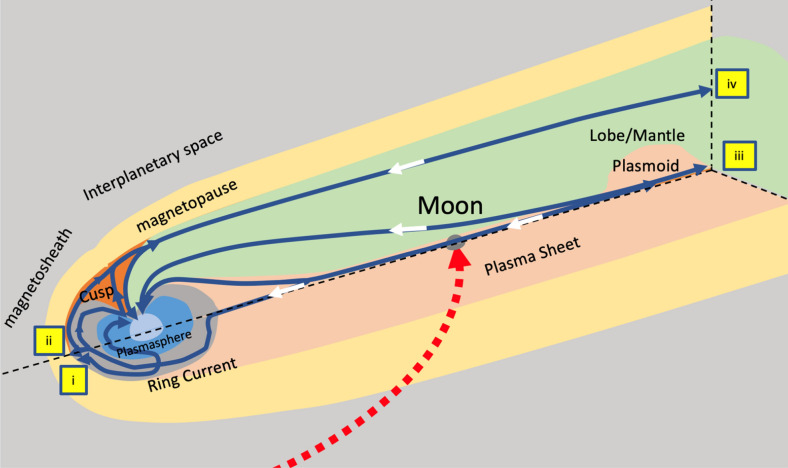
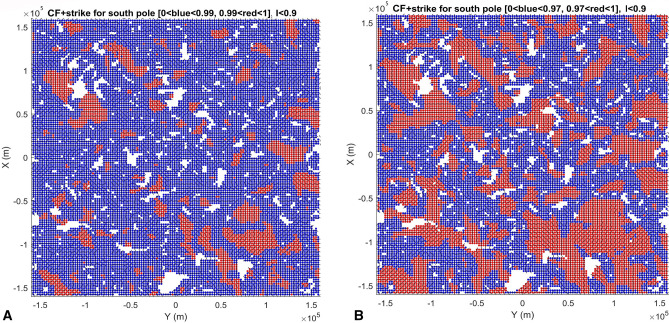
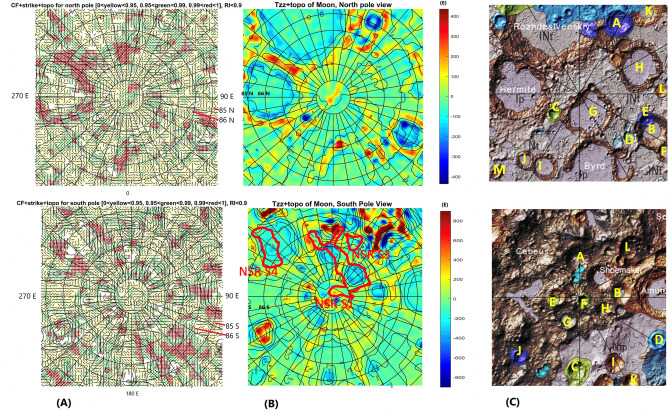
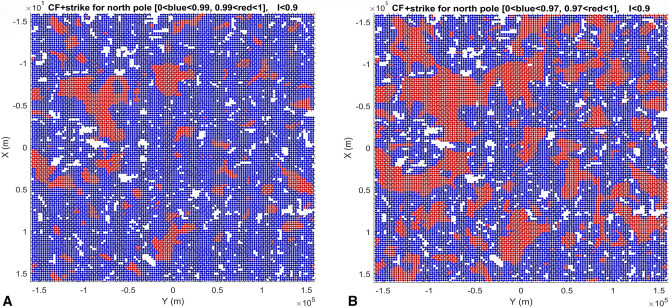
Our Moon periodically moves through the magnetic tail of the Earth that contains terrestrial ions of hydrogen and oxygen. A possible density contrast might have been discovered that could be consistent with the presence of water phase of potential terrestrial origin. Using novel gravity aspects (descriptors) derived from harmonic potential coefficients of gravity field of the Moon, we discovered gravity strike angle anomalies that point to water phase locations in the polar regions of the Moon. Our analysis suggests that impact cratering processes were responsible for specific pore space network that were subsequently filled with the water phase filling volumes of permafrost in the lunar subsurface. In this work, we suggest the accumulation of up to ~ 3000 km of terrestrial water phase (Earth's atmospheric escape) now filling the pore spaced regolith, portion of which is distributed along impact zones of the polar regions of the Moon. These unique locations serve as potential resource utilization sites for future landing exploration and habitats (e.g., NASA Artemis Plan objectives).
我们的月球周期性地穿过地球的磁尾,磁尾中包含氢和氧的陆地离子。可能已经发现了可能存在潜在地球起源的水相的密度对比。使用源自月球重力场调和势系数的新型重力方面(描述符),我们发现了指向月球极地水相位置的重力撞击角度异常。我们的分析表明,撞击坑形成过程负责特定的孔隙空间网络,随后这些网络被月球次表层永冻层的水相填充体积填满。在这项工作中,我们提出了多达~3000 公里的陆地水相(地球大气逃逸)的积累,现在正在填充孔隙间隔的风化层,其中一部分分布在月球极地的撞击区沿线。这些独特的位置可以作为未来着陆探索和栖息地的潜在资源利用地点(例如,美国宇航局阿尔忒弥斯计划的目标)。