Skin Cancer Unit/ Department of Dermatology, Venerology and Allergology, German Cancer Research Center (DKFZ), University Medical Centre Mannheim, Heidelberg, Mannheim, Germany.
Mannheim Institute for Innate Immunoscience (MI3), Medical Faculty Mannheim, Ruprecht-Karl University of Heidelberg, Mannheim, Germany.
J Immunother Cancer. 2022 Mar;10(3). doi: 10.1136/jitc-2021-004384.
Myeloid-derived suppressor cells (MDSCs) represent a negative prognostic factor in malignant melanoma. These cells are generated under chronic inflammatory conditions typical of cancer. The transcription factor signal transducer and activator of transcription 3 (STAT3) orchestrates MDSC accumulation and acquisition of immunosuppressive properties. Here we studied STAT3 inhibition by Napabucasin as a way to block MDSC accumulation and activity and its potential to treat malignant melanoma.
generated murine MDSC and primary MDSC from melanoma-bearing mice were used to investigate the effects of Napabucasin on MDSC . The transgenic mouse model of malignant melanoma was used to examine Napabucasin therapy efficiency and its underlying mechanisms . Furthermore, STAT3 activation and its correlation with survival were explored in MDSC from 19 patients with malignant melanoma and human generated monocytic myeloid-derived suppressor cell (M-MDSC) were used to evaluate the effects of Napabucasin.
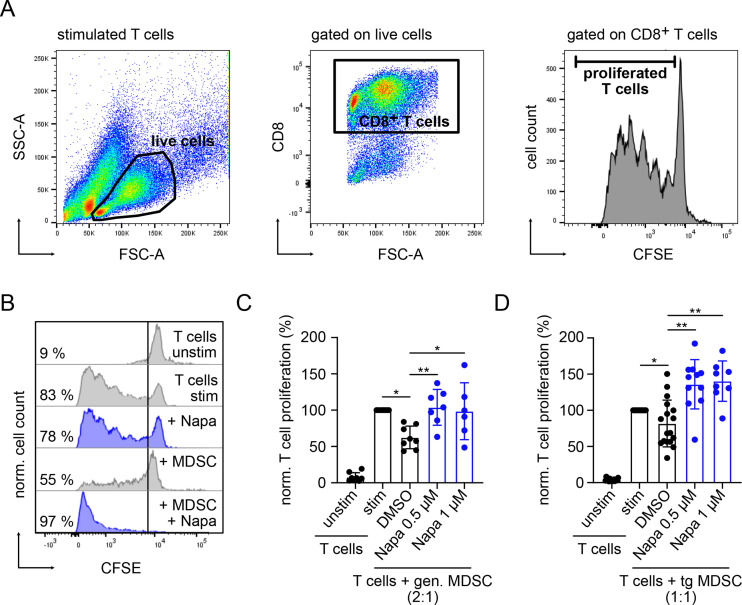
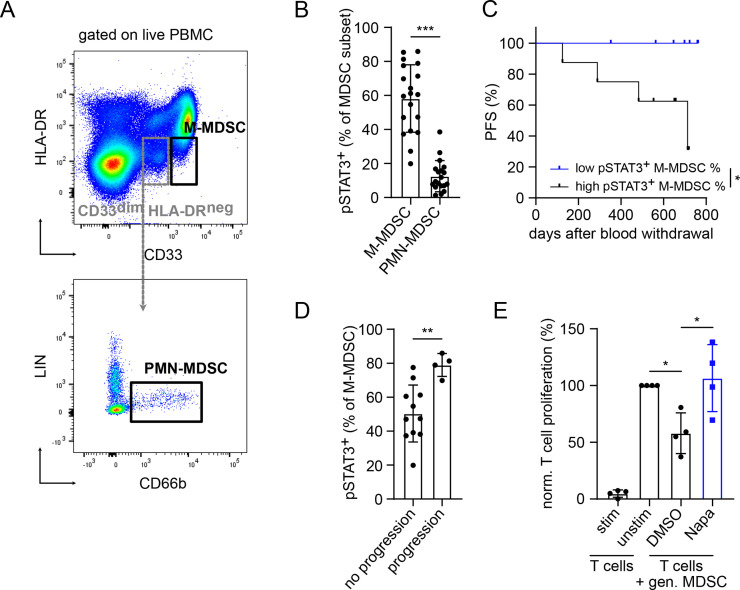
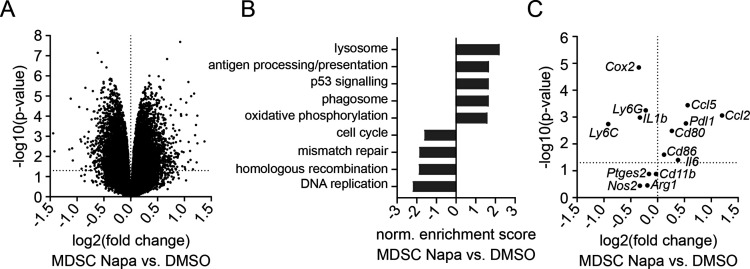
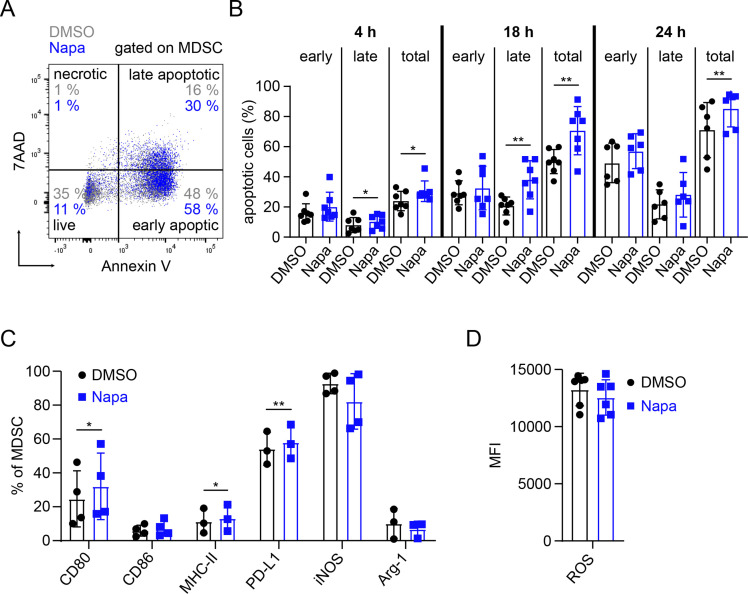
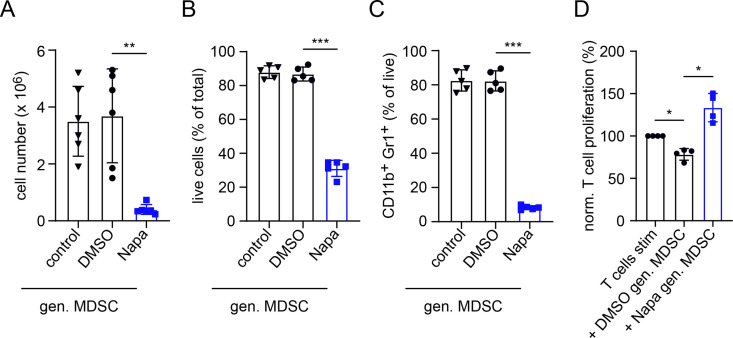
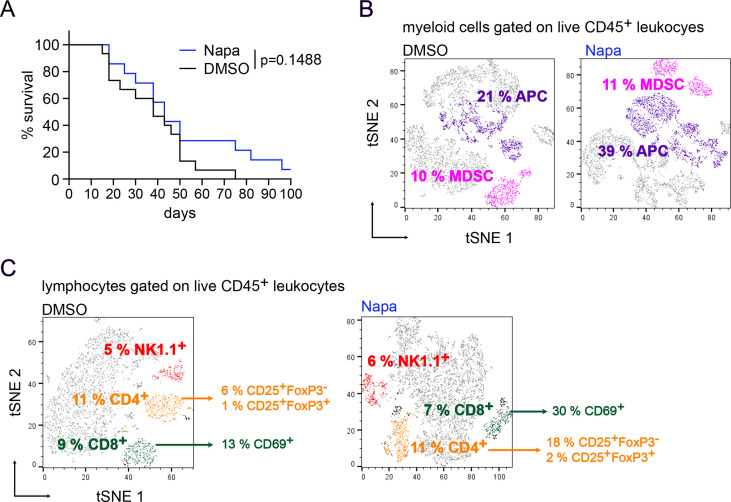
Napabucasin was able to abrogate the capacity of murine MDSC to suppress CD8 T-cell proliferation. The STAT3 inhibitor induced apoptosis in murine MDSC, significantly increased expression of molecules associated with antigen processing and presentation, as well as slightly decreased expression of immunosuppressive factors on these cells. transgenic mice treated with Napabucasin showed prolonged survival accompanied by a strong accumulation of tumor-infiltrating antigen-presenting cells and activation of CD8 and CD4 T cells. Interestingly, patients with malignant melanoma with high expression of activated STAT3 in circulating M-MDSC showed significantly worse progression-free survival (PFS) than patients with low levels of activated STAT3. In addition, Napabucasin was able to abrogate suppressive capacity of human generated M-MDSC.
Our findings demonstrate that STAT3 inhibitor Napabucasin completely abrogated the immunosuppressive capacity of murine MDSC and human M-MDSC and improved melanoma-bearing mouse survival. Moreover, patients with malignant melanoma with high expression levels of activated STAT3 in M-MDSC displayed shorter PFS, indicating its role as a promising therapeutic target in patients with malignant melanoma and a predictive marker for their clinical outcome.
髓源性抑制细胞(MDSCs)是恶性黑色素瘤的一个负预后因素。这些细胞是在癌症典型的慢性炎症条件下产生的。转录因子信号转导和转录激活因子 3(STAT3)协调 MDSC 的积累和获得免疫抑制特性。在这里,我们研究了 Napabucasin 通过抑制 STAT3 来阻止 MDSC 积累和活性的作用,以及其治疗恶性黑色素瘤的潜力。
从荷瘤小鼠中生成小鼠 MDSC 和原代 MDSC,以研究 Napabucasin 对 MDSC 的影响。使用恶性黑色素瘤的转基因小鼠模型来研究 Napabucasin 治疗的效率及其潜在机制。此外,在 19 名恶性黑色素瘤患者的 MDSC 中探索了 STAT3 的激活及其与生存的相关性,并使用人源诱导的单核细胞髓源性抑制细胞(M-MDSC)来评估 Napabucasin 的作用。
Napabucasin 能够阻断小鼠 MDSC 抑制 CD8 T 细胞增殖的能力。STAT3 抑制剂诱导小鼠 MDSC 凋亡,显著增加与抗原处理和呈递相关的分子表达,同时略微降低这些细胞上免疫抑制因子的表达。用 Napabucasin 治疗的转基因小鼠表现出延长的生存时间,伴有肿瘤浸润性抗原呈递细胞的强烈积累和 CD8 和 CD4 T 细胞的激活。有趣的是,循环 M-MDSC 中表达激活 STAT3 的恶性黑色素瘤患者的无进展生存期(PFS)明显差于表达低水平激活 STAT3 的患者。此外,Napabucasin 能够阻断人源诱导的 M-MDSC 的抑制能力。
我们的研究结果表明,STAT3 抑制剂 Napabucasin 完全阻断了小鼠 MDSC 和人 M-MDSC 的免疫抑制能力,并改善了荷瘤小鼠的生存。此外,在 M-MDSC 中表达高水平激活 STAT3 的恶性黑色素瘤患者的 PFS 较短,表明其作为恶性黑色素瘤患者有前途的治疗靶点和他们临床结果的预测标志物的作用。