Halli Kathrin, Bohlouli Mehdi, Schulz Lisa, Sundrum Albert, König Sven
Institute of Animal Breeding and Genetics, Group Animal Breeding, Justus Liebig University, Giessen, 35390, Germany.
Department of Animal Nutrition and Animal Health, Kassel University, Witzenhausen, 37213, Germany.
Transl Anim Sci. 2022 Feb 3;6(1):txac022. doi: 10.1093/tas/txac022. eCollection 2022 Jan.
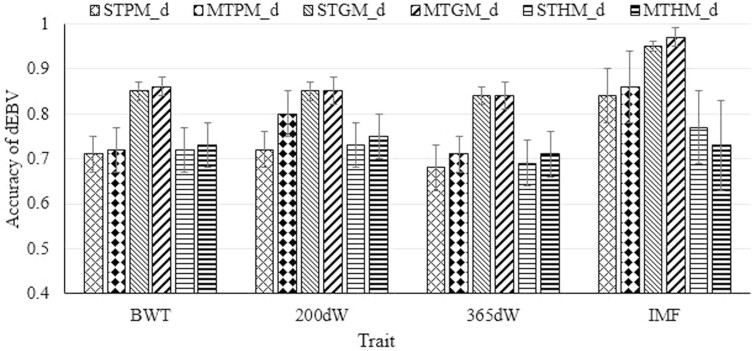
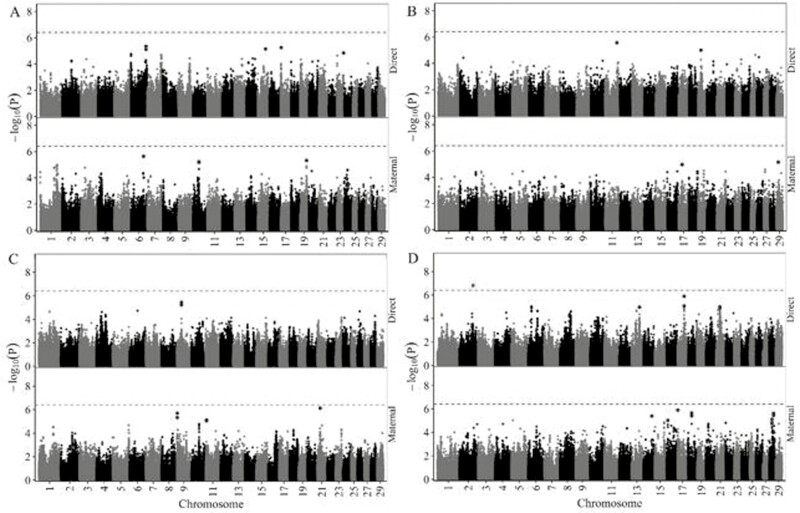
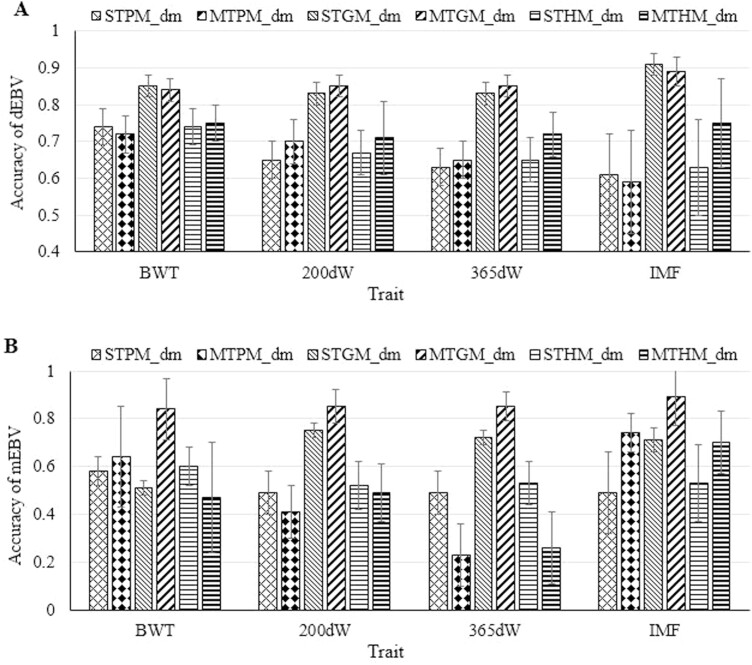
With regard to potential applications of genomic selection in small numbered breeds, we evaluated genomic models and focused on potential candidate gene annotations for weight and meat quality traits in the local Rotes Höhenvieh (RHV) breed. Traits included 6,003 birth weights (BWT), 5,719 200 d-weights (200dw), 4,594 365 d-weights (365dw), and 547 records for intramuscular fat content (IMF). A total of 581,304 SNP from 370 genotyped cattle with phenotypic records were included in genomic analyses. Model evaluations focused on single- and multiple-trait models with direct and with direct and maternal genetic effects. Genetic relationship matrices were based on pedigree (-matrix), SNP markers (-matrix), or both (-matrix). Genome-wide association studies (GWASs) were carried out using linear mixed models to identify potential candidate genes for the traits of interest. De-regressed proofs (DRP) for direct and maternal genetic components were used as pseudo-phenotypes in the GWAS. Accuracies of direct breeding values were higher from models based on or on compared to . Highest accuracies (> 0.89) were obtained for IMF with multiple-trait models using the -matrix. Direct heritabilities with maternal genetic effects ranged from 0.62 to 0.66 for BWT, from 0.45 to 0.55 for 200dW, from 0.40 to 0.44 for 365dW, and from 0.48 to 0.75 for IMF. Maternal heritabilities for BWT, 200dW, and 365dW were in a narrow range from 0.21 to 0.24, 0.24 to 0.27, and 0.21 to 0.25, respectively, and from 0.25 to 0.65 for IMF. Direct genetic correlations among body weight traits were positive and favorable, and very similar from different models but showed a stronger variation with 0.31 (A), -0.13 (G), and 0.45 (H) between BWT and IMF. In gene annotations, we identified 6, 3, 1, and 6 potential candidate genes for direct genetic effect on BWT, 200dW, 365dW, and IMF traits, respectively. Regarding maternal genetic effects, four (, , , and ) and two ( and ) genes were detected as potential candidate genes for BWT and 365dW, respectively. Potential candidate genes for maternal effect on IMF were , , , and . As the most important finding from a practical breeding perspective, a small number of genotyped RHV cattle enabled accurate breeding values for high heritability IMF.
关于基因组选择在小品种中的潜在应用,我们评估了基因组模型,并重点关注了当地红高地牛(RHV)品种体重和肉质性状的潜在候选基因注释。性状包括6003个出生体重(BWT)、5719个200日龄体重(200dw)、4594个365日龄体重(365dw)以及547个肌内脂肪含量(IMF)记录。对370头有表型记录的基因分型牛的581304个单核苷酸多态性(SNP)进行了基因组分析。模型评估集中在具有直接遗传效应以及直接和母体遗传效应的单性状和多性状模型上。遗传关系矩阵基于系谱(-矩阵)、SNP标记(-矩阵)或两者(-矩阵)。使用线性混合模型进行全基因组关联研究(GWAS),以识别感兴趣性状的潜在候选基因。直接和母体遗传成分的去回归证明(DRP)被用作GWAS中的伪表型。与基于相比,基于或的模型得出的直接育种值准确性更高。使用-矩阵的多性状模型对IMF获得了最高的准确性(>0.89)。考虑母体遗传效应时,BWT的直接遗传力范围为0.62至0.66,200dW为0.45至0.55,365dW为0.40至0.44,IMF为0.48至0.75。BWT、200dW和365dW的母体遗传力分别在0.21至0.24、0.24至0.27和0.21至0.25的狭窄范围内,IMF的母体遗传力为0.25至0.65。体重性状之间的直接遗传相关性为正且有利,不同模型的结果非常相似,但BWT与IMF之间的相关性变化较大,分别为0.31(A)、-0.13(G)和0.45(H)。在基因注释中,我们分别鉴定出6个、3个、1个和6个对BWT、200dW、365dW和IMF性状有直接遗传效应的潜在候选基因。关于母体遗传效应,分别检测到4个(、、和)和2个(和)基因作为BWT和365dW的潜在候选基因。对IMF有母体效应的潜在候选基因是、、、和。从实际育种角度来看,最重要的发现是,少量基因分型的RHV牛能够得出高遗传力IMF的准确育种值。