Department of Anesthesiology, Tongren Hospital of Wuhan University (Wuhan Third Hospital), Wuhan, Hubei 430060, China.
Comput Math Methods Med. 2022 Mar 9;2022:2813521. doi: 10.1155/2022/2813521. eCollection 2022.
Hepatocellular carcinoma (HCC) is a significant cause of human death in the world. Recently, it is found that midazolam can modulate miRs to participate in HCC progression. This research project was designed to elucidate the impacts of midazolam and miR-217 on HCC cell metastasis and apoptosis.
Human HCC cell strains (Hep3B and SK-HEP-1) were selected and intervened by midazolam at different concentrations in our research. miR-217-inhibitor intervened in the two HCC cell strains to observe the alterations of cell migration, invasiveness, and apoptosis. The miR-217 level in HCC cells was identified by reverse transcription-quantitative polymerase chain reaction (RT-qPCR).
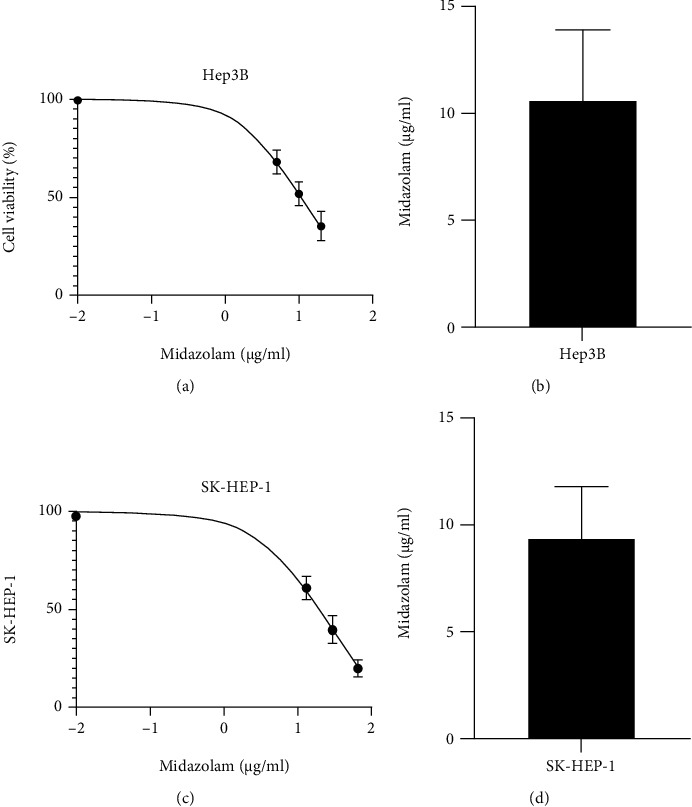
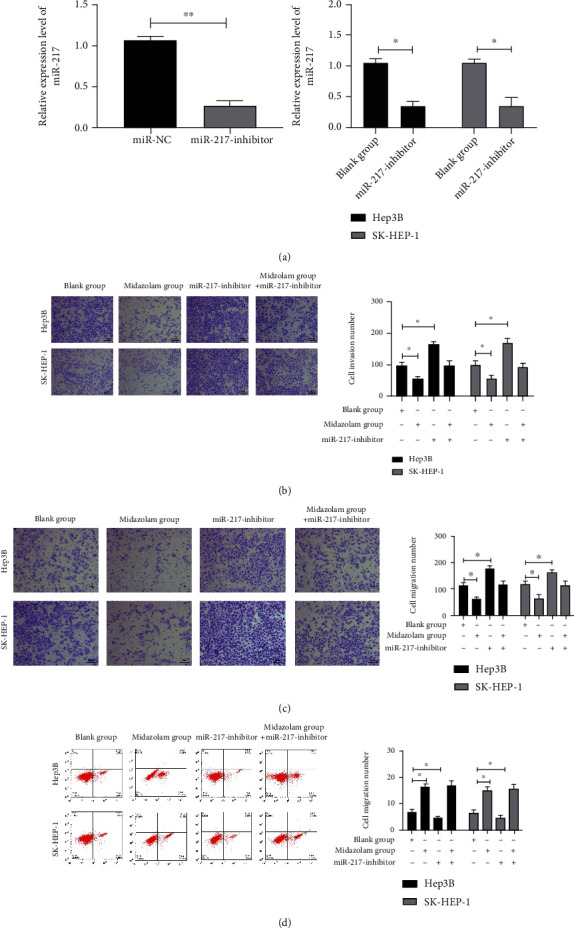
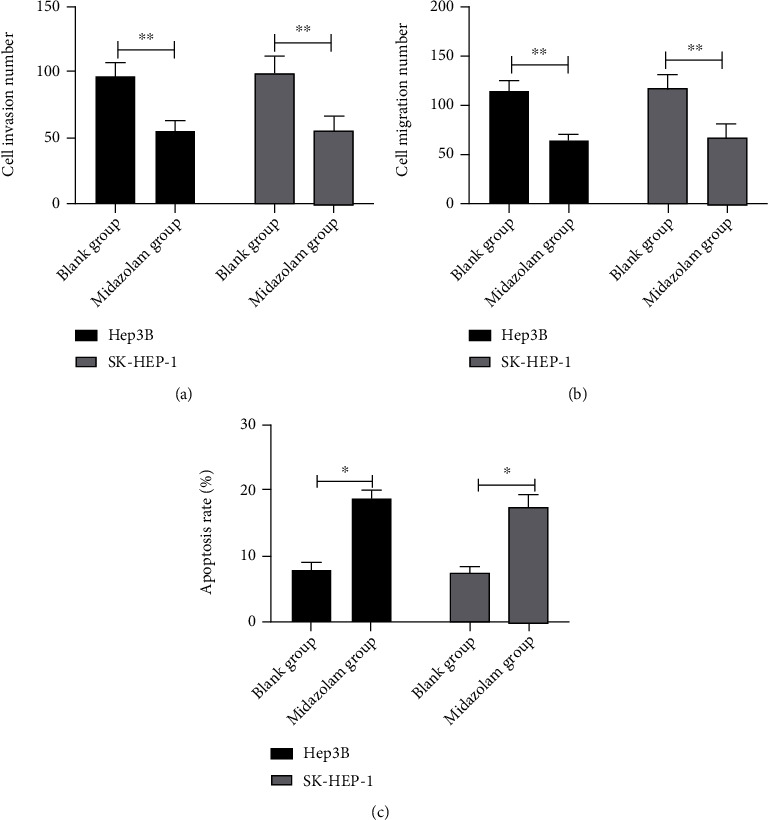
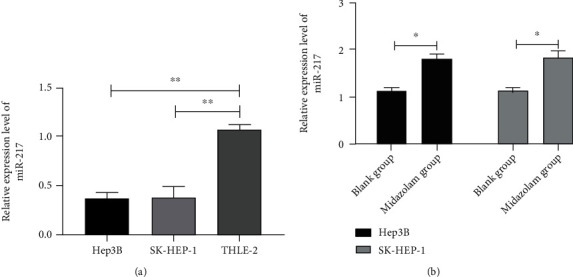
As midazolam concentration was elevated, Hep3B and SK-HEP-1 viabilities were more obviously suppressed. The 10 g/mL concentration was selected for analysis since Hep3B and SK-HEP-1 had an IC50 of 10.57 g/mL and 9.35 g/m, respectively. The qRT-PCR results showed the decreased of miR-217 in HCC cells, which was enhanced notably by midazolam intervention. Compared with the blank group, the invasiveness and migration (Transwell assay) of miR-217-inhibitor-transfected HCC cells were distinctly enhanced and the apoptosis rate (flow cytometry) was noticeably reduced.
Midazolam can upregulate miR-217 in HCC cells, thus inhibiting HCC cell metastasis and apoptosis.
肝细胞癌(HCC)是全球范围内导致人类死亡的重要原因。最近发现,咪达唑仑可以调节miRs 参与 HCC 进展。本研究旨在阐明咪达唑仑和 miR-217 对 HCC 细胞转移和凋亡的影响。
在本研究中,选择人 HCC 细胞株(Hep3B 和 SK-HEP-1),并通过不同浓度的咪达唑仑进行干预。用 miR-217 抑制剂干预两种 HCC 细胞系,观察细胞迁移、侵袭和凋亡的变化。采用逆转录定量聚合酶链反应(RT-qPCR)检测 HCC 细胞中的 miR-217 水平。
随着咪达唑仑浓度的升高,Hep3B 和 SK-HEP-1 的活力明显受到抑制。由于 Hep3B 和 SK-HEP-1 的 IC50 分别为 10.57 g/mL 和 9.35 g/m,因此选择 10 g/mL 浓度进行分析。qRT-PCR 结果显示 HCC 细胞中 miR-217 水平降低,咪达唑仑干预后明显增强。与空白组相比,miR-217 抑制剂转染的 HCC 细胞的侵袭和迁移(Transwell 检测)明显增强,凋亡率(流式细胞术)明显降低。
咪达唑仑可上调 HCC 细胞中的 miR-217,从而抑制 HCC 细胞的转移和凋亡。