Yamao Kentaro, Ogura Takeshi, Shiomi Hideyuki, Eguchi Takaaki, Matsumoto Hisakazu, Li Zhao Liang, Hashimoto Hiroaki, Chiba Yasutaka, Takenaka Mamoru, Watanabe Tomohiro, Kudo Masatoshi, Sanuki Tsuyoshi
Department of Gastroenterology and Hepatology Kindai University Hospital Osaka Japan.
The Second Department of Internal Medicine Osaka Medical College Osaka Japan.
DEN Open. 2021 Aug 25;2(1):e20. doi: 10.1002/deo2.20. eCollection 2022 Apr.
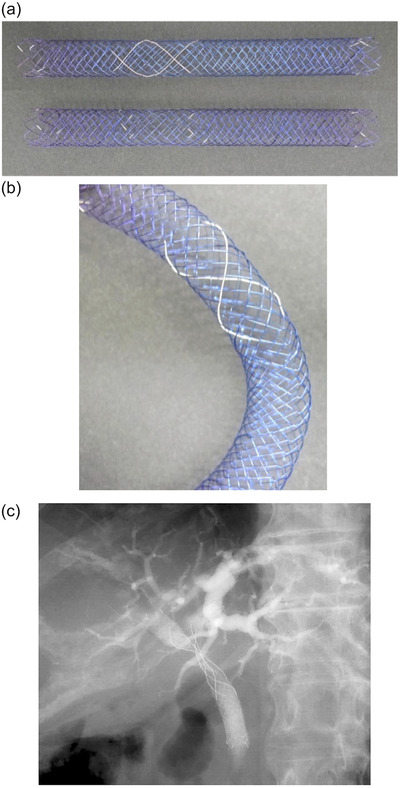
The endoscopic bilateral stent-in-stent (SIS) deployment is a challenging procedure. Such difficulty is mainly caused by sticking of the tip of the delivery sheath into the self-expandable metal stents (SEMSs) mesh, requiring an additional dilating procedure. Herein, we assessed the clinical results of using cross-wired metal stent for endoscopic bilateral SIS deployment (BONASTENT M-Hilar) in patients with malignant hilar biliary obstruction (MHBO) in both high-volume and non-high-volume centers.
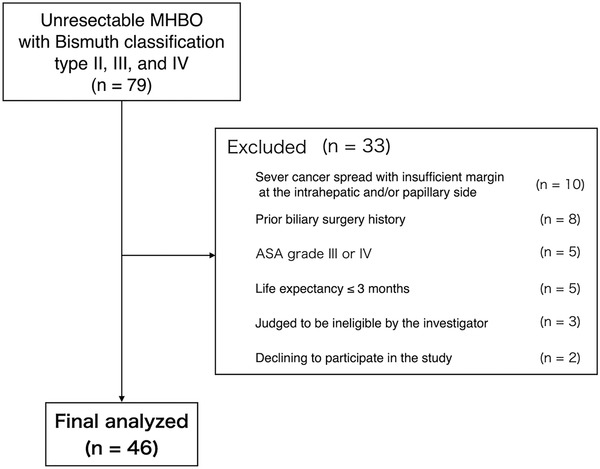
We prospectively enrolled consecutive patients with MHBO between February 2016 and December 2018 at eight centers.
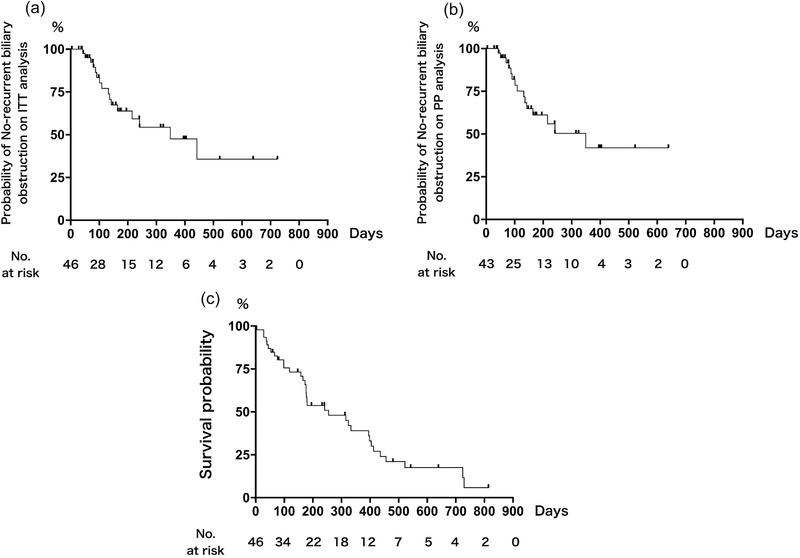
Forty-six patients were enrolled during the study period. The proportions of technical success were 93.5% (43/46) and clinical success (CS) on intention-to-treat and per-protocol analyses were 91.3% (42/46) and 93.0% (40/43), respectively. The proportion of an additional dilating procedure during the primary procedure was 50.0% (23/46). Recurrent biliary obstruction (RBO) on intention-to-treat analysis occurred in 32.6% (15/46) of cases. Almost all of the events were caused by stent ingrowth (14/15). The median survival time and time to RBO were 255 and 349 days, respectively. The probability of stent patency at 3, 6, and 12 months was 86.5%, 63.9%, and 47.6%, respectively.
The cross-wired metal stent had excellent technical and CS, although non-high-volume centers were included in this study (UMIN000021441).
内镜下双侧支架套叠置入术是一项具有挑战性的操作。这种困难主要是由于输送鞘尖端粘在自膨式金属支架(SEMS)网孔中,需要额外的扩张操作。在此,我们评估了在大容量和非大容量中心使用交叉钢丝金属支架进行内镜下双侧支架套叠置入术(BONASTENT M-肝门部)治疗恶性肝门部胆管梗阻(MHBO)患者的临床结果。
2016年2月至2018年12月,我们在8个中心前瞻性纳入了连续的MHBO患者。
研究期间共纳入46例患者。技术成功率为93.5%(43/46),意向性分析和符合方案分析的临床成功率(CS)分别为91.3%(42/46)和93.0%(40/43)。初次操作期间额外进行扩张操作的比例为50.0%(23/46)。意向性分析中复发性胆管梗阻(RBO)发生率为32.6%(15/46)。几乎所有事件均由支架向内生长引起(14/15)。中位生存时间和至RBO时间分别为255天和349天。3、6和12个月时支架通畅的概率分别为86.5%、63.9%和47.6%。
尽管本研究纳入了非大容量中心(UMIN000021441),但交叉钢丝金属支架具有出色的技术和临床成功率。