Lindner F H, Fitzpatrick E G, Haffa D, Ponnath L, Schmidt A-K, Speicher M, Zielbauer B, Schreiber J, Thirolf P G
Ludwig-Maximilians-Universität München, Am Coulombwall 1, 85748, Garching bei München, Germany.
GSI Helmholtzzentrum für Schwerionenforschung GmbH, Planckstraße 1, 64291, Darmstadt, Germany.
Sci Rep. 2022 Mar 21;12(1):4784. doi: 10.1038/s41598-022-08556-8.
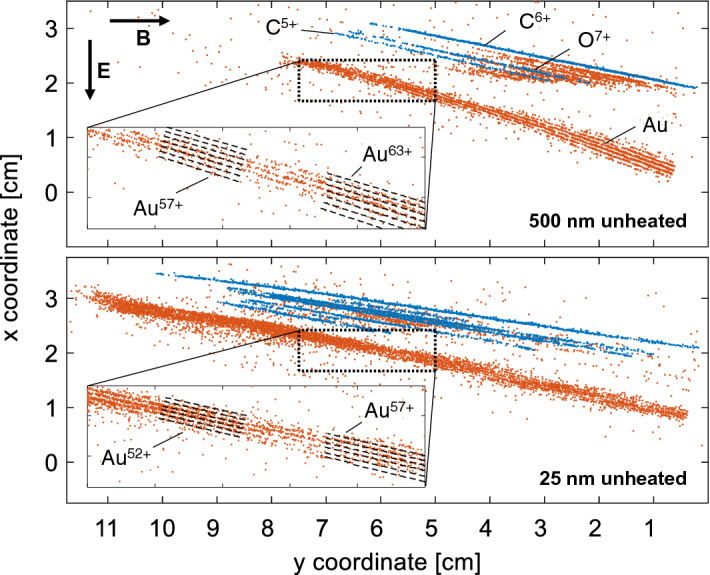
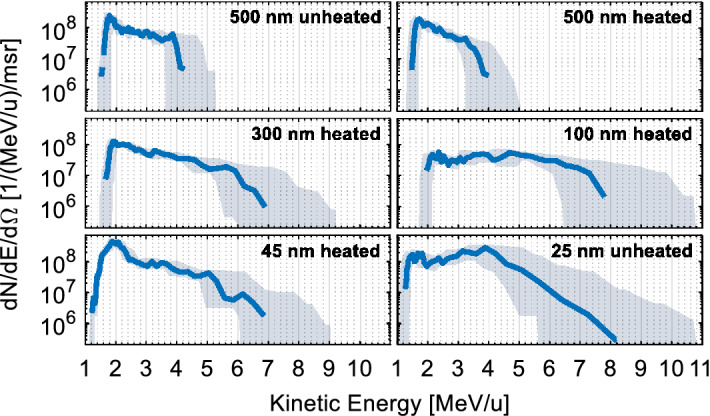
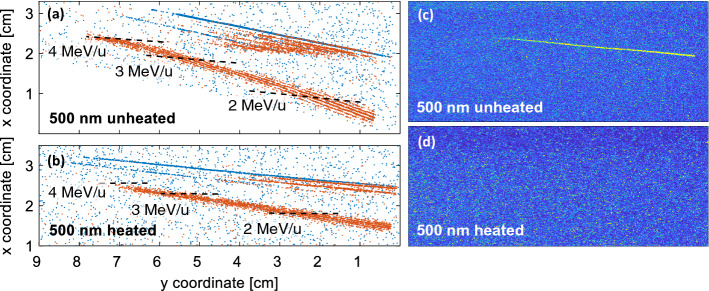
In the past years, the interest in the laser-driven acceleration of heavy ions in the mass range of [Formula: see text] has been increasing due to promising application ideas like the fission-fusion nuclear reaction mechanism, aiming at the production of neutron-rich isotopes relevant for the astrophysical r-process nucleosynthesis. In this paper, we report on the laser acceleration of gold ions to beyond 7 MeV/u, exceeding for the first time an important prerequisite for this nuclear reaction scheme. Moreover, the gold ion charge states have been detected with an unprecedented resolution, which enables the separation of individual charge states up to 4 MeV/u. The recorded charge-state distributions show a remarkable dependency on the target foil thickness and differ from simulations, lacking a straight-forward explanation by the established ionization models.
在过去几年中,由于诸如裂变 - 聚变核反应机制等有前景的应用设想,旨在生产与天体物理r过程核合成相关的富中子同位素,人们对质量范围在[公式:见原文]的重离子激光驱动加速的兴趣不断增加。在本文中,我们报告了将金离子激光加速至超过7 MeV/u,首次超越了该核反应方案的一个重要前提条件。此外,金离子电荷态已以前所未有的分辨率被检测到,这使得能够分离高达4 MeV/u的各个电荷态。记录的电荷态分布显示出对靶箔厚度的显著依赖性,并且与模拟结果不同,现有电离模型无法直接解释这种差异。