Division of Pulmonary and Critical Care Medicine, Department of Medicine, Samsung Medical Center, Sungkyunkwan University School of Medicine, Seoul, Republic of Korea.
Division of Pulmonary, Allergy and Critical Care Medicine, Department of Internal Medicine, Kyung Hee University Hospital, Seoul, Republic of Korea.
Int J Chron Obstruct Pulmon Dis. 2022 Mar 17;17:579-590. doi: 10.2147/COPD.S326037. eCollection 2022.
Vitamin D insufficiency or deficiency is prevalent in patients with chronic obstructive pulmonary disease (COPD). However, the association between vitamin D levels and respiratory symptoms in patients with stable COPD has not been fully investigated. This study evaluated the association between vitamin D levels and respiratory symptoms in patients with stable COPD.
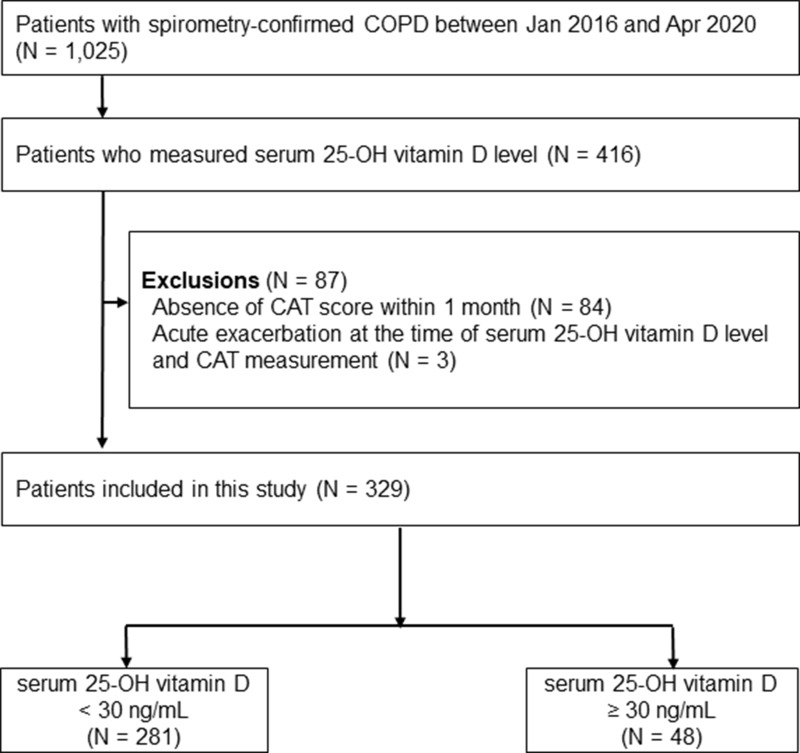
Patients with COPD who had their serum 25-hydroxyvitamin D (25-OH vitamin D) level measured within 6 months of spirometry between January 2016 and April 2020 were retrospectively included. Respiratory symptoms were assessed using the modified Medical Research Council (mMRC) scale and COPD assessment test (CAT) score.
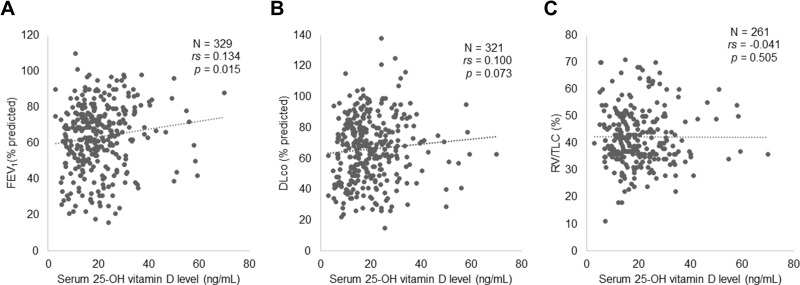
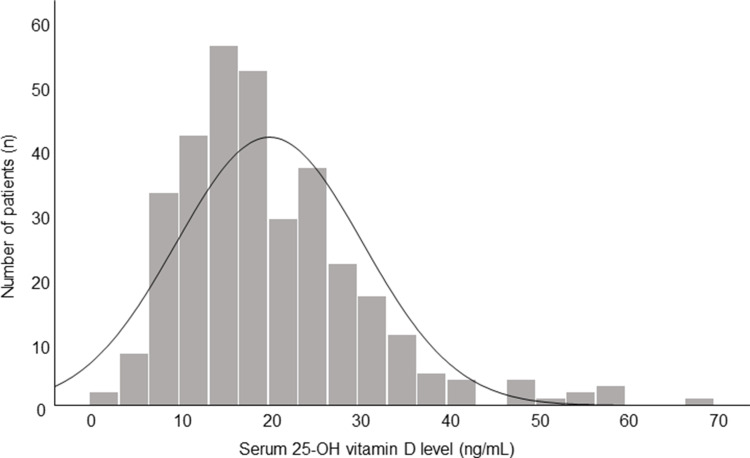
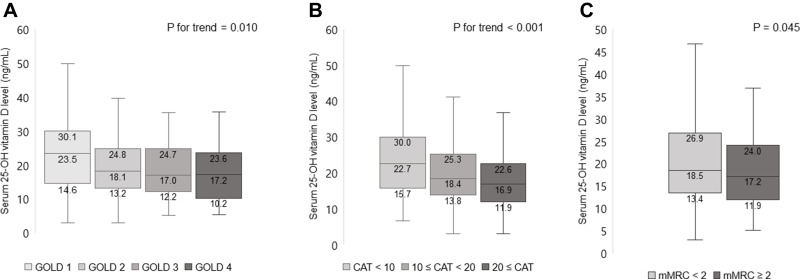
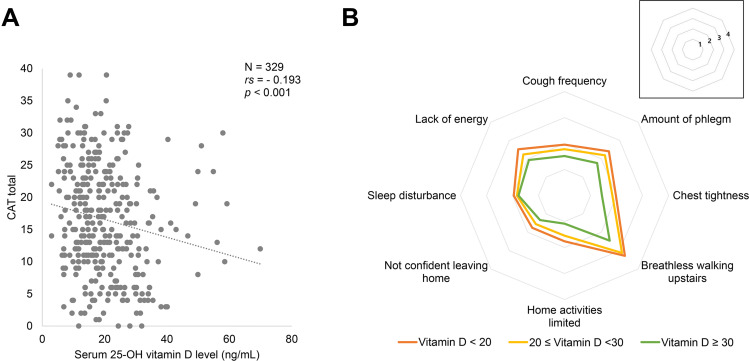
Of the 329 included patients, 193, 88, and 48 were categorized as having vitamin D deficiency (<20 ng/mL), insufficiency (20-29 ng/mL), and sufficiency (≥30 ng/mL), respectively. The mean serum 25-OH vitamin D level of each group was 13.45 ng/mL, 24.61 ng/mL, and 38.90 ng/mL, respectively. Patients with vitamin D insufficiency/deficiency showed higher CAT scores than those with vitamin D sufficiency ( = 0.004). In multivariable adjusted models, vitamin D insufficiency/deficiency was significantly associated with a CAT score of 10 or more (adjusted odds ratio [aOR] = 2.41, 95% confidence interval [CI] = 1.20-4.82, = 0.013) and mMRC ≥ 2 (aOR = 2.39, 95% CI = 1.08-5.32, = 0.032). Among CAT items, the amount of phlegm ( = 0.008), chest tightness ( = 0.030), breathlessness walking upstairs ( < 0.001), home activity limitations ( = 0.002), and lack of energy ( = 0.003) were significantly associated with vitamin D insufficiency/deficiency after adjustment for age, sex, body mass index, smoking history, Charlson comorbidity index, post-bronchodilator forced expiratory volume in 1 second, and season of blood draw.
Vitamin D insufficiency/deficiency were associated with worse respiratory symptoms in patients with stable COPD.
维生素 D 不足或缺乏在慢性阻塞性肺疾病(COPD)患者中很常见。然而,维生素 D 水平与稳定期 COPD 患者的呼吸症状之间的关系尚未得到充分研究。本研究评估了稳定期 COPD 患者中维生素 D 水平与呼吸症状之间的关系。
回顾性纳入 2016 年 1 月至 2020 年 4 月期间在肺功能检查 6 个月内测量血清 25-羟维生素 D(25-OH 维生素 D)水平的 COPD 患者。使用改良的医学研究委员会(mMRC)量表和 COPD 评估测试(CAT)评分评估呼吸症状。
在纳入的 329 名患者中,分别有 193 名、88 名和 48 名患者被归类为维生素 D 缺乏症(<20ng/mL)、不足症(20-29ng/mL)和充足症(≥30ng/mL)。各组的平均血清 25-OH 维生素 D 水平分别为 13.45ng/mL、24.61ng/mL 和 38.90ng/mL。维生素 D 不足/缺乏症患者的 CAT 评分高于维生素 D 充足症患者(=0.004)。在多变量调整模型中,维生素 D 不足/缺乏症与 CAT 评分≥10 分(调整优势比[aOR] = 2.41,95%置信区间[CI] = 1.20-4.82,=0.013)和 mMRC≥2(aOR = 2.39,95% CI = 1.08-5.32,=0.032)显著相关。在 CAT 项目中,痰量(=0.008)、胸闷(=0.030)、上楼梯时呼吸困难(<0.001)、家庭活动受限(=0.002)和缺乏精力(=0.003)在调整年龄、性别、体重指数、吸烟史、Charlson 合并症指数、支气管扩张剂后与维生素 D 不足/缺乏症显著相关一秒用力呼气容积(FEV1)和采血季节。
维生素 D 不足/缺乏与稳定期 COPD 患者的呼吸症状恶化有关。