Internal Medicine, The University of Texas Southwestern Medical Center, 5323 Harry Hines Blvd, E1, Dallas, TX75390, USA.
Population and Data Sciences, The University of Texas Southwestern Medical Center, Dallas, TX, USA.
Public Health Nutr. 2023 May;26(5):1082-1087. doi: 10.1017/S136898002200074X. Epub 2022 Mar 24.
Food pantries and the Supplemental Nutrition Assistance Program (SNAP) are widely available resources for individuals facing food insecurity, yet the dietary quality of individuals using both programmes is not well characterised. We describe the dietary intake of individuals in North Texas who use both food pantries and SNAP to identify nutritional gaps and opportunities to improve food assistance programmes.
We analysed baseline data from a randomised controlled trial examining food security and dietary intake. At baseline, we administered the validated, 26-item Dietary Screener Questionnaire (DSQ). We calculated descriptive statistics for dietary intake variables and compared with the 2020-2025 Dietary Guidelines for Americans recommended intake values.
Two large food pantries in Dallas County, TX.
Eligible participants were English or Spanish speaking adults receiving SNAP benefits who had used the food pantry within the last 4 months.
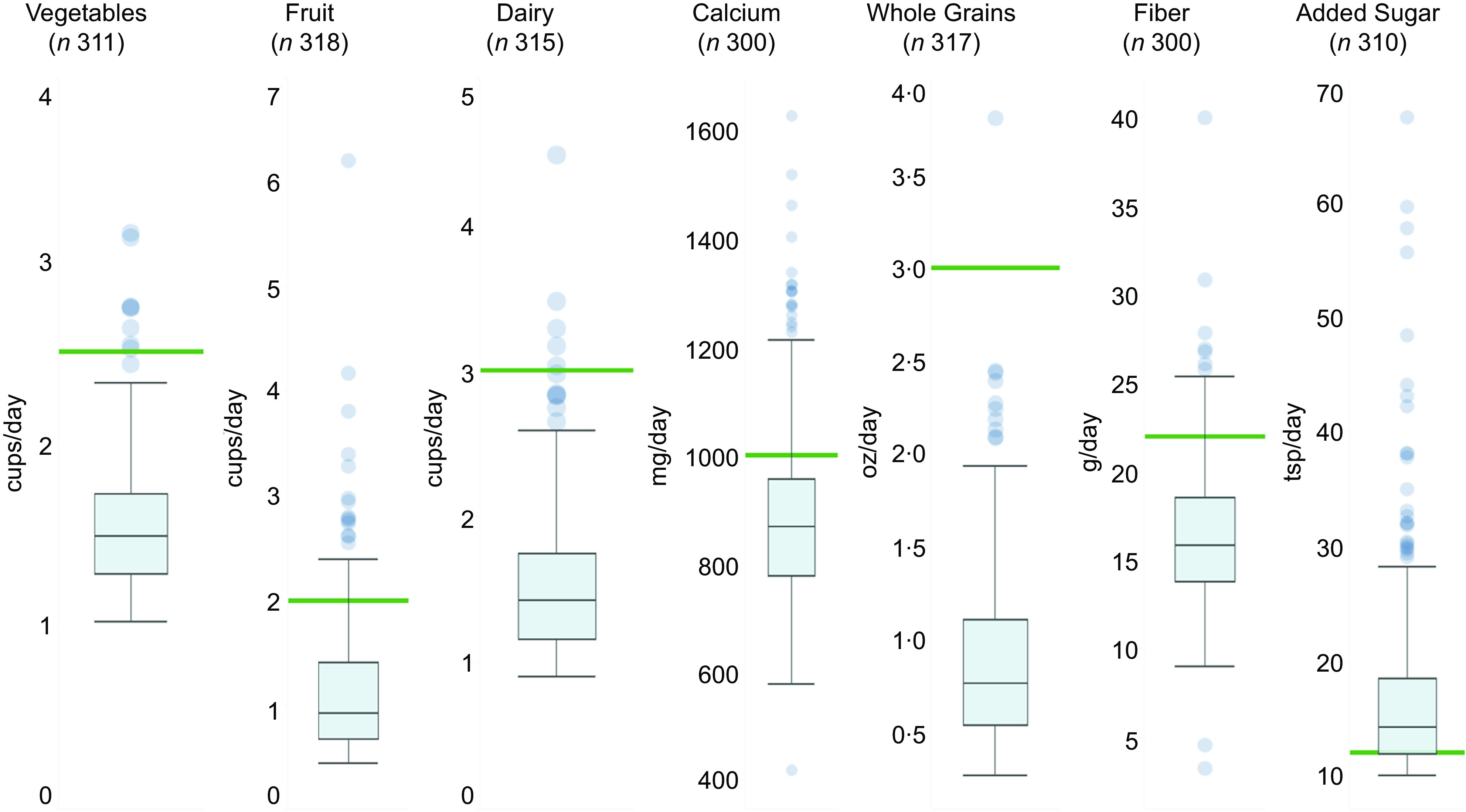
We analysed baseline DSQ data from 320 participants (mean age 47 years; 90% female; 45% Black or African American; 37% Hispanic or Latino). Despite receiving SNAP benefits and food pantry assistance, most participants did not meet the minimum recommended intake values for fruits (88.4%), vegetables (97.4%), fibre (90·7%), whole grains (99·7%), dairy products (98·4%) and Ca (83·4%). Furthermore, 73·2% of participants exceeded the maximum recommended intake for added sugar. Still, the gap between median daily intake and recommended daily intake could be partially bridged with food obtained through current food assistance programmes.
Multilevel, coordinated approaches within both SNAP and food pantry networks are needed to improve diet quality in individuals receiving food assistance.
食品储藏室和补充营养援助计划(SNAP)是为面临粮食不安全的个人提供的广泛可用资源,但使用这两个计划的个人的饮食质量尚未得到充分描述。我们描述了在北德克萨斯州使用食品储藏室和 SNAP 的个人的饮食摄入情况,以确定营养差距和改善食品援助计划的机会。
我们分析了一项随机对照试验的基线数据,该试验检查了粮食安全和饮食摄入情况。在基线时,我们使用经过验证的 26 项饮食筛查问卷(DSQ)进行了管理。我们计算了饮食摄入变量的描述性统计数据,并与 2020-2025 年美国人饮食指南的建议摄入量值进行了比较。
德克萨斯州达拉斯县的两个大型食品储藏室。
符合条件的参与者是使用 SNAP 福利且在过去 4 个月内使用过食品储藏室的讲英语或西班牙语的成年人。
我们分析了 320 名参与者的基线 DSQ 数据(平均年龄 47 岁;90%为女性;45%为黑人和非洲裔美国人;37%为西班牙裔或拉丁裔)。尽管接受了 SNAP 福利和食品储藏室援助,但大多数参与者没有达到水果(88.4%)、蔬菜(97.4%)、纤维(90.7%)、全谷物(99.7%)、乳制品(98.4%)和 Ca(83.4%)的最低建议摄入量值。此外,73.2%的参与者摄入的添加糖超过了建议的最大摄入量。尽管如此,通过当前的食品援助计划获得的食物可以部分弥合中位数每日摄入量和建议每日摄入量之间的差距。
需要在 SNAP 和食品储藏室网络内采取多层次、协调的方法来提高接受食品援助的个人的饮食质量。