
对基于互联网和移动设备的健康促进干预措施进行文化适应性调整可能不值得:一项系统评价和荟萃分析。
Culturally adapting internet- and mobile-based health promotion interventions might not be worth the effort: a systematic review and meta-analysis.
作者信息
Balci Sumeyye, Spanhel Kerstin, Sander Lasse Bosse, Baumeister Harald
机构信息
Department of Clinical Psychology and Psychotherapy, Institute of Psychology and Education, Ulm University, Lise-Meitner-Str. 16, D-89081, Ulm, Germany.
Department of Rehabilitation Psychology and Psychotherapy, Institute of Psychology, University of Freiburg, Engelbergerstr. 41, D-79085, Freiburg, Germany.
出版信息
NPJ Digit Med. 2022 Mar 23;5(1):34. doi: 10.1038/s41746-022-00569-x.
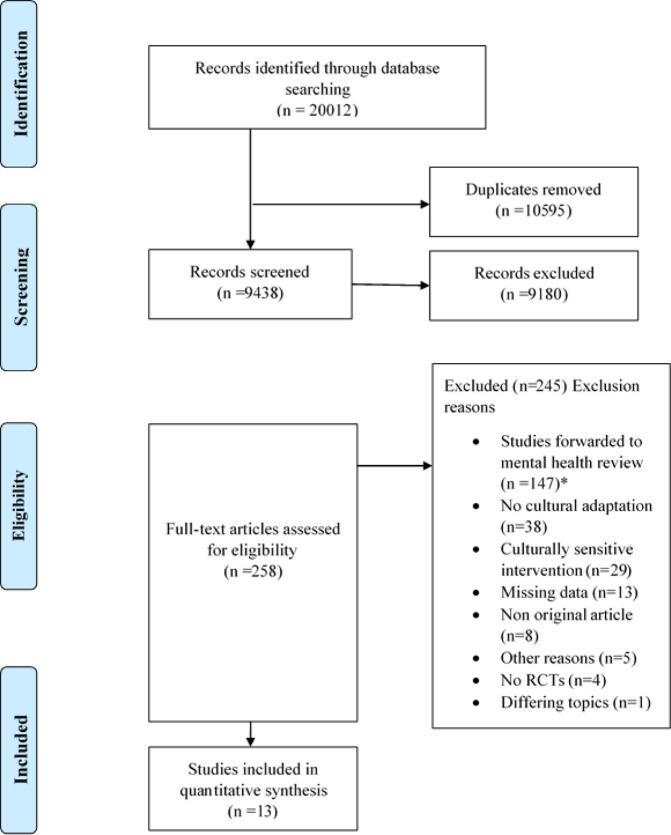
Health promotion interventions offer great potential in advocating a healthy lifestyle and the prevention of diseases. Some barriers to communicating health promotion to people of certain cultural groups might be overcome via the internet- and mobile-based interventions (IMI). This systematic review and meta-analysis aims to explore the effectiveness of culturally adapted IMI for health promotion interventions among culturally diverse populations. We systematically searched on Cochrane Central Register of Controlled Trials (CENTRAL), EbscoHost/MEDLINE, Ovid/Embase, EbscoHost/PsychINFO, and Web of Science databases in October 2020. Out of 9438 records, 13 randomized controlled trials (RCT) investigating culturally adapted health promotion IMI addressing healthy eating, physical activity, alcohol consumption, sexual health behavior, and smoking cessation included. From the included studies 10,747 participants were eligible. Culturally adapted IMI proved to be non-superior over active control conditions in short- (g = 0.10, [95% CI -0.19 to 0.40]) and long-term (g = 0.20, [95% CI -0.11 to 0.51]) in promoting health behavior. However, culturally adapted IMI for physical activity (k = 3, N = 296) compared to active controls yielded a beneficial effect in long-term (g = 0.48, [95%CI 0.25 to 0.71]). Adapting health promotion IMI to the cultural context of different cultural populations seems not yet to be recommendable given the substantial adaption efforts necessary and the mostly non-significant findings. However, these findings need to be seen as preliminary given the limited number of included trials with varying methodological rigor and the partly substantial between-trial heterogeneity pointing in the direction of potentially useful culturally adapted IMI which now need to be disentangled from the less promising approaches.PROSPERO registration number: 42020152939.
健康促进干预措施在倡导健康生活方式和预防疾病方面具有巨大潜力。通过基于互联网和移动设备的干预措施(IMI),可以克服向某些文化群体的人们传播健康促进信息时遇到的一些障碍。本系统评价和荟萃分析旨在探讨针对不同文化背景人群的健康促进干预措施中,经过文化适应的IMI的有效性。我们于2020年10月在Cochrane对照试验中心注册库(CENTRAL)、EbscoHost/MEDLINE、Ovid/Embase、EbscoHost/PsychINFO和Web of Science数据库中进行了系统检索。在9438条记录中,纳入了13项随机对照试验(RCT),这些试验研究了针对健康饮食、体育活动、饮酒、性健康行为和戒烟的经过文化适应的健康促进IMI。纳入研究的10747名参与者符合条件。在促进健康行为方面,经过文化适应的IMI在短期(g = 0.10,[95%CI -0.19至0.40])和长期(g = 0.20,[95%CI -0.11至0.51])内并不优于积极对照条件。然而,与积极对照相比,针对体育活动的经过文化适应的IMI(k = 3,N = 296)在长期内产生了有益效果(g = 0.48,[95%CI 0.25至0.71])。考虑到所需的大量适应工作以及大多无显著结果,将健康促进IMI适应不同文化群体的文化背景似乎尚不具有推荐性。然而,鉴于纳入试验数量有限、方法学严谨性各异,且试验间部分异质性较大,这些结果应被视为初步结果,这表明可能存在有用的经过文化适应的IMI,现在需要将其与前景不太乐观的方法区分开来。国际前瞻性系统评价注册编号:42020152939。



 Zotero 插件