Zuo Huixin, Wang Pengsen, Guo Zonglin, Luo Xin, Zhang Yimin, Mao Yanwei
Laboratory of Beef Processing and Quality Control, College of Food Science and Engineering, Shandong Agricultural University, Tai'an 271018, China.
National R&D Center for Beef Processing Technology, Tai'an 271018, China.
Metabolites. 2022 Mar 13;12(3):242. doi: 10.3390/metabo12030242.
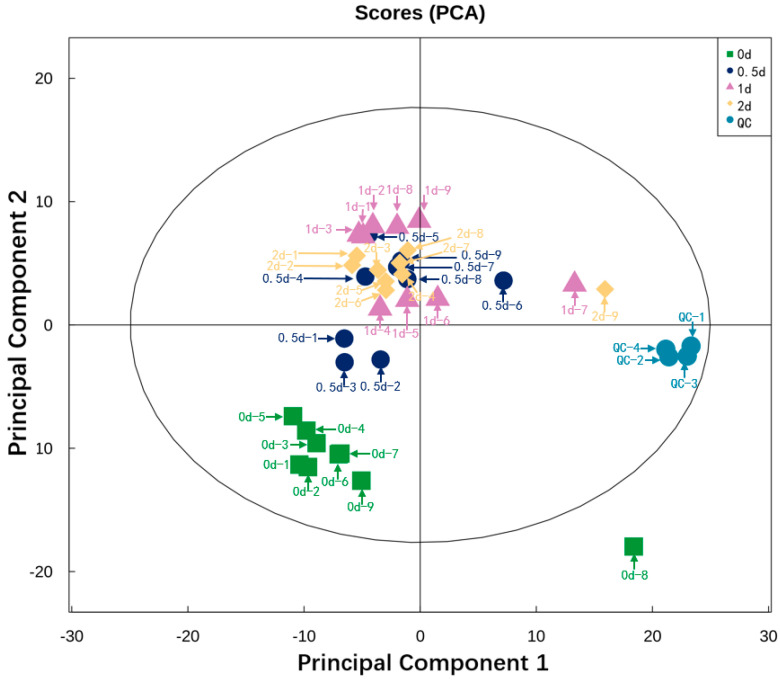
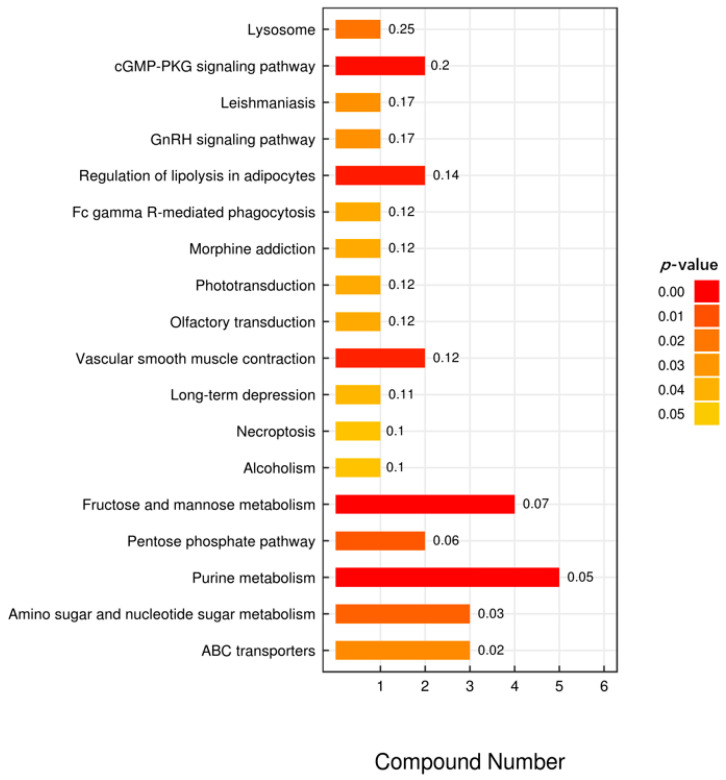
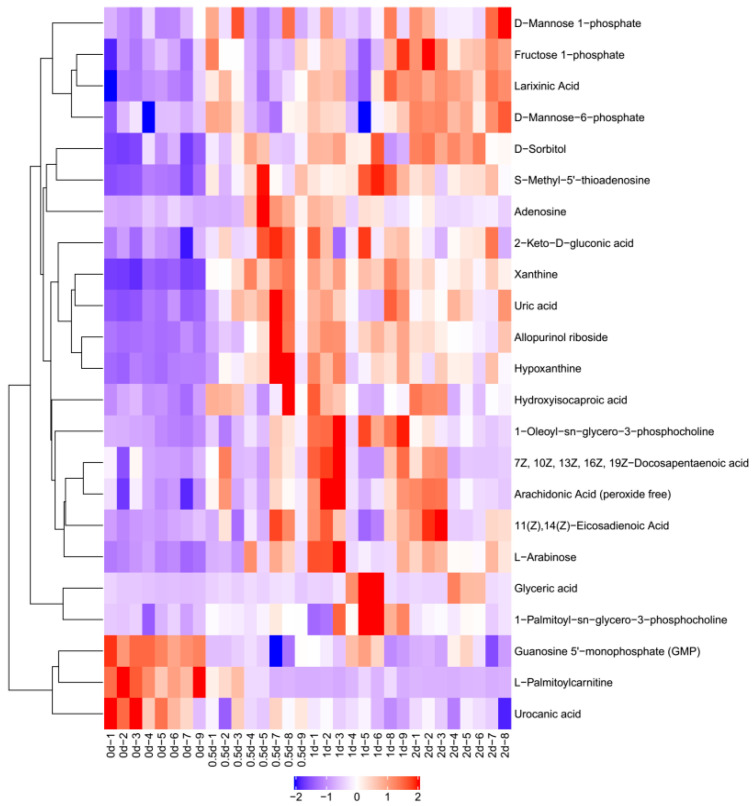
Currently, the metabolomic research on water-holding capacity (WHC) of beef during postmortem aging is still insufficient. In this paper, the kit method was adopted for energy metabolites testing, the ultra-high-performance liquid chromatography (UHPLC) system was used for sample separation, and the mass spectrometer was applied to collect the primary and secondary spectra of the samples. The results showed that lactic acid reached saturation at day 2 postmortem, while energy metabolites changed significantly within day 2 postmortem (p < 0.05). Based on these findings, it was suggested that the energy metabolism qualities of the beef had already achieved a largely stable state at around day 2 postmortem. Then, through metabolomic analysis, 25 compounds were differentially abundant at days 0, 0.5, 1, and 2 during postmortem aging. Within the period of day 0−2 postmortem, the purine metabolism in beef was relatively active until 0.5 d postmortem, while glycolysis metabolism remained active until day 2 postmortem. The functions of the identified metabolites contribute to a more detailed molecular view of the processes behind WHC and are a valuable resource for future investigations into the flavor of postmortem beef.
目前,关于宰后成熟过程中牛肉持水力(WHC)的代谢组学研究仍不充分。本文采用试剂盒法进行能量代谢物检测,使用超高效液相色谱(UHPLC)系统进行样品分离,并应用质谱仪收集样品的一级和二级光谱。结果表明,乳酸在宰后第2天达到饱和,而能量代谢物在宰后2天内变化显著(p<0.05)。基于这些发现,表明牛肉的能量代谢质量在宰后约第2天已基本达到稳定状态。然后,通过代谢组学分析,在宰后成熟的第0、0.5、1和2天有25种化合物的丰度存在差异。在宰后0至2天期间,牛肉中的嘌呤代谢在宰后0.5天之前相对活跃,而糖酵解代谢在宰后第2天之前一直保持活跃。所鉴定代谢物的功能有助于更详细地了解持水力背后的分子过程,并且是未来对宰后牛肉风味进行研究的宝贵资源。