Yoon Byung-Ho, Kang Ho Won, Kim Su Min, Koh Young Do
Department of Orthopedic Surgery, Ewha Womans University, College of Medicine, Mokdong Hospital, Seoul, Korea.
J Bone Metab. 2022 Feb;29(1):43-49. doi: 10.11005/jbm.2022.29.1.43. Epub 2022 Feb 28.
T-score discordance between the spine and hip is commonly observed when dual energy X-ray absorptiometry (DXA) is used to diagnose osteoporosis. However, information is scarce regarding the prevalence and risk factors for this problem in Korea. This study evaluated the prevalence of major/minor discordance and associated risk factors in elderly Korean patients with osteoporotic vertebral compression fractures (OVCFs).
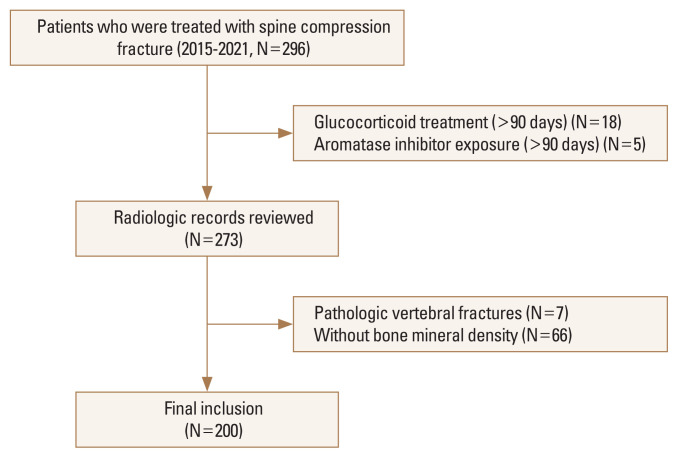
This study included 200 patients (37 men, 163 women) treated for thoracic or lumbar compression fractures between January 2015 and August 2021. DXA was performed to examine T-scores and determine the prevalence of discordance, defined as a difference between the T-score categories of the femur and spine in the same individual. The t-tests, χ2 tests, and regression analyses were used to assess the associated risk factors of T-score discordance among the subjects.
T-score concordance, minor discordance, and major discordance were observed in 137 (68.5%), 59 (29.5%), and 4 (2%) patients with OVCFs, respectively. The spinal T-score was lower than the femoral T-score in all major discordance and 81.3% (48/59) of minor discordant cases. Overall, the only factor related to T-score discordance was the age at fracture (odds ratio, -0.01; P=0.014).
The results of this study showed that a significant number of subjects (31.5%) showed spine-hip discordance, even with a mean age in their 80s. More attention should be paid to the appropriate evaluation and management of elderly patients with OVCFs. Moreover, a longitudinal study is necessary to verify the clinical importance of T-score discordance in this population.
使用双能X线吸收法(DXA)诊断骨质疏松症时,脊柱和髋部的T值不一致情况较为常见。然而,关于韩国人群中这一问题的患病率及危险因素的信息却很匮乏。本研究评估了韩国老年骨质疏松性椎体压缩骨折(OVCF)患者中主要/次要不一致的患病率及相关危险因素。
本研究纳入了2015年1月至2021年8月期间因胸腰椎压缩骨折接受治疗的200例患者(37例男性,163例女性)。进行DXA检查以检测T值,并确定不一致的患病率,不一致定义为同一个体股骨和脊柱的T值类别差异。采用t检验、χ²检验和回归分析来评估受试者中T值不一致的相关危险因素。
在患有OVCF的患者中,分别有137例(68.5%)、59例(29.5%)和4例(2%)出现了T值一致、次要不一致和主要不一致情况。在所有主要不一致病例以及81.3%(共48/59例)的次要不一致病例中,脊柱T值低于股骨T值。总体而言,与T值不一致相关的唯一因素是骨折时的年龄(比值比,-0.01;P=0.014)。
本研究结果表明,即使平均年龄在80多岁,仍有相当数量的受试者(31.5%)存在脊柱-髋部不一致情况。对于老年OVCF患者,应更加重视其恰当的评估和管理。此外,有必要开展纵向研究以验证T值不一致在该人群中的临床重要性。