
一种用于估计兔体内活性氧-多不饱和脂肪酸-抗氧化剂相互作用的动态模型。
A Dynamic Model for Estimating the Interaction of ROS-PUFA-Antioxidants in Rabbit.
作者信息
Mattioli Simona, Dimauro Corrado, Cesarani Alberto, Dal Bosco Alessandro, Bartolini Desiree, Galli Francesco, Migni Anna, Sebastiani Bartolomeo, Signorini Cinzia, Oger Camille, Collodel Giulia, Castellini Cesare
机构信息
Department of Agricultural, Environmental and Food Science, University of Perugia, Borgo 20 Giugno, 74, 06123 Perugia, Italy.
Department of Agricultural Sciences, University of Sassari, Sassari, Viale Italia, 39, 07100 Sassari, Italy.
出版信息
Antioxidants (Basel). 2022 Mar 10;11(3):531. doi: 10.3390/antiox11030531.
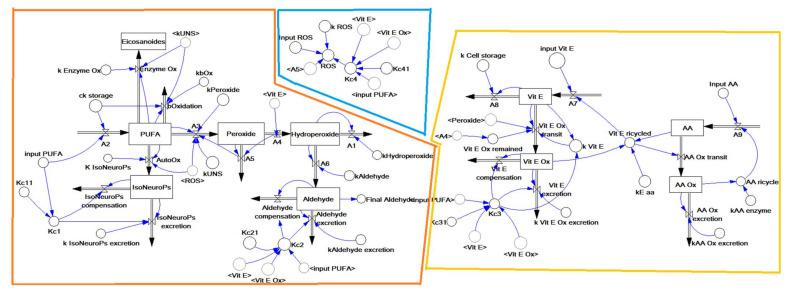
Defining optimal nutrition in animals and humans remains a main scientific challenge. The objective of the work was to develop a dynamic model of reactive oxygen species (ROS)-polyunsaturated fatty acid (PUFA)-antioxidant homeostasis using the rabbit as a model. The problem entity was to evaluate the main metabolites generated from interactions between traits included in the conceptual model and identified by three main sub-models: (i) ROS generation, (ii) PUFA oxidation and (iii) antioxidant defence. A mathematical model (VENSIM software) that consisted of molecular stocks (INPUTs, OUTPUTs), exchange flows (intermediate OUTPUTs) and process rates was developed. The calibration was performed by using standard experimental data (Experiment 1), whereas the validation was carried out in Experiments 2 and 3 by using supra-nutritional dietary inputs (VIT E+ and PUFA+). The accuracy of the models was measured using 95% confidence intervals. Analytical OUTPUTs (ROS, PUFA, Vit E, Ascorbic acid, Iso-/NeuroProstanes, Aldehydes) were well described by the standard model. There was also good accuracy for the VIT E+ scenario, whereas some compensatory rates (K-K) were added to assess body compensation when high levels of dietary PUFA were administered (Experiment 3). In conclusion, the model can be very useful for predicting the effects of dietary treatments on the redox homeostasis of rabbits.
确定动物和人类的最佳营养仍是一项主要的科学挑战。这项工作的目的是以兔子为模型,建立一个活性氧(ROS)-多不饱和脂肪酸(PUFA)-抗氧化剂稳态的动态模型。问题实体是评估由概念模型中包含并由三个主要子模型确定的性状之间相互作用产生的主要代谢产物:(i)ROS生成,(ii)PUFA氧化和(iii)抗氧化防御。开发了一个由分子存量(输入、输出)、交换流(中间输出)和过程速率组成的数学模型(VENSIM软件)。校准通过使用标准实验数据(实验1)进行,而验证在实验2和3中通过使用超营养膳食输入(维生素E+和PUFA+)进行。模型的准确性使用95%置信区间进行测量。标准模型很好地描述了分析输出(ROS、PUFA、维生素E、抗坏血酸、异前列腺素/神经前列腺素、醛)。维生素E+情景也有很好的准确性,而在给予高水平膳食PUFA时(实验3),添加了一些补偿率(K-K)来评估身体补偿。总之,该模型对于预测膳食处理对兔子氧化还原稳态的影响可能非常有用。




 Zotero 插件