First Propaedeutic Department of Internal Medicine and Diabetes Center, Medical Faculty, Laiko General Hospital, National Kapodistrian University of Athens, 17 Agiou Thoma Street, 11527 Athens, Greece.
Int J Mol Sci. 2022 Mar 17;23(6):3225. doi: 10.3390/ijms23063225.
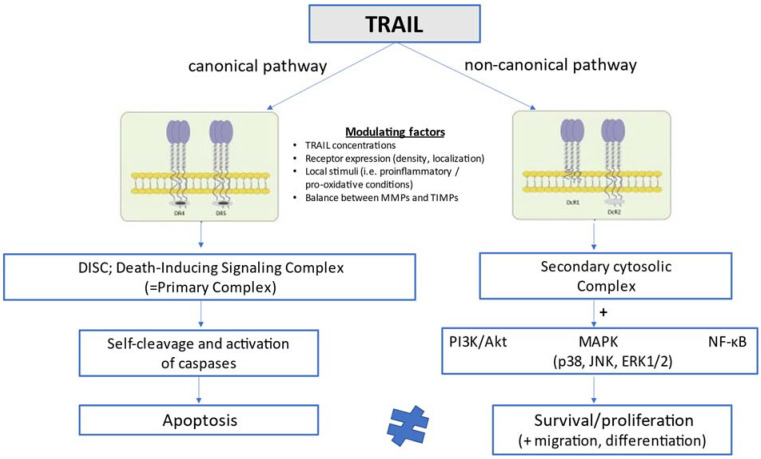
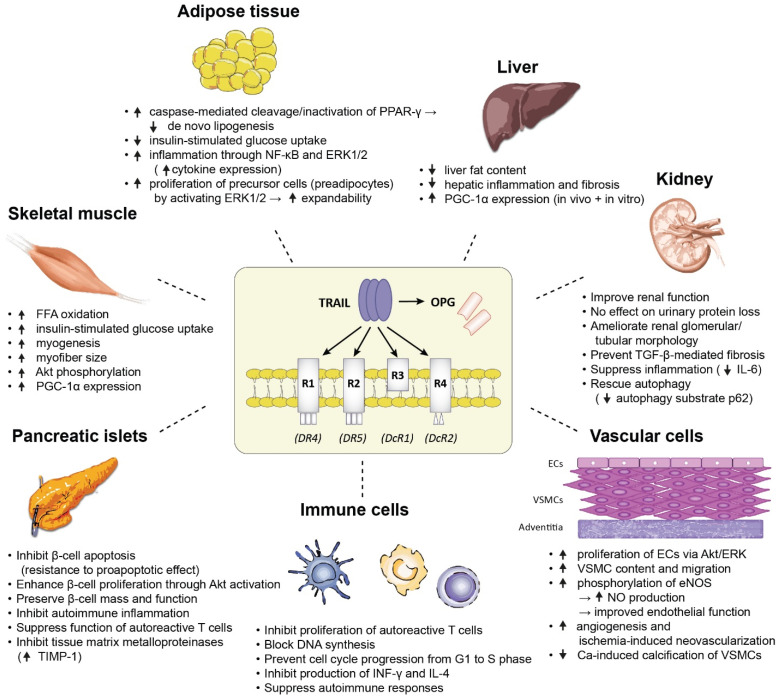
Tumor necrosis factor (TNF)-related apoptosis-inducing ligand (TRAIL), a member of the TNF protein superfamily, represents a multifaceted cytokine with unique biological features including both proapoptotic and pro-survival effects in different cell types depending on receptor interactions and local stimuli. Beyond its extensively studied anti-tumor and immunomodulatory properties, a growing body of experimental and clinical evidence over the past two decades suggests a protective role of TRAIL in the development of type 1 (T1DM) and type 2 (T2DM) diabetes mellitus. This evidence can be briefly summarized by the following observations: (i) acceleration and exacerbation of T1DM and T2DM by TRAIL blockade or genetic deficiency in animal models, (ii) prevention and amelioration of T1DM and T2DM with recombinant TRAIL treatment or systemic TRAIL gene delivery in animal models, (iii) significantly reduced circulating soluble TRAIL levels in patients with T1DM and T2DM both at disease onset and in more advanced stages of diabetes-related complications such as cardiovascular disease and diabetic nephropathy, (iv) increase of serum TRAIL levels in diabetic patients after initiation of antidiabetic treatment and metabolic improvement. To explore the underlying mechanisms and provide mechanistic links between TRAIL and diabetes, a number of animal and in vitro studies have reported direct effects of TRAIL on several tissues involved in diabetes pathophysiology such as pancreatic islets, skeletal muscle, adipose tissue, liver, kidney, and immune and vascular cells. Residual controversy remains regarding the effects of TRAIL on adipose tissue homeostasis. Although the existing evidence is encouraging and paves the way for investigating TRAIL-related interventions in diabetic patients with cardiometabolic abnormalities, caution is warranted in the extrapolation of animal and in vitro data to the clinical setting, and further research in humans is imperative in order to uncover all aspects of the TRAIL-diabetes relationship and delineate its therapeutic implications in metabolic disease.
肿瘤坏死因子(TNF)相关凋亡诱导配体(TRAIL)是 TNF 蛋白超家族的一员,它是一种多功能细胞因子,具有独特的生物学特性,包括在不同细胞类型中通过受体相互作用和局部刺激产生促凋亡和抗凋亡作用。除了广泛研究的抗肿瘤和免疫调节特性外,过去二十年来的大量实验和临床证据表明,TRAIL 在 1 型(T1DM)和 2 型(T2DM)糖尿病的发展中具有保护作用。这些证据可以通过以下观察结果简要总结:(i)在动物模型中,TRAIL 阻断或基因缺失加速和恶化了 T1DM 和 T2DM,(ii)在动物模型中,用重组 TRAIL 治疗或全身 TRAIL 基因递送预防和改善了 T1DM 和 T2DM,(iii)在 T1DM 和 T2DM 患者中,无论是在疾病发作时还是在更严重的糖尿病相关并发症(如心血管疾病和糖尿病肾病)阶段,循环可溶性 TRAIL 水平均显著降低,(iv)糖尿病患者在开始抗糖尿病治疗和代谢改善后,血清 TRAIL 水平升高。为了探索 TRAIL 与糖尿病之间的潜在机制并提供机制联系,许多动物和体外研究报告了 TRAIL 对几种参与糖尿病病理生理学的组织的直接作用,如胰腺胰岛、骨骼肌、脂肪组织、肝脏、肾脏、免疫和血管细胞。关于 TRAIL 对脂肪组织稳态的影响仍存在争议。尽管现有证据令人鼓舞,并为研究代谢异常的糖尿病患者的 TRAIL 相关干预铺平了道路,但在将动物和体外数据外推到临床环境时需要谨慎,并且必须在人类中进行进一步研究,以揭示 TRAIL-糖尿病关系的各个方面,并阐明其在代谢疾病中的治疗意义。