Koepp Andrew E, Gershoff Elizabeth T, Castelli Darla M, Bryan Amy E
Department of Human Development and Family Sciences, The University of Texas at Austin, Austin, TX 78712, USA.
Department of Kinesiology and Health Education, The University of Texas at Austin, Austin, TX 78712, USA.
Int J Environ Res Public Health. 2022 Mar 12;19(6):3354. doi: 10.3390/ijerph19063354.
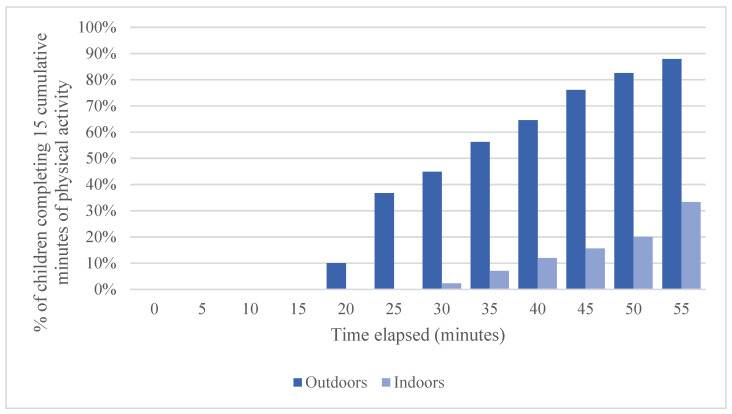
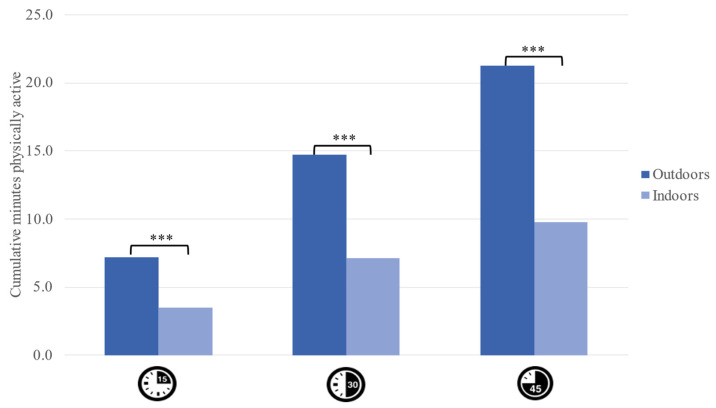
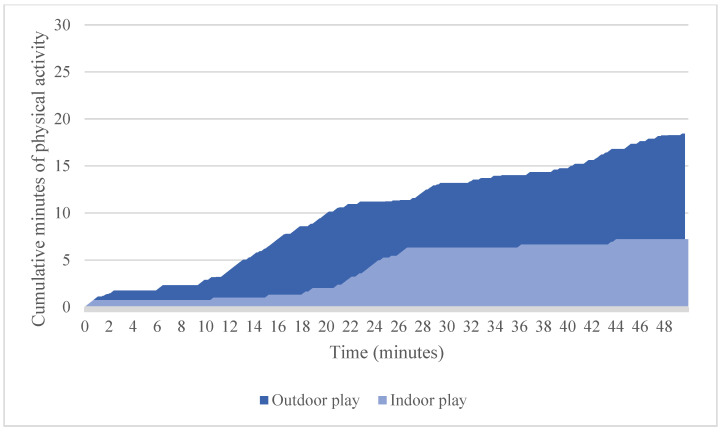
Health guidelines suggest that caregivers provide preschoolers with opportunities to be physically active for 3 h per day (roughly 15 min per waking hour), but because children are not continuously active, it is unclear what amount of time is needed to reach this goal. This naturalistic study enrolled 67 children ( = 4.5 years, 46% female) who wore accelerometers to measure their activity during indoor and outdoor free -play ( = 315,061 s). An hour of indoor play was insufficient for most children to reach 15 min of physical activity. When outside, most children reached 15 min of physical activity after slightly more than 30 min. Children engaged in outdoor activity sporadically (1.7 starts/stops per minute). Most physical activity occurred in bouts shorter than 20 s. Indoor free-play does not, on its own, provide sufficient opportunity for preschoolers to engage in physical activity consistent with health guidelines. As a result, outdoor play for at least 30 min at a time has a key role in meeting these guidelines.
健康指南建议照顾者每天为学龄前儿童提供3小时的体育活动机会(大约每清醒一小时15分钟),但由于儿童并非持续活动,尚不清楚达到这一目标需要多少时间。这项自然主义研究招募了67名儿童(平均年龄 = 4.5岁,46%为女性),他们佩戴加速度计来测量在室内和室外自由玩耍期间的活动情况(总计 = 315,061秒)。对大多数儿童来说,一小时的室内玩耍不足以达到15分钟的体育活动量。在户外时,大多数儿童在略超过30分钟后达到了15分钟的体育活动量。儿童进行户外活动时断断续续(每分钟1.7次开始/停止)。大多数体育活动以短于20秒的时段进行。仅室内自由玩耍本身并不能为学龄前儿童提供足够的机会来进行符合健康指南的体育活动。因此,每次至少30分钟的户外玩耍在达到这些指南要求方面起着关键作用。