Peng Pan, Kessi Miriam, Mao Leilei, He Fang, Zhang Ciliu, Chen Chen, Pang Nan, Yin Fei, Pan Zou, Peng Jing
Department of Pediatrics, Xiangya Hospital, Central South University, Changsha, China.
Hunan Intellectual and Developmental Disabilities Research Center, Changsha, China.
Front Pediatr. 2022 Mar 7;10:774828. doi: 10.3389/fped.2022.774828. eCollection 2022.
To explore the etiology of infantile spasms (IS) in a large Chinese cohort based on the United States National Infantile Spasms Consortium (NISC) classification.
In the present study, we recruited IS patients diagnosed at a single center (Xiangya Hospital, Central South University) between Jan 2010 and Aug 2019. Thereafter, we collected their clinical and genetic information retrospectively. Their underlying etiologies were classified according to the NISC classification and then compared in different scenarios to understand their distribution.
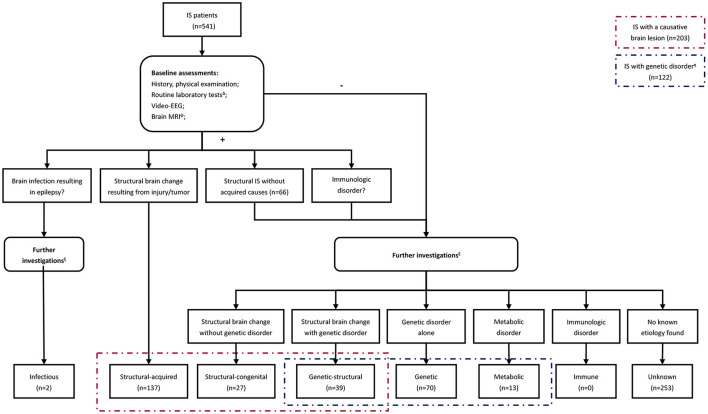
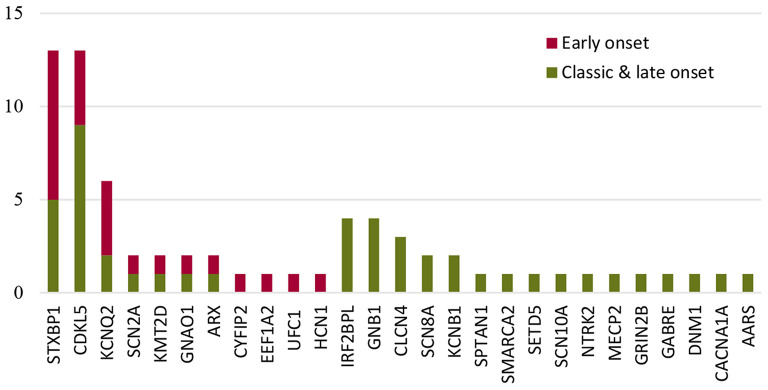
A total of 541 patients with IS from 18 provinces were included in this study. The underlying etiology was identified in 53.2% of the cases: structural-acquired, 25.3%; genetic, 12.9%; genetic-structural, 7.2%; structural-congenital, 5.0%; metabolic, 2.4%; infections, 0.4% and immune, 0%. Whole-exome sequencing (WES) provided the highest diagnostic yield (26.9%). In structural-acquired IS, the proportion of hypoglycemic brain injuries was significant, second only to hypoxic-ischemic encephalopathy. There was no patient discovered to have Down syndrome. , and were the most frequently implicated genes. Genetic causes were found to be the most common cause of IS in the early onset group, while structural-acquired etiologies were common in males and preterm babies. Patients with pre-spasm seizures were associated with a higher proportion of identified causes than those without. Non-acquired structural etiologies were more common in patients without hypsarrhythmia than in those with hypsarrhythmia.
The most prevalent cause of IS was structural acquired followed by genetic causes. When brain MRI fails to detect the etiology, we propose WES as the next step. Structural-acquired IS and cases with genetic disorders are characteristic of the Chinese cohort, however, the etiology differs with the patient's age of onset, gestation age at birth, sex, and the presence/absence of both pre-spasm seizures, and hypsarrhythmia.
基于美国国家婴儿痉挛症联盟(NISC)分类,在中国一个大型队列中探究婴儿痉挛症(IS)的病因。
在本研究中,我们招募了2010年1月至2019年8月期间在单一中心(中南大学湘雅医院)确诊的IS患者。之后,我们回顾性收集了他们的临床和基因信息。根据NISC分类对其潜在病因进行分类,然后在不同情况下进行比较以了解其分布情况。
本研究共纳入了来自18个省份的541例IS患者。53.2%的病例确定了潜在病因:结构后天性,25.3%;遗传性,12.9%;遗传 - 结构性,7.2%;结构先天性,5.0%;代谢性,2.4%;感染性,0.4%;免疫性,0%。全外显子测序(WES)提供了最高的诊断率(26.9%)。在结构后天性IS中,低血糖脑损伤的比例显著,仅次于缺氧缺血性脑病。未发现有患者患有唐氏综合征。 和 是最常涉及的基因。发现遗传原因是早发型组IS最常见的原因,而结构后天性病因在男性和早产儿中常见。有痉挛前发作的患者比没有的患者确定病因的比例更高。非后天性结构病因在无高峰失律的患者中比有高峰失律的患者更常见。
IS最常见的病因是结构后天性,其次是遗传原因。当脑部MRI未能检测到病因时,我们建议下一步进行WES。结构后天性IS和遗传疾病病例是中国队列的特征,然而,病因因患者的发病年龄、出生孕周、性别以及是否存在痉挛前发作和高峰失律而有所不同。