Tianjin Eye Hospital, Clinical College of Ophthalmology of Tianjin Medical University, Tianjin Key Laboratory of Ophthalmology and Vision Science, Tianjin, 300020, China.
QuanZhou Women's and Children's Hospital, Quanzhou, 362000, China.
BMC Ophthalmol. 2022 Mar 24;22(1):134. doi: 10.1186/s12886-022-02367-1.
To evaluate the efficacy and safety of slanted bilateral lateral rectus recession (S-BLRc) for the treatment of convergence insufficiency-type intermittent exotropia (CI-IXT) in children and to probe the relationship of the slanted amount and surgical outcomes.
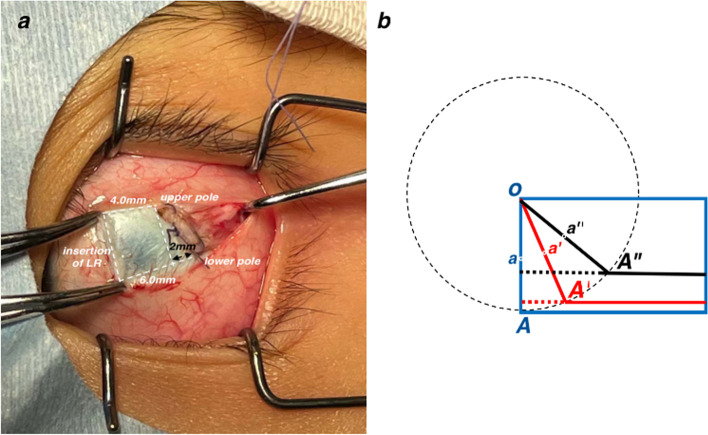
Retrospective study. Fifty-eight patients with CI-IXT, aged 4 to 10 years old, underwent S-BLRc procedures. According to the different slanted amount between the upper and lower poles of lateral rectus, all the patients were grouped: Group A (slanting 1 mm, n = 22), Group B (slanting 1.5 mm, n = 18) and Group C (slanting 2 mm, n = 18). The successful surgical outcome was defined as deviation in the primary position ranging from exotropia< 8 to esotropia< 5 both at near and at distant as well as the near-distance difference (NDD) < 5. We analyzed and compared the preoperative and postoperative data including deviations both at near and at distance, NDD, objective torsion, horizontal deviation at up and down gaze, lateral incomitance, binocular vision and surgical success rate among three groups.
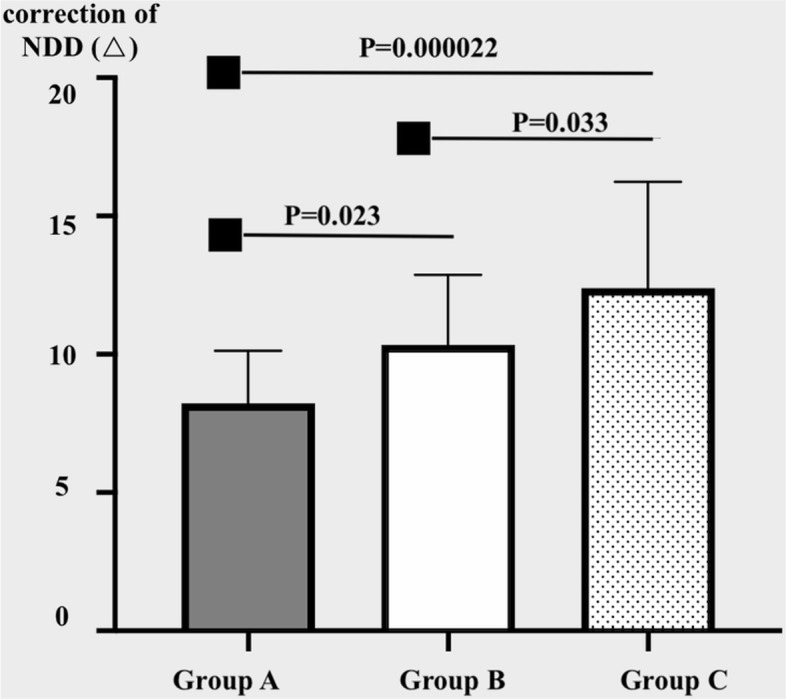
The average deviations were significantly decreased from - 37.1 ± 4.2 (-,exotropia) to - 1.4 ± 4.6 at near (P < 0.05) and from - 25.8 ± 3.7 to - 0.1 ± 4.1 at distance (P < 0.05). The postoperative NDD on average was significantly reduced from 10.0 to 1.8 in Group A (P < 0.05), from 11.2 to 0.8 in Group B (P < 0.05) and from 13.3 to 0.9 in Group C (P < 0.05). There was a significant difference in the mean corrections of NDD among the three groups (8.2 in group A, 10.3 in group B and 12.4 in group C respectively, P < 0,05). All the patients attained various improvement of stereopsis after surgery. None had torsional diplopia, A-V pattern and lateral incomitance after strabismic surgery. Totally, the surgical success rate was 89.7% in our series at the 6- to 8-month follow-up.
Slanted bilateral lateral rectus recession is an effective and safe procedure for the treatment of CI-IXT in children. S-BLRc can successfully collapse exotropia both at distance and at near, decrease NDD and benefit to gain binocular vision. The correction of NDD was associated with the slanted amount.
评估斜向双侧外直肌后退术(S-BLRc)治疗儿童集合不足型间歇性外斜视(CI-IXT)的疗效和安全性,并探讨斜视量与手术效果的关系。
回顾性研究。58 例 CI-IXT 患儿(4~10 岁)接受 S-BLRc 手术。根据外直肌上下极的倾斜量,将所有患者分为 A 组(倾斜 1mm,n=22)、B 组(倾斜 1.5mm,n=18)和 C 组(倾斜 2mm,n=18)。将手术成功定义为:在近距和远距时,第一眼位的偏斜度从外斜视<8 至内斜视<5,且近距远距差值(NDD)<5。分析并比较三组患者术前和术后的近距和远距斜视度、NDD、客观旋转、上、下注视时的水平斜视度、外侧斜视度、双眼视觉和手术成功率。
平均斜视度从远距-37.1±4.2(外斜视)显著降低至近距-1.4±4.6(P<0.05),从远距-25.8±3.7 显著降低至近距-0.1±4.1(P<0.05)。术后 NDD 平均值在 A 组从 10.0 显著降低至 1.8(P<0.05),在 B 组从 11.2 显著降低至 0.8(P<0.05),在 C 组从 13.3 显著降低至 0.9(P<0.05)。三组 NDD 的平均矫正值差异有统计学意义(A 组 8.2,B 组 10.3,C 组 12.4,P<0.05)。所有患者术后立体视均有不同程度改善。斜视手术后无一例出现扭转复视、A-V 征和外侧斜视。6~8 个月随访时,手术总成功率为 89.7%。
斜向双侧外直肌后退术是治疗儿童 CI-IXT 的有效且安全的方法。S-BLRc 可成功矫正远距和近距外斜视,降低 NDD,有利于获得双眼视觉。NDD 的矫正与斜视量有关。