Division of Internal Medicine, Hepatobiliary and Immunoallergic Diseases, S. Orsola-Malpighi Hospital, IRCCS Azienda Ospedaliero-Universitaria di Bologna, 40138 Bologna, Italy.
Department of Medical and Surgical Sciences, University of Bologna, 40138 Bologna, Italy.
Nutrients. 2022 Mar 14;14(6):1223. doi: 10.3390/nu14061223.
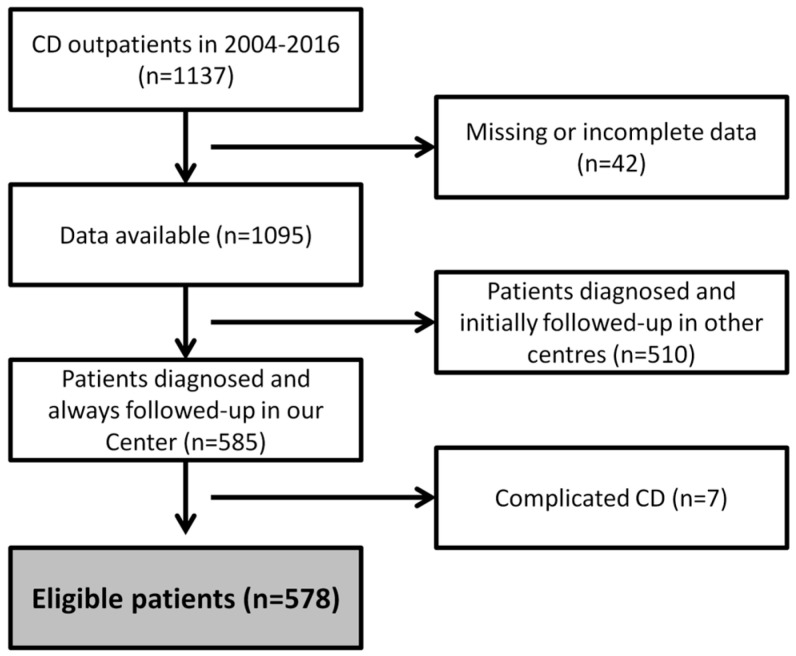
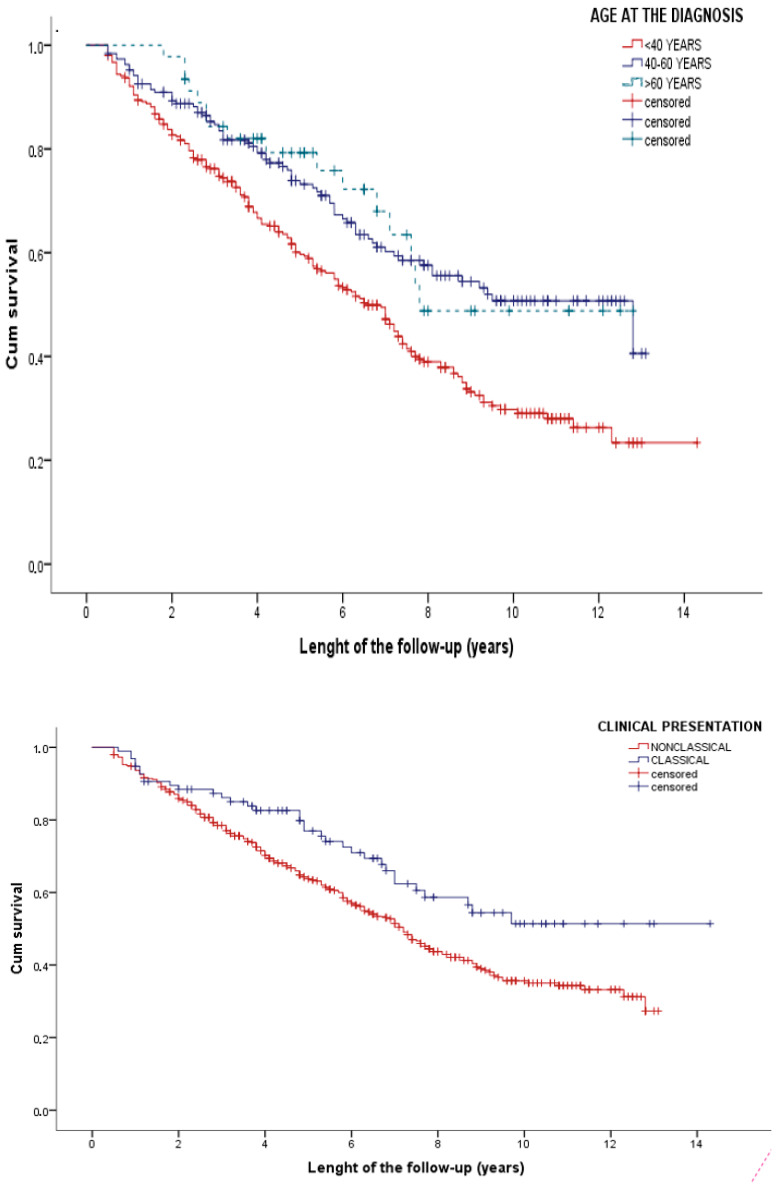
Background: Celiac disease (CD) follow-up is a relatively underevaluated topic. However, correct adherence to follow-up procedures is central to the early recognition of complicated CD and other conditions typically associated with CD. Establishing whether patients at increased risk of complications follow clinicians’ recommendations has multiple repercussions. Methods: We retrospectively analyzed the records of patients consecutively diagnosed with CD in our outpatient clinic between January 2004 and October 2017 to investigate the factors associated with drop-out from follow-up procedures. Results: Among the 578 patients analyzed, 40 (6.9%) dropped out during the first six months and 272 (50.6%) during the observation period. The median time to drop-out was 7.4 years (95% confidence interval: 6.8−8.0). No factors were associated with early drop-out. Instead, age at diagnosis >40 years (40−59 years, p < 0.001; ≥60 years, p = 0.048) and classical clinical presentation (p = 0.016) were significantly associated with a lower risk of later drop-out. Conclusions: Patients at increased risk of complicated CD are more compliant with follow-up procedures than patients at lower risk, despite being prescribed the same controls. These results indirectly support the hypothesis of tailored follow-up strategies, differentiated according to the risk of complications.
乳糜泻(CD)的随访是一个相对被低估的问题。然而,正确遵循随访程序对于早期识别复杂 CD 以及与 CD 相关的其他疾病至关重要。确定是否有并发症风险增加的患者遵循临床医生的建议,这具有多重影响。
我们回顾性分析了 2004 年 1 月至 2017 年 10 月期间在我们的门诊连续诊断为 CD 的患者的记录,以研究与随访程序中断相关的因素。
在分析的 578 例患者中,有 40 例(6.9%)在最初 6 个月内退出,272 例(50.6%)在观察期间退出。退出的中位时间为 7.4 年(95%置信区间:6.8-8.0)。没有因素与早期退出有关。相反,诊断时的年龄>40 岁(40-59 岁,p<0.001;≥60 岁,p=0.048)和经典临床表现(p=0.016)与较低的后期退出风险显著相关。
尽管接受了相同的治疗,但患有更严重 CD 的患者比风险较低的患者更遵守随访程序。这些结果间接支持了根据并发症风险制定量身定制的随访策略的假设。