Department of Pharmacology, School of Pharmacy at Fukuoka, International University of Health and Welfare, 137-1 Enokizu, Okawa 831-8501, Japan.
Institute for Advanced Study, Kyushu University, 744 Motooka, Nishi-ku, Fukuoka 819-0395, Japan.
Molecules. 2022 Mar 16;27(6):1919. doi: 10.3390/molecules27061919.
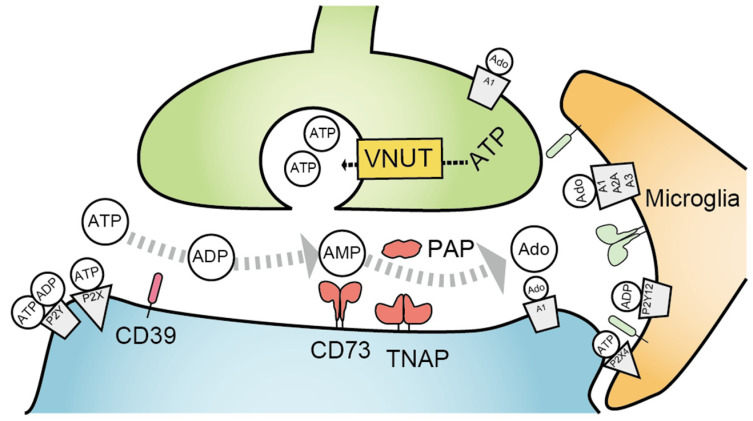
Pain is an essential modality of sensation in the body. Purinergic signaling plays an important role in nociceptive pain transmission, under both physiological and pathophysiological conditions, and is important for communication between both neuronal and non-neuronal cells. Microglia and astrocytes express a variety of purinergic effectors, and a variety of receptors play critical roles in the pathogenesis of neuropathic pain. In this review, we discuss our current knowledge of purinergic signaling and of the compounds that modulate purinergic transmission, with the aim of highlighting the importance of purinergic pathways as targets for the treatment of persistent pain.
疼痛是身体感觉的基本方式。嘌呤能信号在生理和病理生理条件下的伤害性疼痛传递中起着重要作用,并且对于神经元和非神经元细胞之间的通讯很重要。小胶质细胞和星形胶质细胞表达多种嘌呤能效应器,多种受体在神经病理性疼痛的发病机制中发挥关键作用。在这篇综述中,我们讨论了我们对嘌呤能信号转导以及调节嘌呤能传递的化合物的现有认识,目的是强调嘌呤能途径作为治疗持续性疼痛的靶点的重要性。