Ashfaq Mehran, Shah Shahid, Rasul Akhtar, Hanif Muhammad, Khan Hafeez Ullah, Khames Ahmed, Abdelgawad Mohamed A, Ghoneim Mohammed M, Ali Muhammad Yasir, Abourehab Mohammad A S, Maheen Safirah, Iqbal Omeira, Abbas Ghulam, El Sisi Amani M
Department of Pharmaceutics, Faculty of Pharmaceutical Sciences, Government College University, Faisalabad 38000, Pakistan.
Department of Pharmacy Practice, Faculty of Pharmaceutical Sciences, Government College University, Faisalabad 38000, Pakistan.
Pharmaceutics. 2022 Feb 22;14(3):482. doi: 10.3390/pharmaceutics14030482.
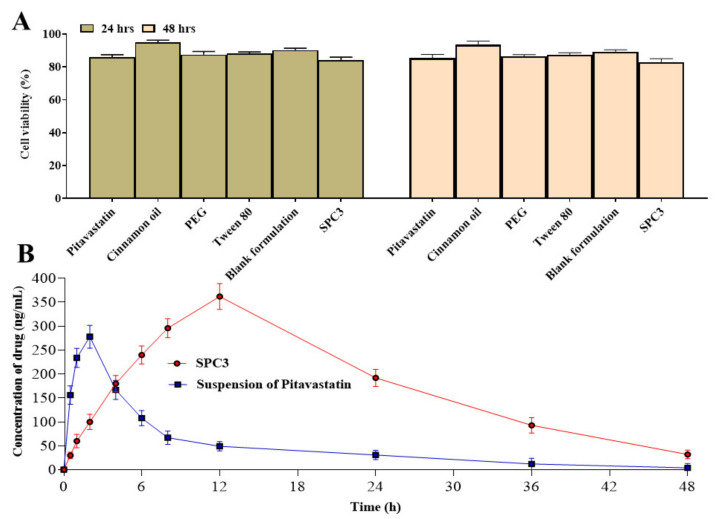
The purpose of the study was to develop an SNEDDS to improve the solubility and bioavailability of pitavastatin. The solubility of pitavastatin in different oils, surfactants, and co-surfactants was determined and a pseudo-ternary phase diagram was constructed. The SNEDDS was characterized by zeta-sizer, zeta-potential, FTIR, DSC, and TGA. Release and permeation of pitavastatin from the SNEDDS was studied for 12 and 24 h, respectively. The lipolysis test, RBC lysis, effect on lipid profile, and pharmacokinetics were studied. The SPC3 formulation showed a 104 ± 1.50 nm particle size, a 0.198 polydispersity index (PDI), and a -29 zeta potential. FTIR, DSC, and TGA showed the chemical compatibility and thermal stability. The release and permeation of pitavastatin from SPC3 was 88.5 ± 2.5% and 96%, respectively. In the lipolysis test, the digestion of SPC3 yielded a high amount of pitavastatin and showed little RBC lysis. The lipid profile suggested that after 35 days of administration of the SNEDDS, there was a marked decrease in TC, LDL, and triglyceride levels. The SNEDDS of SPC3 showed an 86% viability of Caco-2 cells. Pharmacokinetics of SPC3 showed improved values of C, T, half-life, MRT, AUC, and AUMC compared to the reference formulation. Our study demonstrated that the SNEDDS effectively enhanced the solubility and bioavailability of a BCS class II drug.
本研究的目的是开发一种自乳化药物传递系统(SNEDDS)以提高匹伐他汀的溶解度和生物利用度。测定了匹伐他汀在不同油类、表面活性剂和助表面活性剂中的溶解度,并构建了伪三元相图。通过zeta粒度分析仪、zeta电位仪、傅里叶变换红外光谱仪(FTIR)、差示扫描量热仪(DSC)和热重分析仪(TGA)对SNEDDS进行了表征。分别研究了匹伐他汀从SNEDDS中的释放和渗透情况,持续时间为12小时和24小时。进行了脂解试验、红细胞裂解试验、对血脂谱的影响以及药代动力学研究。SPC3制剂的粒径为104±1.50纳米,多分散指数(PDI)为0.198,zeta电位为-29。FTIR、DSC和TGA显示了化学相容性和热稳定性。匹伐他汀从SPC3中的释放率和渗透率分别为88.5±2.5%和96%。在脂解试验中,SPC3的消化产生了大量的匹伐他汀,且红细胞裂解程度较小。血脂谱表明,在给予SNEDDS 35天后,总胆固醇(TC)、低密度脂蛋白(LDL)和甘油三酯水平显著降低。SPC3的SNEDDS对Caco-2细胞的存活率为86%。与参比制剂相比,SPC3的药代动力学显示其血药浓度(C)、达峰时间(T)、半衰期、平均滞留时间(MRT)、曲线下面积(AUC)和一阶矩曲线下面积(AUMC)的值有所改善。我们的研究表明,SNEDDS有效地提高了BCS II类药物的溶解度和生物利用度。