Rashid Rizwana, Zaman Muhammad, Ahmad Mahmood, Khan Mahtab Ahmad, Butt Muhammad Hammad, Salawi Ahmad, Almoshari Yosif, Alshamrani Meshal, Sarfraz Rai Muhammad
Faculty of Pharmacy, University of Central Punjab (UCP), Lahore 54000, Pakistan.
Department of Pharmaceutics, College of Pharmacy, Jazan University, Jazan 45142, Saudi Arabia.
Pharmaceuticals (Basel). 2022 Mar 8;15(3):326. doi: 10.3390/ph15030326.
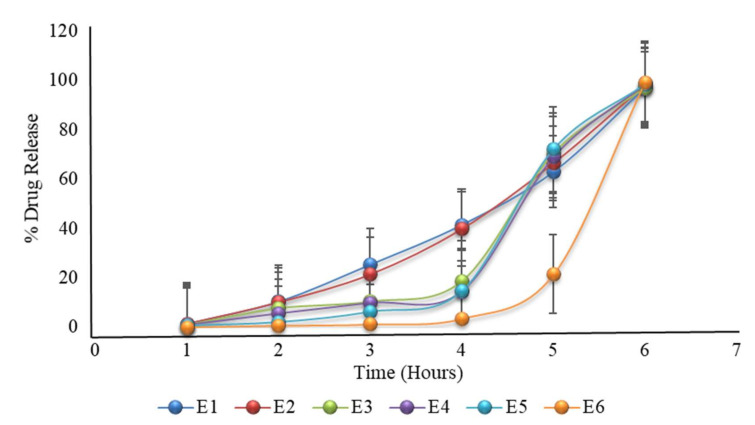
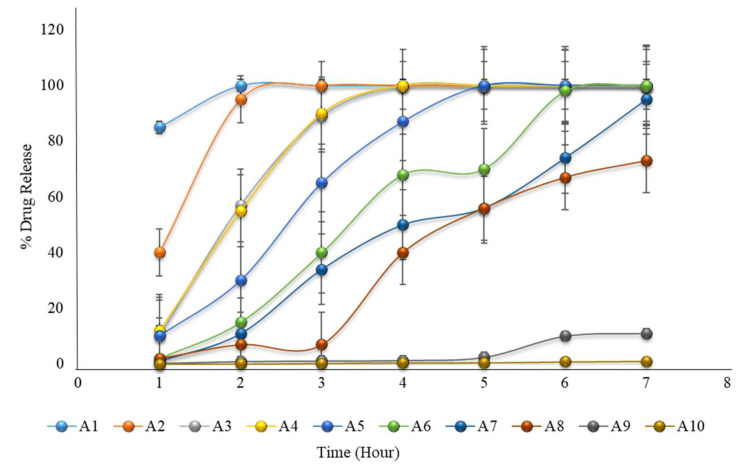
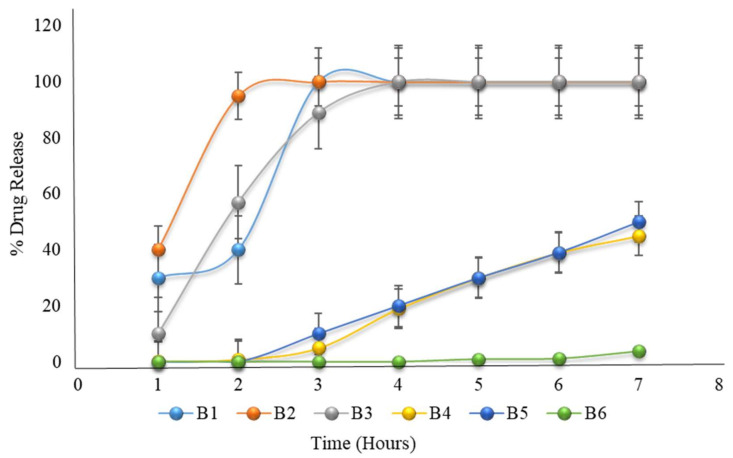
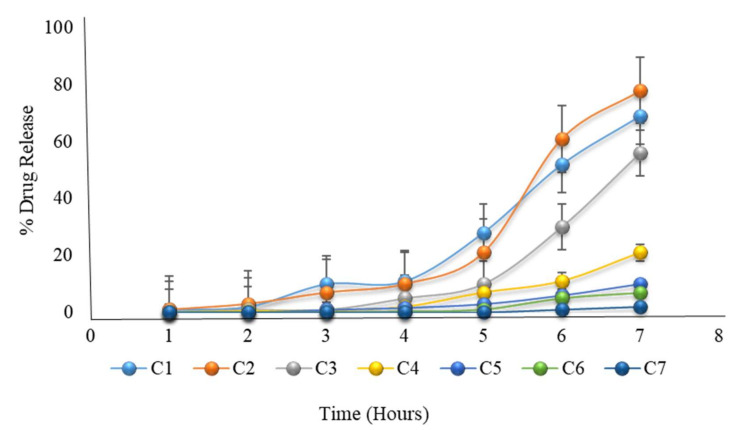
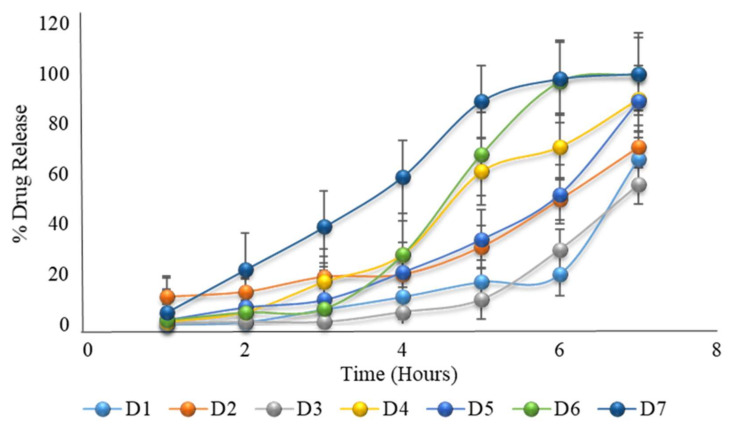
The symptoms of some diseases show circadian rhythms, such as the morning stiffness associated with pain at the time of awakening in rheumatoid arthritis. Therapy for such diseases doesn't require immediate release or sustained release of medicament. In such therapies, pulsatile drug release is more suitable with a programmed drug release. The purpose of this research was to formulate press-coated aceclofenac tablets for pulsatile drug delivery with a distinct delay time of no drug release and release of the drug when it is more likely desired (i.e., after 5 to 6 h). Immediate release core tablets having aceclofenac were formulated. Three formulations, F1, F2, and F3, were prepared with variable concentrations of sodium croscarmellose. Pre- and post-compression tests were performed on the core tablets. The selection criteria included the lowest disintegration time as a requirement of pulsatile drug delivery with an immediate release core and a delayed release coat. The disintegration times of F1, F2, and F3 were 120 s, 60 s, and 15 s, respectively. Therefore, the F3 formulation was selected as the core tablet formulation because it had the shortest disintegration time (15 s). The core tablets were press-coated using different polymers, such as HPMC K100M, Eudragit L100, HEC, and HPMC E5. The polymers were used in the coatings to hinder the release of the core for the desired time. 36 formulations of polymer were prepared: A1 to A10 had HPMC K100M and Avicel PH102; formulations B1 to B6 had HPMC K100M, Eudragit L100, and Avicel PH102; formulations C1 to C7 had HPMC K100M and hydroxyethyl cellulose; formulations D1 to D7 had HPMC K100M and HPMC E5; and formulations E1 to E6 had changed the coating weight of the formulation used for D6 (having HPMC K100M and HPMC E5 in the ratio of 12.5% to 87.5%). Evaluations of the press-coated tablets were carried out through thickness, hardness, weight variation, friability, and in vitro dissolution tests. These parameters concluded that the formulation of E6, having HPMC K100M and HPMC E5 in the ratio of 12.5% to 87.5% at 600 mg weight, was the most optimum formulation as it showed 3.5% drug release after 4 h, 21.4% drug release after 5 h, and 99.27% drug release after 6 h.
一些疾病的症状呈现昼夜节律,比如类风湿性关节炎患者醒来时与疼痛相关的晨僵。针对这类疾病的治疗并不需要药物的速释或缓释。在这类治疗中,脉冲式药物释放更适合程序控制的药物释放。本研究的目的是制备包衣阿昔洛韦片用于脉冲式药物递送,使其具有明显的延迟时间,即开始时不释放药物,而在更需要药物的时候(即5至6小时后)释放。制备了含阿昔洛韦的速释片芯。用不同浓度的交联羧甲基纤维素钠制备了三种制剂F1、F2和F3。对片芯进行了压片前和压片后的测试。选择标准包括最短崩解时间,这是脉冲式药物递送中速释片芯和缓释包衣的要求。F1、F2和F3的崩解时间分别为120秒、60秒和15秒。因此,选择F3制剂作为片芯制剂,因为它的崩解时间最短(15秒)。片芯用不同的聚合物进行包衣,如羟丙甲纤维素K100M、丙烯酸树脂L100、羟乙基纤维素和羟丙甲纤维素E5。这些聚合物用于包衣以在所需时间内阻止片芯药物的释放。制备了36种聚合物制剂:A1至A10含有羟丙甲纤维素K100M和微晶纤维素PH102;制剂B1至B6含有羟丙甲纤维素K100M、丙烯酸树脂L100和微晶纤维素PH102;制剂C1至C7含有羟丙甲纤维素K100M和羟乙基纤维素;制剂D1至D7含有羟丙甲纤维素K100M和羟丙甲纤维素E5;制剂E1至E6改变了用于D6的制剂的包衣重量(羟丙甲纤维素K100M和羟丙甲纤维素E5的比例为12.5%至87.5%)。通过厚度、硬度、重量差异、脆碎度和体外溶出试验对包衣片进行评估。这些参数表明,制剂E6是最优化的制剂,其重量为600毫克,羟丙甲纤维素K100M和羟丙甲纤维素E5的比例为12.5%至87.5%,在4小时后药物释放率为3.5%,5小时后为21.4%,6小时后为99.27%。