Department of Ophthalmology, Ludwig-Maximilians-University, Mathildenstrasse 8, 80336, Munich, Germany.
Department of Ophthalmology, University Clinic Ulm, Ulm, Germany.
BMC Ophthalmol. 2022 Mar 25;22(1):138. doi: 10.1186/s12886-022-02334-w.
Choroidal neovascularizations (CNV) are partially stabilized through a coverage of pericytes leading to a partial anti-VEGF resistence. Drugs licensed for neovascular AMD (nAMD) do not take this mechanical and growth factor-driven CNV stability into account. The purpose of this work was to see if inhibiting the mammalian target of rapamycin (mTOR) may successfully block angiogenic cellular pathways in primary human retinal pericytes in an in vitro model of nAMD.
The mTOR inhibitor rapamycin was used to treat human retinal pericytes (HRP) at doses ranging from 0.005 to 15 g/ml. A modified metabolism-based XTT-Assay was used to assess toxicity and anti-proliferative effects. A scratch wound experiment showed the effects on migration. On Cultrex basement membrane gels, the influence of rapamycin on the development of endothelial cell capillary-like structures by human umbilical vein vascular endothelial cells (HUVEC) in the absence and presence of pericytes was investigated.
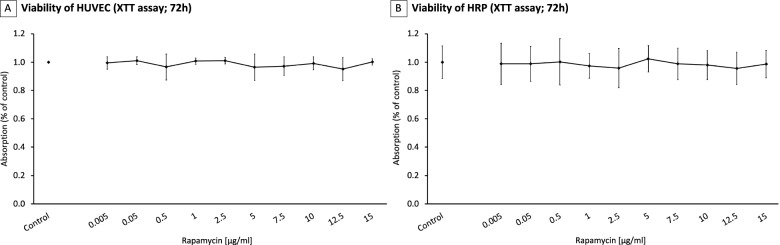
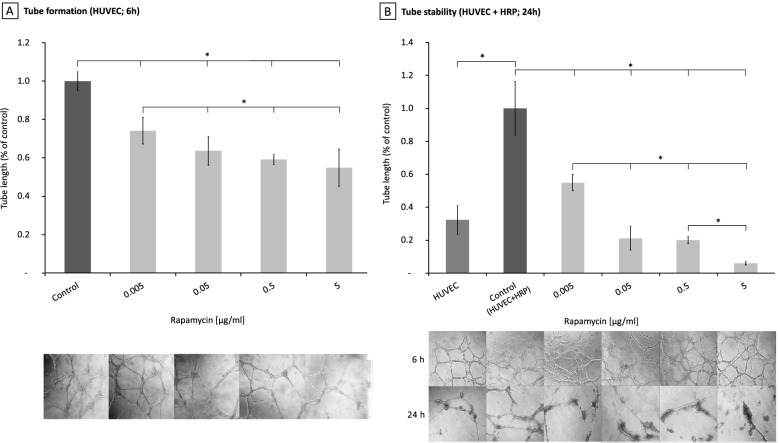
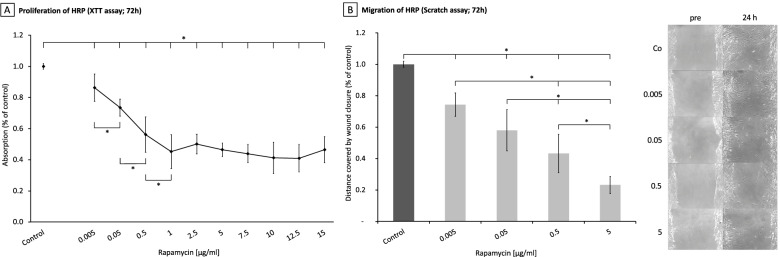
Rapamycin showed no signs of toxicity within its range of solubility. The drug showed dose dependent anti-proliferative activity and inhibited migration into the scratch wound. Endothelial cell tube formation in a HUVEC monoculture was effectively inhibited at 45%. A co-culture of HUVEC with pericytes on Cultrex induced endothelial tube stabilization but was disrupted by the addition of rapamycin leading to degradation of 94% of the tubes.
Rapamycin allows for an efficient modulation of aspects of angiogenesis in pericytes via mTOR-modulation in vitro. Further studies are needed to elucidate whether rapamycin may have an impact on CNV in nAMD in vivo.
脉络膜新生血管(CNV)通过周细胞的覆盖而部分稳定,从而导致部分抗 VEGF 抵抗。用于治疗新生血管性年龄相关性黄斑变性(nAMD)的药物并未考虑到这种机械和生长因子驱动的 CNV 稳定性。本研究旨在观察是否抑制哺乳动物雷帕霉素靶蛋白(mTOR)可能会成功阻断体外 nAMD 模型中原发性人视网膜周细胞的血管生成细胞途径。
使用雷帕霉素(mTOR 抑制剂)以 0.005 至 15 g/ml 的剂量治疗人视网膜周细胞(HRP)。改良的基于代谢的 XTT 测定法用于评估毒性和抗增殖作用。划痕实验显示了迁移的影响。在 Cultrex 基底膜凝胶上,研究了雷帕霉素在存在和不存在周细胞的情况下对人脐静脉血管内皮细胞(HUVEC)形成内皮细胞毛细血管样结构的影响。
雷帕霉素在其溶解度范围内没有表现出毒性迹象。该药物表现出剂量依赖性的抗增殖活性,并抑制向划痕伤口的迁移。在没有周细胞的情况下,雷帕霉素可有效抑制 45%的 HUVEC 单核培养物中的内皮细胞管形成。HUVEC 与周细胞的共培养物在 Cultrex 上诱导内皮细胞管稳定,但添加雷帕霉素会破坏这种稳定,导致 94%的管降解。
雷帕霉素通过 mTOR 调节,可在体外有效调节周细胞中血管生成的各个方面。需要进一步的研究来阐明雷帕霉素是否会对 nAMD 中的 CNV 产生影响。