Department of Biochemistry and Molecular Biology, Key Laboratory for Experimental Teratology of Chinese Ministry of Education, School of Basic Medical Sciences, Cheeloo College of Medicine, Shandong University, 250012, Jinan, People's Republic of China.
Department of Microbiology, Key Laboratory for Experimental Teratology of Chinese Ministry of Education, School of Basic Medical sciences, Cheeloo College of Medicine, Shandong University, Jinan, P. R. China.
Cell Death Dis. 2022 Mar 25;13(3):268. doi: 10.1038/s41419-022-04696-x.
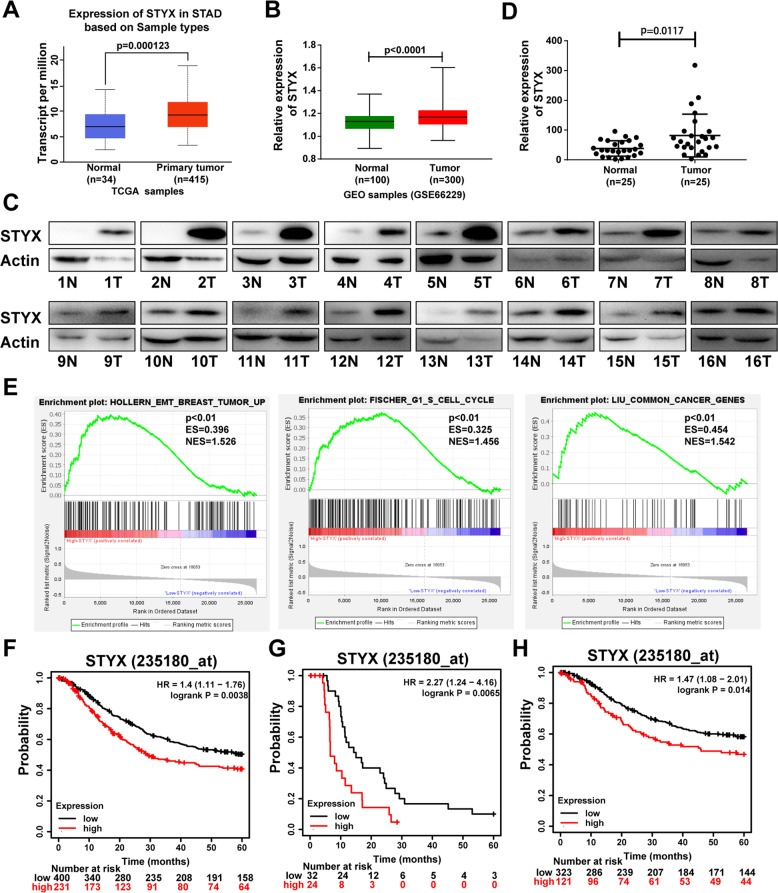
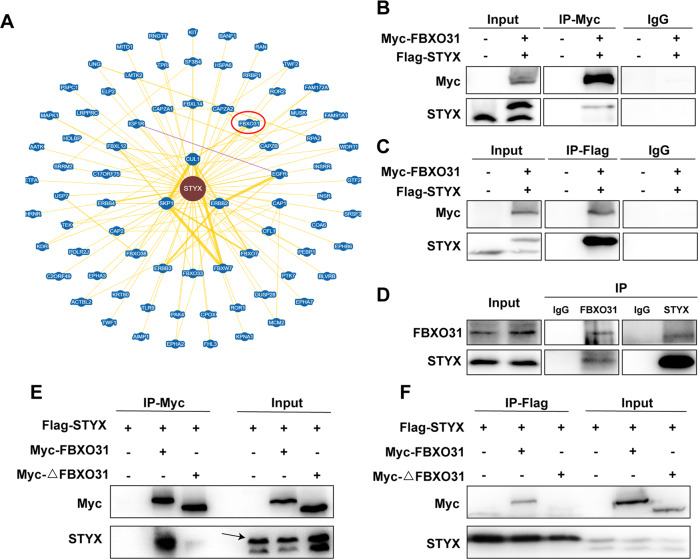
Gastric cancer (GC) is one of the most common malignancies in the world and ranks third in terms of cancer-related deaths. The catalytically inactive pseudophosphatase STYX (serine/threonine/tyrosine interacting protein) is a member of the protein tyrosine phosphatase family. It has been recently reported that STYX functions as a potential oncogene in different types of cancers. However, the potential role and regulatory mechanism of STYX in GC remains unknown. In this study, we find that STYX is highly expressed in GC tissues compared with adjacent noncancerous tissues and closely correlates with the prognosis of GC patients. STYX overexpression facilitates the proliferation and migration in GC cells, whereas STYX knockdown has the opposite effects. Nude mice experiments indicate that STYX knockdown in GC cells dramatically suppresses the tumor growth and lung metastasis in vivo. Mechanically, our results suggest that STYX interacts with the F-box protein FBXO31 and disrupts the degradation function of FBXO31 to its target proteins CyclinD1 and Snail1, thereby increasing the level of CyclinD1 and Snail1 in GC. STYX-mediated biological changes can be reversed by the co-expression of STYX and FBXO31 in GC cells. In addition, transcription factor c-Jun can enhance the expression of STYX in GC. The expression of STYX can also be induced by Helicobacter pylori (H. pylori) infection in c-Jun-dependent manner. Together, our present study suggests that STYX plays an oncogenic role in GC by inhibiting FBXO31 function and represents a potential therapeutic target and prognostic biomarker in GC.
胃癌(GC)是世界上最常见的恶性肿瘤之一,在癌症相关死亡中排名第三。催化非活性假磷酸酶 STYX(丝氨酸/苏氨酸/酪氨酸相互作用蛋白)是蛋白酪氨酸磷酸酶家族的一员。最近有报道称,STYX 在不同类型的癌症中作为潜在的癌基因发挥作用。然而,STYX 在 GC 中的潜在作用和调节机制尚不清楚。在本研究中,我们发现 STYX 在 GC 组织中的表达水平明显高于相邻的非癌组织,并且与 GC 患者的预后密切相关。STYX 过表达促进 GC 细胞的增殖和迁移,而 STYX 敲低则具有相反的效果。裸鼠实验表明,GC 细胞中 STYX 的敲低显著抑制体内肿瘤生长和肺转移。从机制上讲,我们的结果表明,STYX 与 F-box 蛋白 FBXO31 相互作用,并破坏 FBXO31 对其靶蛋白 CyclinD1 和 Snail1 的降解功能,从而增加 GC 中 CyclinD1 和 Snail1 的水平。在 GC 细胞中共同表达 STYX 和 FBXO31 可以逆转 STYX 介导的生物学变化。此外,转录因子 c-Jun 可以增强 GC 中 STYX 的表达。幽门螺杆菌(H. pylori)感染也可以依赖 c-Jun 诱导 STYX 的表达。总之,本研究表明,STYX 通过抑制 FBXO31 功能在 GC 中发挥致癌作用,代表 GC 潜在的治疗靶点和预后生物标志物。