Wirtz Mathijs R, Roelofs Joris J, Goslings J Carel, Juffermans Nicole P
Department of Intensive Care Medicine, Amsterdam University Medical Centres, Amsterdam, Netherlands.
Laboratory of Experimental Intensive Care and Anesthesiology, Amsterdam University Medical Centres, Amsterdam, Netherlands.
Trauma Surg Acute Care Open. 2022 Mar 8;7(1):e000852. doi: 10.1136/tsaco-2021-000852. eCollection 2022.
Trauma-induced hemorrhagic shock is characterized by increased endothelial permeability and coagulopathy. Vasopressin analog ddAVP (desmopressin) acts by reorganizing and redistributing adhesive and tight junction molecules, enhancing endothelial barrier function. Furthermore, ddAVP increases von Willebrand factor (vWF) plasma levels and thereby potentially enhances platelet-based coagulation. The objective of this study was to assess whether the use of ddAVP results in improvement of both endothelial barrier function and platelet-based coagulation, thereby improving shock reversal and reduce organ failure in a rat model of trauma and transfusion.
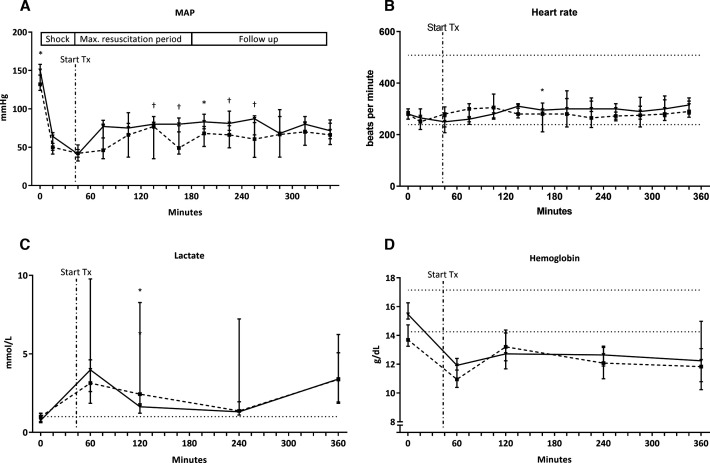
Blood products were prepared from syngeneic rat blood according to blood bank standards. Polytrauma was induced in Sprague Dawley rats by a fractured femur and crush injury to the intestines and liver. The rats were hemorrhaged until a mean arterial pressure of 40 mm Hg and transfused with RBCs, fresh frozen plasmas and platelets in a 1:1:1 ratio, and randomized to receive a single dose of ddAVP (n=7 per group). Blood samples were taken up to 6 hours after trauma to assess biochemistry, markers of endothelial injury and coagulation status by rotational thromboelastometry (ROTEM). Organ damage was assessed by histopathology.
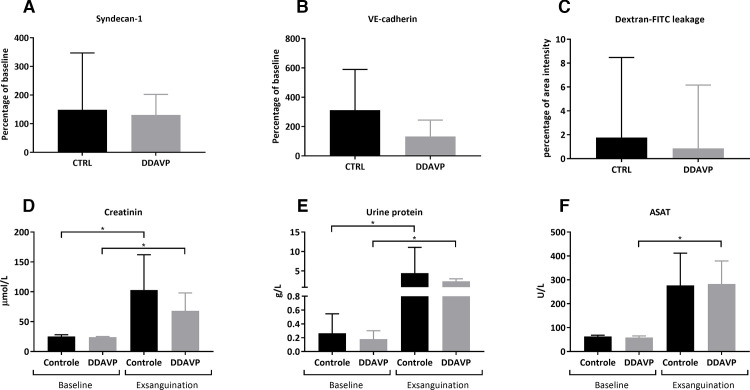
Rats receiving ddAVP showed significantly better shock reversal compared with controls. Also, coagulation parameters remained stable in the ddAVP treated group, whereas rats in the control group showed deterioration of coagulation parameters, including decreased clot strength and decreased platelet functioning (89% (IQR 82% to 92%) of baseline values). Platelet count and vWF antigen levels at exsanguination did not differ between groups. ddAVP did not reduce markers of endothelial dysfunction nor markers of organ injury.
The use of ddAVP in a rat trauma-transfusion model improved shock parameters and ROTEM parameters of clot formation. However, this did not abrogate the amount of organ failure.
Level III.
创伤性失血性休克的特点是内皮通透性增加和凝血病。血管加压素类似物去氨加压素(ddAVP)通过重组和重新分布黏附分子和紧密连接分子发挥作用,增强内皮屏障功能。此外,ddAVP可提高血管性血友病因子(vWF)的血浆水平,从而潜在地增强基于血小板的凝血功能。本研究的目的是评估使用ddAVP是否能改善内皮屏障功能和基于血小板的凝血功能,从而在创伤和输血大鼠模型中改善休克逆转并减少器官衰竭。
根据血库标准从同基因大鼠血液中制备血液制品。通过股骨骨折以及对肠道和肝脏的挤压伤在Sprague Dawley大鼠中诱导多发伤。将大鼠放血至平均动脉压为40 mmHg,然后以1:1:1的比例输注红细胞、新鲜冰冻血浆和血小板,并随机接受单剂量的ddAVP(每组7只)。在创伤后6小时内采集血样,通过旋转血栓弹力图(ROTEM)评估生化指标、内皮损伤标志物和凝血状态。通过组织病理学评估器官损伤。
与对照组相比,接受ddAVP的大鼠休克逆转明显更好。此外,ddAVP治疗组的凝血参数保持稳定,而对照组的大鼠凝血参数恶化,包括凝血强度降低和血小板功能下降(为基线值的89%(四分位间距82%至92%))。放血时两组之间的血小板计数和vWF抗原水平没有差异。ddAVP并未降低内皮功能障碍标志物或器官损伤标志物。
在大鼠创伤输血模型中使用ddAVP可改善休克参数和ROTEM凝血形成参数。然而,这并未消除器官衰竭的程度。
III级。