Singla Monika, Singh Gagandeep, Kaur Paramdeep, Pandian Jeyaraj D
Department of Neurology, Dayanand Medical College and Hospital, Ludhiana, Punjab, India.
Biostatistical Researcher, Faculty of Medicine, University of British Columbia, Canada.
Ann Indian Acad Neurol. 2022 Jan-Feb;25(1):114-119. doi: 10.4103/aian.aian_711_21. Epub 2022 Feb 8.
The objective of the study was to determine incidence, risk factors, and short-term outcomes of young stroke in Ludhiana city, Northwest India.
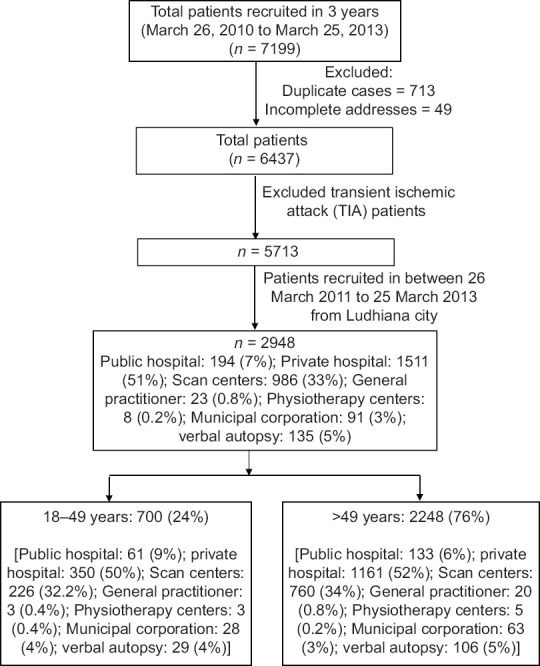
Data were collected on first-ever stroke in patients of age ≥18 years, from hospitals, diagnostic imaging centers, general practitioners, and municipal corporation during March 2011-March 2013 in Ludhiana city, using the World Health Organization Stepwise Approach to Surveillance (WHO STEPS). Outcome was documented using the modified Rankin Scale at 28 days.
Of 2948 patients, 700 (24%) were in the age group 18-49 years. Annual incidence in this age group was 46/100,000 person-years (95% confidence interval [CI], 41-51/100,000). Hypertension (84%), diabetes mellitus (48%), and atrial fibrillation (AF) (12%) were found more common in >49 years age group, as compared with 18-49 years age group. Drug abuse (8.7% vs. 6% in age >49 years; = 0.04) and tobacco intake (8.7% vs. 5.6% in age >49 years; = 0.02) was more common in young people, that is, 18-49 years age group in comparison to older patients, >49 years age group. Recovery was better in younger subjects (60% vs. 46% in age >49 years < 0.001). In a multivariable analysis, younger people were more often literate (odds ratio [OR] 2.52; 95% CI, 1.68-3.77; < 0.001), employed (OR 3.92; 95% CI, 2.20-5.21; < 0.001), and 374 (60%) had good clinical outcome, modified Rankin Scale <2 at 28 days follow-up as compared with 938 (46%) older patients (OR 1.52; 95% CI, 1.15-2.00; = 0.003).
Hypertension, diabetes mellitus, drug addiction, and tobacco intake were significantly associated with young stroke. Outcome was also better in younger people.
本研究的目的是确定印度西北部卢迪亚纳市青年卒中的发病率、危险因素和短期预后。
采用世界卫生组织逐步监测方法(WHO STEPS),于2011年3月至2013年3月期间,从卢迪亚纳市的医院、诊断影像中心、全科医生和市政公司收集年龄≥18岁的首次卒中患者的数据。在28天时使用改良Rankin量表记录预后情况。
在2948例患者中,700例(24%)年龄在18 - 49岁之间。该年龄组的年发病率为46/100,000人年(95%置信区间[CI],41 - 51/100,000)。与18 - 49岁年龄组相比,高血压(84%)、糖尿病(48%)和心房颤动(AF)(12%)在49岁以上年龄组中更为常见。药物滥用(18 - 49岁年龄组为8.7%,49岁以上年龄组为6%;P = 0.04)和烟草摄入(18 - 49岁年龄组为8.7%,49岁以上年龄组为5.6%;P = 0.02)在年轻人(即18 - 49岁年龄组)中比老年患者(49岁以上年龄组)更常见。年轻受试者的恢复情况更好(60%,49岁以上年龄组为46%;P < 0.001)。在多变量分析中,年轻人更常具有文化程度(优势比[OR] 2.52;