Kiang Mathew V, Acosta Rolando J, Chen Yea-Hung, Matthay Ellicott C, Tsai Alexander C, Basu Sanjay, Glymour M Maria, Bibbins-Domingo Kirsten, Humphreys Keith, Arthur Kristen N
Department of Epidemiology and Population Health, Stanford University School of Medicine, 1701 Page Mill Road, Palo Alto, Stanford, CA 94304, USA.
Department of Biostatistics, Harvard T.H. Chan School of Public Health, Boston, MA, USA.
Lancet Reg Health Am. 2022 Jul;11:100237. doi: 10.1016/j.lana.2022.100237. Epub 2022 Mar 19.
The coronavirus disease 2019 (COVID-19) pandemic is co-occurring with a drug addiction and overdose crisis.
We fit overdispersed Poisson models, accounting for seasonality and secular trends, to estimate the excess fatal drug overdoses (i.e., deaths greater than expected), using data on all deaths in California from 2016 to 2020.
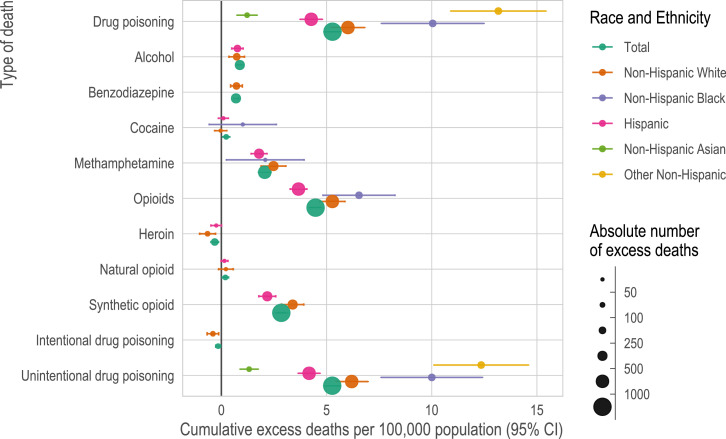
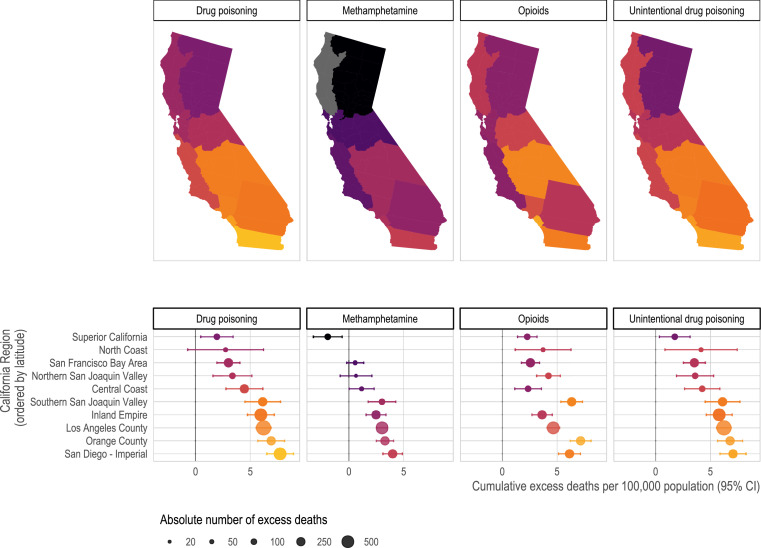
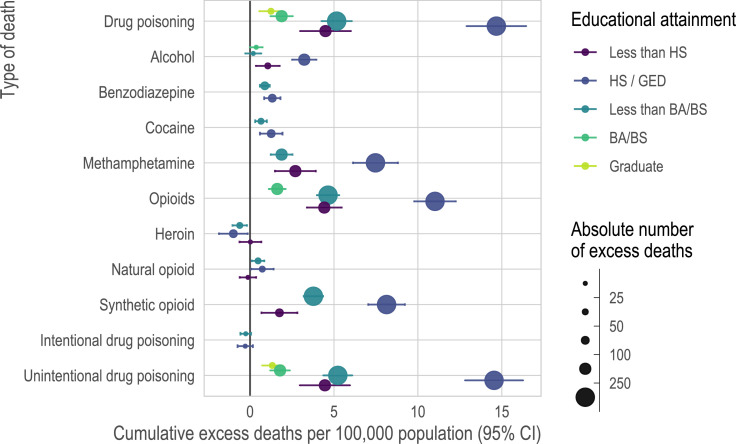
Between January 5, 2020 and December 26, 2020, there were 8605 fatal drug overdoses-a 44% increase over the same period one year prior. We estimated 2084 (95% CI: 1925 to 2243) fatal drug overdoses were excess deaths, representing 5·28 (4·88 to 5·68) excess fatal drug overdoses per 100,000 population. Excess fatal drug overdoses were driven by opioids (4·48 [95% CI: 4·18 to 4·77] per 100,000), especially synthetic opioids (2·85 [95% CI: 2·56 to 3·13] per 100,000). The non-Hispanic Black and Other non-Hispanic populations were disproportionately affected with 10·1 (95% CI: 7·6 to 12·5) and 13·26 (95% CI: 11·0 to 15·5) excess fatal drug overdoses per 100,000 population, respectively, compared to 5·99 (95% CI: 5.2 to 6.8) per 100,000 population in the non-Hispanic white population. There was a steep, nonlinear educational gradient with the highest rate among those with only a high school degree. There was a strong spatial patterning with the highest levels of excess mortality in the southernmost region and consistently lower levels at progressively more northern latitudes (7·73 vs 1·96 per 100,000).
Fatal drug overdoses disproportionately increased in 2020 among structurally marginalized populations and showed a strong geographic gradient. Local, tailored public health interventions are urgently needed to reduce growing inequities in overdose deaths.
US National Institutes of Health and Department of Veterans Affairs.
2019年冠状病毒病(COVID-19)大流行与药物成瘾和过量用药危机同时发生。
我们采用考虑季节性和长期趋势的过度分散泊松模型,利用2016年至2020年加利福尼亚州所有死亡数据,估计过量致命药物过量(即死亡人数超过预期)情况。
在2020年1月5日至2020年12月26日期间,有8605例致命药物过量——比前一年同期增加了44%。我们估计有2084例(95%置信区间:1925至2243)致命药物过量为额外死亡,相当于每10万人中有5.28例(4.88至5.68例)过量致命药物过量。过量致命药物过量由阿片类药物驱动(每10万人中有4.48例[95%置信区间:4.18至4.77例]),尤其是合成阿片类药物(每10万人中有2.85例[95%置信区间:2.56至3.13例])。非西班牙裔黑人和其他非西班牙裔人群受影响尤为严重,每10万人中分别有10.1例(95%置信区间:7.6至12.5例)和13.26例(95%置信区间:11.0至15.5例)过量致命药物过量,而非西班牙裔白人每10万人中有5.99例(95%置信区间:5.2至6.8例)。存在陡峭的非线性教育梯度,高中文化程度人群的发生率最高。存在强烈的空间格局,最南端地区的额外死亡率最高,而越往北纬度地区的死亡率持续较低(每10万人中分别为7.73例和1.96例)。
2020年,在结构上处于边缘地位的人群中,致命药物过量情况不成比例地增加,并呈现出强烈的地理梯度。迫切需要采取因地制宜的地方公共卫生干预措施,以减少过量用药死亡方面日益加剧的不平等现象。
美国国立卫生研究院和退伍军人事务部。