Department of Geriatric Dentistry, Showa University School of Dentistry, 2-1-1 Kitasenzoku, Ohta-ku, Tokyo, 145-8515, Japan.
Department of Dysphagia Rehabilitation, Graduate School of Medical and Dental Sciences, Tokyo Medical and Dental University (TMDU), 1-5-45 Yushima, Bunkyo-ku, Tokyo, 113-8549, Japan.
Support Care Cancer. 2022 Jul;30(7):5779-5788. doi: 10.1007/s00520-022-06984-w. Epub 2022 Mar 28.
Maintenance of oral feeding is important in terms of maintaining and improving the quality of life in terminal cancer patients receiving palliative care. Although adequate oral health status is essential for oral feeding in hospitalized patients, the relationship between oral health and oral feeding in patients receiving palliative care remains unclear. This cross-sectional study aimed to examine how the general condition and oral health status of these patients relate to decisions regarding their nutritional intake methods.
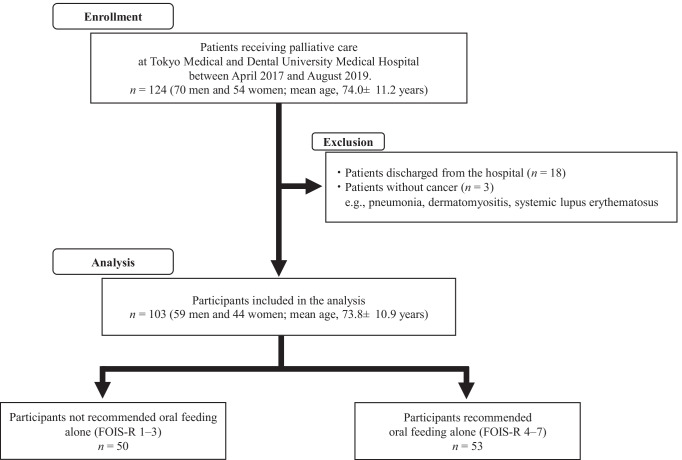
This retrospective cross-sectional study included 103 terminal cancer patients (59 men and 44 women; mean age, 73.8 ± 10.9 years) who received palliative care between April 2017 and August 2019. The nutritional method was assessed using the Functional Oral Intake Scale (FOIS). We assessed two types of nutritional methods: (1) the method advised by the attending physician until the initial dental examination (FOIS-I) and (2) the recommended method based on consultation with a palliative care doctor and dentist after the initial oral examination (FOIS-R). Furthermore, the participants' basic information and Dysphagia Severity Scale (DSS) and Oral Health Assessment Tool (OHAT) scores were assessed.
There was a divergence between FOIS-I and FOIS-R. FOIS-R was significantly higher than FOIS-I (p < 0.001). Multiple regression analysis revealed that the time until death, DSS score, and OHAT score had a significant impact on determining the food form for oral feeding.
Appropriate oral health assessment is important in determining the food form and indication for oral feeding among patients receiving palliative care.
对于接受姑息治疗的终末期癌症患者,维持口服进食对于维持和提高生活质量非常重要。尽管在住院患者中,口腔健康状况对于口服进食是必要的,但姑息治疗患者的口腔健康与口服进食之间的关系仍不清楚。本横断面研究旨在探讨这些患者的一般状况和口腔健康状况与他们的营养摄入方法决策之间的关系。
本回顾性横断面研究纳入了 2017 年 4 月至 2019 年 8 月期间接受姑息治疗的 103 例终末期癌症患者(59 名男性和 44 名女性;平均年龄,73.8±10.9 岁)。使用功能性口腔摄入量表(FOIS)评估营养方法。我们评估了两种营养方法:(1)在初始牙科检查前由主治医生建议的方法(FOIS-I)和(2)在初始口腔检查后咨询姑息治疗医生和牙医建议的方法(FOIS-R)。此外,评估了患者的基本信息、吞咽困难严重程度量表(DSS)和口腔健康评估工具(OHAT)评分。
FOIS-I 和 FOIS-R 之间存在差异。FOIS-R 显著高于 FOIS-I(p<0.001)。多元回归分析显示,死亡时间、DSS 评分和 OHAT 评分对确定口服进食的食物形式有显著影响。
在确定姑息治疗患者的食物形式和口服进食适应证时,进行适当的口腔健康评估非常重要。