Department of Gastroenterology and Hepatology, Nagoya University Graduate School of Medicine, Nagoya, Japan,
Department of Gastroenterology and Hepatology, Nagoya University Graduate School of Medicine, Nagoya, Japan.
Dig Dis. 2023;41(1):138-147. doi: 10.1159/000524298. Epub 2022 Mar 28.
Lenvatinib has been widely used for the treatment of advanced hepatocellular carcinoma (HCC). Some adverse events, including diarrhea, have been reported for lenvatinib. Diarrhea may be associated with the changes in the intestinal microbiome; however, the underlying mechanism has not been elucidated.
In this study, we aimed to investigate the relationship between the intestinal microbiome and diarrhea caused by lenvatinib via analysis of fecal samples collected before treatment.
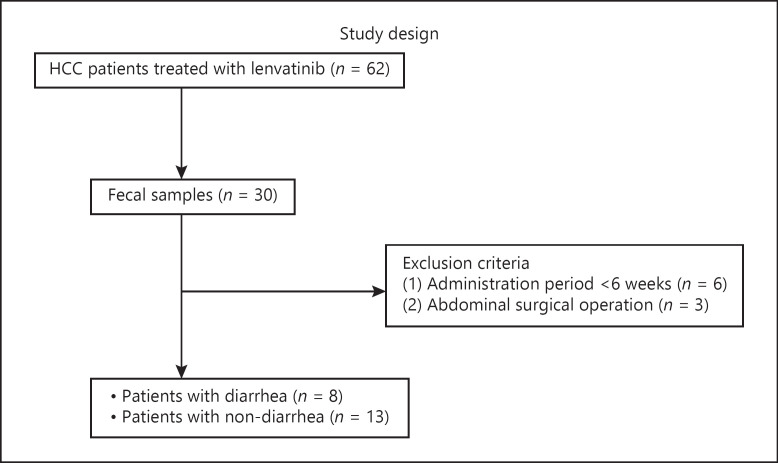
A total of 21 patients with advanced HCC who were treated with lenvatinib were enrolled. Fecal samples were collected from patients. The patients were divided into diarrhea (n = 8) and nondiarrhea groups (n = 12). We compared the characteristics of patients, incidence of adverse events, composition of the intestinal microbiome, and enrichment of functional pathways between both groups using QIIME2 and PICRUSt2.
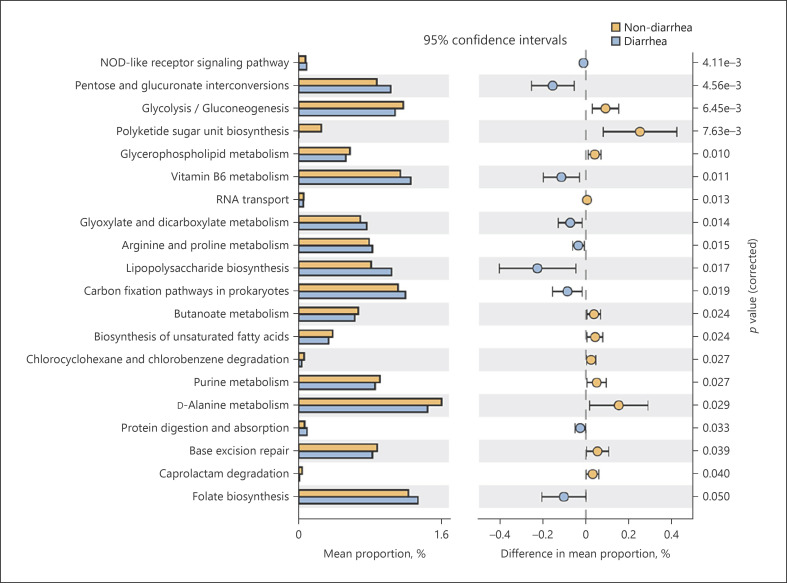
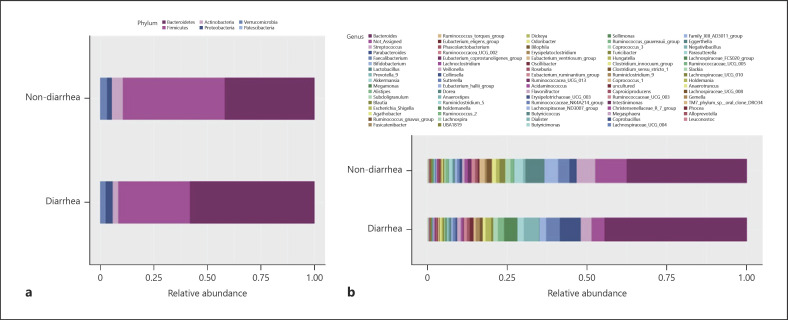
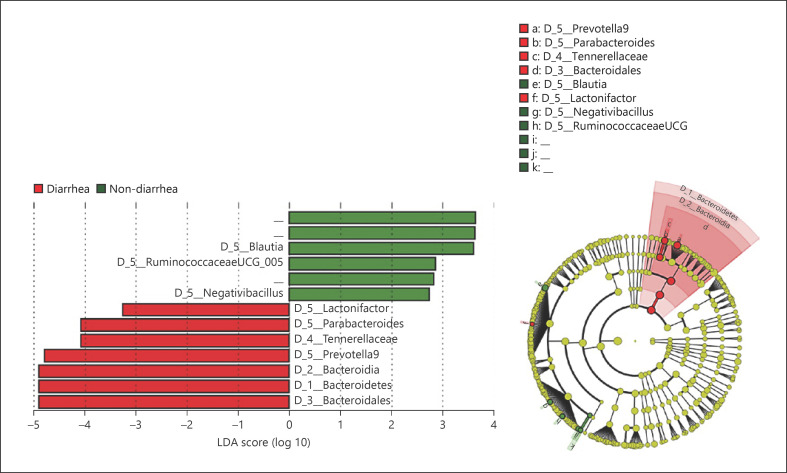
The median age of the two groups was 73 years. The nondiarrhea group comprised a relatively higher number of male patients than the diarrhea group; however, there were no significant differences in patient characteristics between both groups. The proportion of the microbiome was similar, and alpha and beta diversities were not significantly different between both groups. The relative abundance of order Bacteroidales, including Parabacteroides and Prevotella, was higher in the diarrhea group than in the nondiarrhea group. PICRUSt2 analysis showed some metabolic pathways, including butanoate (butyrate) metabolism, were enriched in the nondiarrhea group when compared with those in the diarrhea group.
Differences in the intestinal microbiomes and their functions may influence the incidence of diarrhea during lenvatinib treatment.
仑伐替尼已广泛用于治疗晚期肝细胞癌(HCC)。仑伐替尼的一些不良反应,包括腹泻,已有报道。腹泻可能与肠道微生物群的变化有关;然而,其潜在机制尚未阐明。
本研究旨在通过分析治疗前采集的粪便样本,研究肠道微生物群与仑伐替尼引起的腹泻之间的关系。
共纳入 21 例接受仑伐替尼治疗的晚期 HCC 患者。采集患者粪便样本。将患者分为腹泻组(n=8)和非腹泻组(n=12)。我们使用 QIIME2 和 PICRUSt2 比较两组患者的特征、不良事件发生率、肠道微生物群组成和功能途径的富集情况。
两组患者的中位年龄均为 73 岁。非腹泻组男性患者比例相对较高,但两组患者特征无显著差异。两组微生物群的比例相似,α多样性和β多样性无显著差异。腹泻组中双歧杆菌目(Bacteroidales)的相对丰度较高,包括拟杆菌属(Parabacteroides)和普雷沃氏菌属(Prevotella)。PICRUSt2 分析显示,与腹泻组相比,非腹泻组中一些代谢途径,包括丁酸盐(butyrate)代谢,更为丰富。
肠道微生物群及其功能的差异可能影响仑伐替尼治疗期间腹泻的发生。