Long Tao, Zhang Ying, Zeng Chunping, Zheng Siyuan, Zhou Lin, Liu Haiyan
Endocrinology Department, The Fifth Affiliated Hospital of Guangzhou Medical University, Guangzhou, China.
Endocrinology Department, The Third Affiliated Hospital of Guangzhou Medical University, Guangzhou, China.
Int J Endocrinol. 2022 Mar 19;2022:9927240. doi: 10.1155/2022/9927240. eCollection 2022.
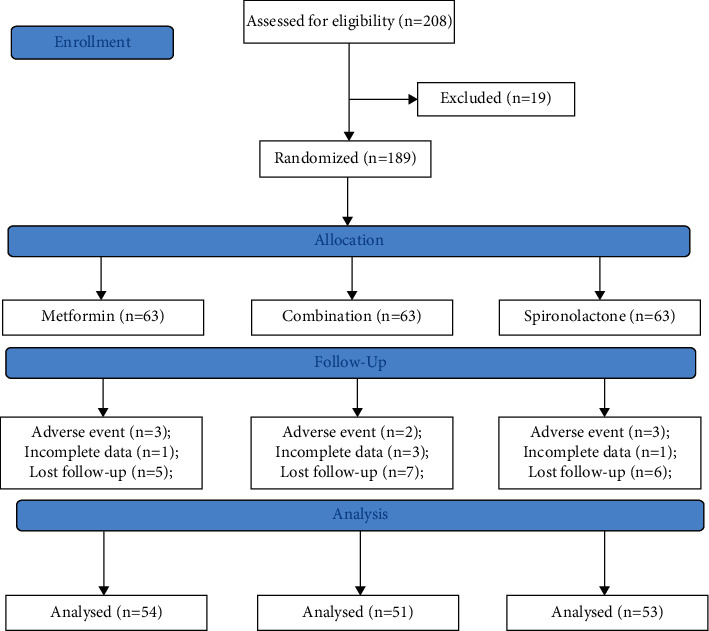
Metformin and spironolactone alone can be used for the management of polycystic ovarian syndrome (PCOS), and their combination could result in even better outcomes. To compare the effects and safety of low-dose spironolactone combined with metformin or either drug alone on insulin resistance (IR) and functional improvement in patients with PCOS, this was a single-center, randomized, open-label, pilot study of patients with PCOS at the Third Affiliated Hospital of Guangzhou Medical University between 01/2014 and 01/2016. The participants were randomized 1 : 1 : 1 to metformin, spironolactone, or metformin + spironolactone. The primary endpoint was the change in the homeostatic model assessment (HOMA)-IR after 12 weeks of treatment. A total of 189 participants were randomized (63 per group); 31 dropped out, and 54, 51, and 53 completed the 12-week treatment in the metformin, spironolactone, and combined groups, respectively. There were no differences in any parameters between the metformin and spironolactone groups (all > 0.05). In the combined group, after 12 weeks of treatment, HOMA-IR (1.71 ± 0.91) was lower than in the metformin (1.92 ± 1.07, < 0.05) and spironolactone (2.38 ± 1.14, < 0.05) groups. In addition, total testosterone (TT), free androgen index (FAI), and area under the curve-insulin (AUCins) were lower in the combined group compared with the metformin group (all < 0.05), while TT, FAI, HOMA-, fasting plasma glucose, and AUCins were lower in the spironolactone group (all < 0.05). Both metformin and spironolactone decreased HOMA-IR in patients with PCOS but without differences between the two monotherapies. The combined therapy decreased HOMA-IR to a greater extent than monotherapy.
二甲双胍和螺内酯单独使用均可用于多囊卵巢综合征(PCOS)的治疗,二者联合使用可能会产生更好的效果。为比较低剂量螺内酯联合二甲双胍或单独使用其中任一药物对PCOS患者胰岛素抵抗(IR)及功能改善的效果和安全性,本研究是一项于2014年1月至2016年1月在广州医科大学附属第三医院进行的针对PCOS患者的单中心、随机、开放标签的试点研究。参与者按1∶1∶1随机分为二甲双胍组、螺内酯组或二甲双胍 + 螺内酯组。主要终点是治疗12周后稳态模型评估(HOMA)-IR的变化。共有189名参与者被随机分组(每组63人);31人退出,分别有54、51和53人在二甲双胍组、螺内酯组和联合治疗组完成了12周的治疗。二甲双胍组和螺内酯组之间的任何参数均无差异(均P>0.05)。联合治疗组在治疗12周后,HOMA-IR(1.71±0.91)低于二甲双胍组(1.92±1.07,P<0.05)和螺内酯组(2.38±1.14,P<0.05)。此外,联合治疗组的总睾酮(TT)、游离雄激素指数(FAI)和胰岛素曲线下面积(AUCins)低于二甲双胍组(均P<0.05),而螺内酯组的TT、FAI、HOMA-、空腹血糖和AUCins较低(均P<0.05)。二甲双胍和螺内酯均可降低PCOS患者的HOMA-IR,但两种单药治疗之间无差异。联合治疗比单药治疗能更大程度地降低HOMA-IR。