Institute of Biological Chemistry, Biocenter, Medical University of Innsbruck, Innrain 80-82, 6020, Innsbruck, Austria.
Department of General, Inorganic and Theoretical Chemistry, University of Innsbruck, Innrain 80-82, 6020, Innsbruck, Austria.
Cell Mol Life Sci. 2022 Mar 28;79(4):214. doi: 10.1007/s00018-022-04238-w.
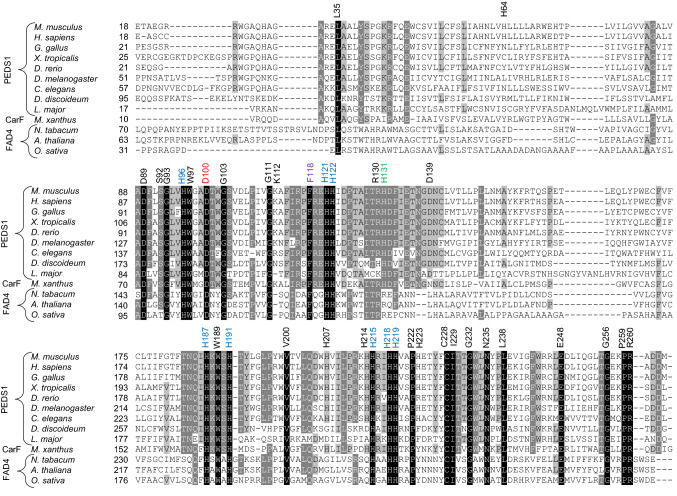
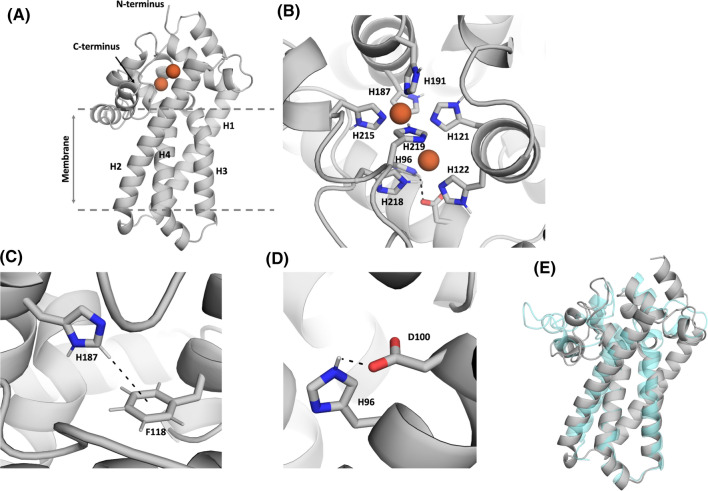
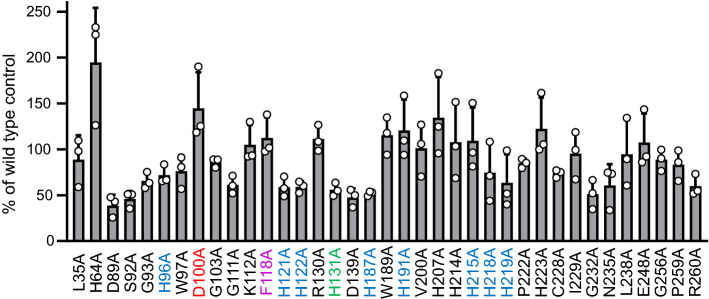
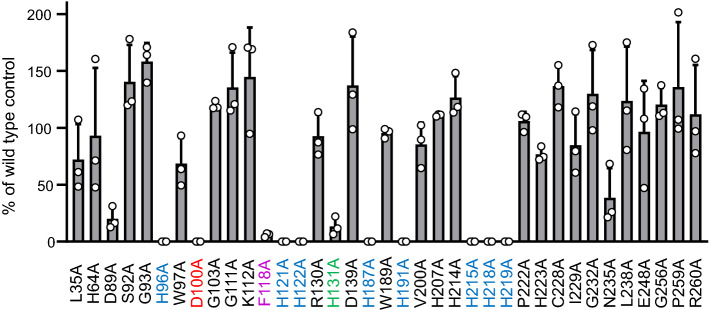
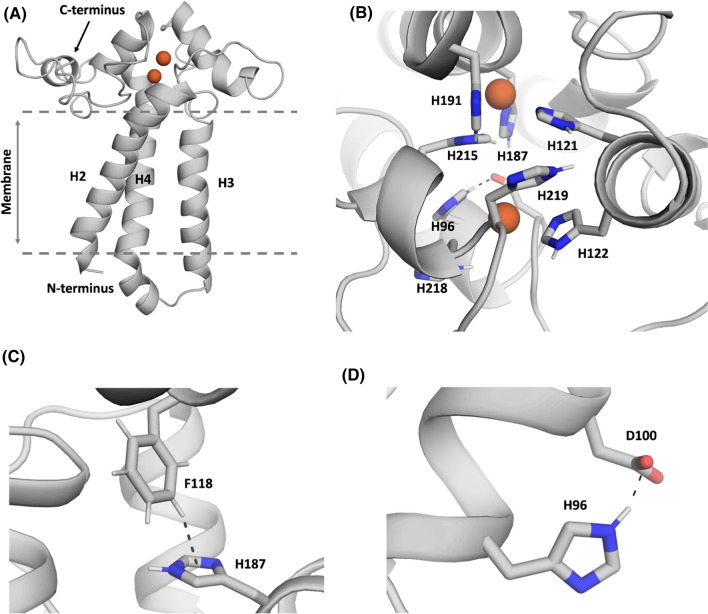
Plasmalogens are an abundant class of glycerophospholipids in the mammalian body, with special occurrence in the brain and in immune cell membranes. Plasmanylethanolamine desaturase (PEDS1) is the final enzyme of plasmalogen biosynthesis, which introduces the characteristic 1-O-alk-1'-enyl double bond. The recent sequence identification of PEDS1 as transmembrane protein 189 showed that its protein sequence is related to a special class of plant desaturases (FAD4), with whom it shares a motif of 8 conserved histidines, which are essential for the enzymatic activity. In the present work, we wanted to gain more insight into the sequence-function relationship of this enzyme and mutated to alanine additional 28 amino acid residues of murine plasmanylethanolamine desaturase including those 20 residues, which are also totally conserved-in addition to the eight-histidine-motif-among the animal PEDS1 and plant FAD4 plant desaturases. We measured the enzymatic activity by transient transfection of tagged murine PEDS1 expression clones to a PEDS1-deficient human HAP1 cell line by monitoring of labeled plasmalogens formed from supplemented 1-O-pyrenedecyl-sn-glycerol in relation to recombinant protein expression. Surprisingly, only a single mutation, namely aspartate 100, led to a total loss of PEDS1 activity. The second strongest impact on enzymatic activity had mutation of phenylalanine 118, leaving only 6% residual activity. A structural model obtained by homology modelling to available structures of stearoyl-CoA reductase predicted that this aspartate 100 residue interacts with histidine 96, and phenylalanine 118 interacts with histidine 187, both being essential histidines assumed to be involved in the coordination of the di-metal center of the enzyme.
磷脂酰乙醇胺-Pl 是哺乳动物体内大量存在的甘油磷脂类,在大脑和免疫细胞膜中特殊存在。Pl 烯醇胺脱饱和酶(PEDS1)是 Pl 生物合成的最后一种酶,它引入了特征性的 1-O-烯-1'-烷基双键。最近的 PEDS1 跨膜蛋白 189 序列鉴定表明,其蛋白序列与植物脱饱和酶(FAD4)的特殊类别有关,它们共享一个由 8 个保守组氨酸组成的基序,这对酶活性至关重要。在本工作中,我们希望更深入地了解该酶的序列-功能关系,并突变包括 20 个残基在内的 28 个额外的氨基酸残基,这些残基在动物 PEDS1 和植物 FAD4 植物脱饱和酶中除了八组氨酸基序外也是完全保守的。我们通过瞬态转染标记的鼠 PEDS1 表达克隆到 PEDS1 缺陷型人 HAP1 细胞系中,通过监测补充 1-O-苊基-sn-甘油形成的标记 Pl 来测量酶活性,与重组蛋白表达有关。令人惊讶的是,只有一个单一的突变,即天冬氨酸 100,导致 PEDS1 活性完全丧失。对酶活性的第二大影响是苯丙氨酸 118 的突变,仅留下 6%的残余活性。通过同源建模获得的结构模型可用于预测硬脂酰辅酶 A 还原酶的结构,预测该天冬氨酸 100 残基与组氨酸 96 相互作用,苯丙氨酸 118 与组氨酸 187 相互作用,两者都是假定参与酶的双金属中心配位的必需组氨酸。