Instituto de Física Interdisciplinar y Sistemas Complejos IFISC (CSIC-UIB), 07122, Palma de Mallorca, Spain.
Department of Biomedical Engineering, Universidad de los Andes, Cr 1 18A-12, Bogotá, Colombia.
Nat Commun. 2022 Mar 29;13(1):1615. doi: 10.1038/s41467-022-28810-x.
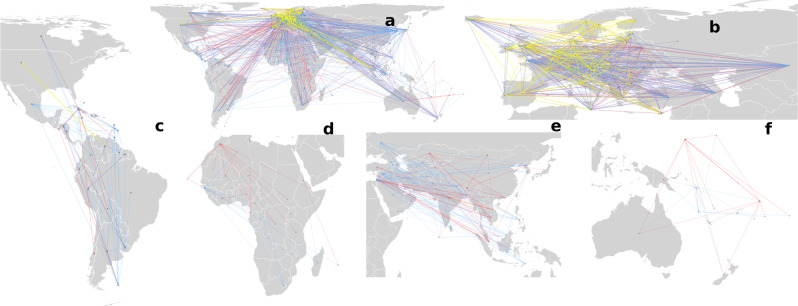
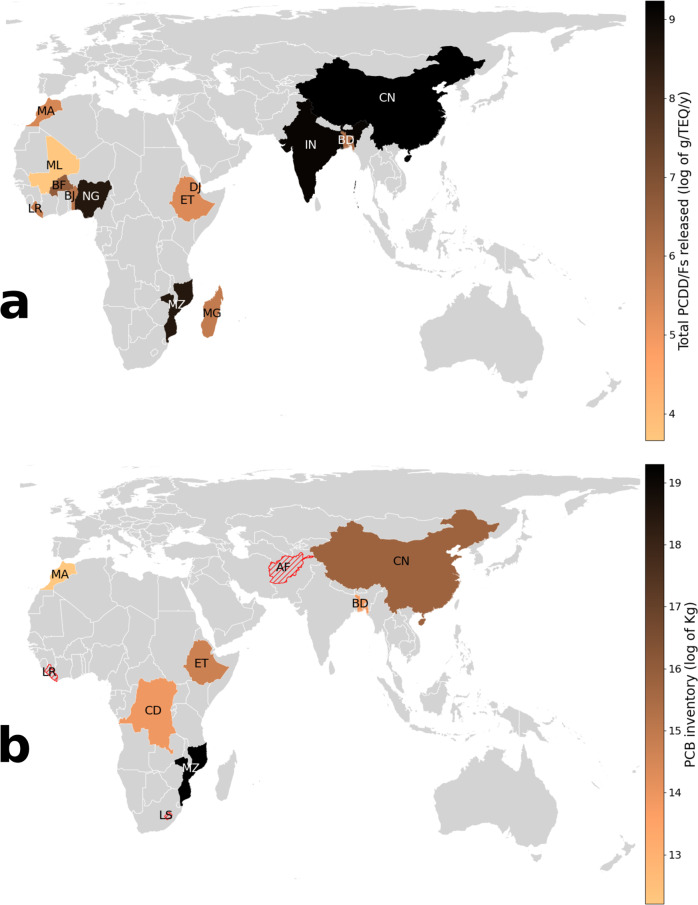
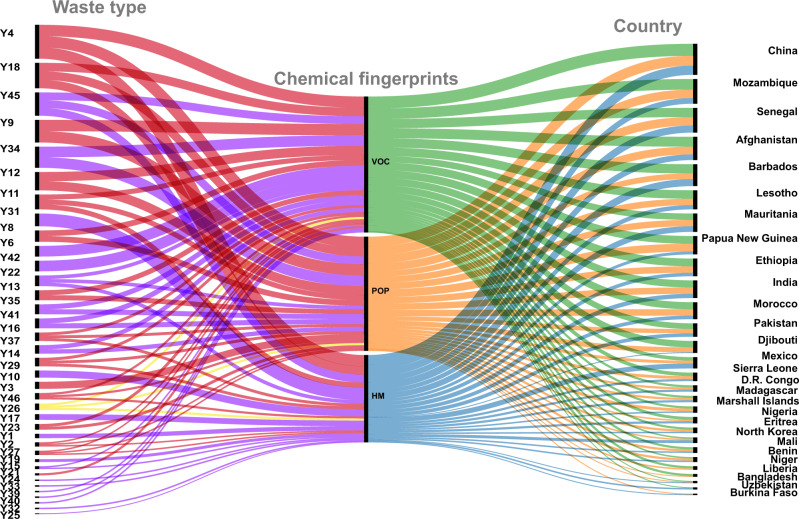
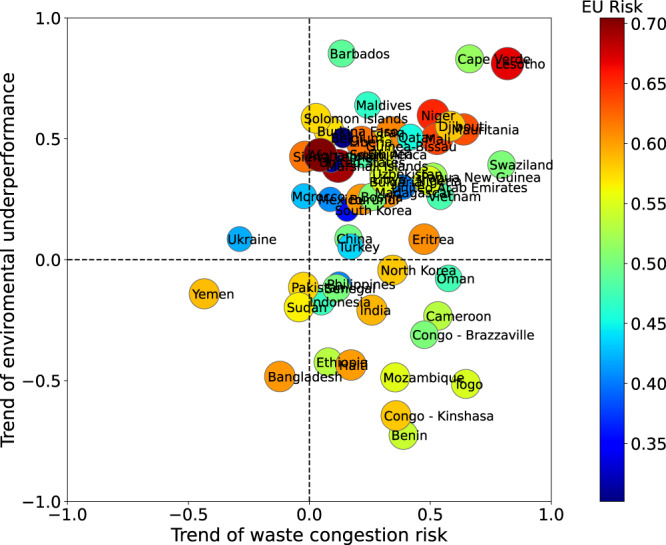
Countries globally trade with tons of waste materials every year, some of which are highly hazardous. This trade admits a network representation of the world-wide waste web, with countries as vertices and flows as directed weighted edges. Here we investigate the main properties of this network by tracking 108 categories of wastes interchanged in the period 2001-2019. Although, most of the hazardous waste was traded between developed nations, a disproportionate asymmetry existed in the flow from developed to developing countries. Using a dynamical model, we simulate how waste stress propagates through the network and affects the countries. We identify 28 countries with low Environmental Performance Index that are at high risk of waste congestion. Therefore, they are at threat of improper handling and disposal of hazardous waste. We find evidence of pollution by heavy metals, by volatile organic compounds and/or by persistent organic pollutants, which are used as chemical fingerprints, due to the improper handling of waste in several of these countries.
全球各国每年都有大量的废物进行贸易,其中一些是高度危险的。这种贸易形成了一个全球性的废物网络,其中国家是顶点,而物流则是有向加权边。在这里,我们通过追踪 2001 年至 2019 年间交换的 108 类废物,研究了这个网络的主要特性。尽管大多数危险废物是在发达国家之间进行交易的,但从发达国家流向发展中国家的废物存在不成比例的不对称性。我们使用动力学模型来模拟废物压力如何在网络中传播并影响各国。我们确定了 28 个环境绩效指数较低的国家,这些国家面临着废物拥堵的高风险。因此,它们面临着危险废物处理不当和处置不当的威胁。我们发现这些国家中的一些国家由于废物处理不当,存在重金属、挥发性有机化合物和/或持久性有机污染物污染的证据,这些污染物被用作化学指纹。