Integrative Life Sciences Doctoral Program, Virginia Commonwealth University, Richmond, Virginia, USA.
Department of Forensic Science, Virginia Commonwealth University, Richmond, Virginia, USA.
J Forensic Sci. 2022 Jul;67(4):1660-1667. doi: 10.1111/1556-4029.15029. Epub 2022 Mar 30.
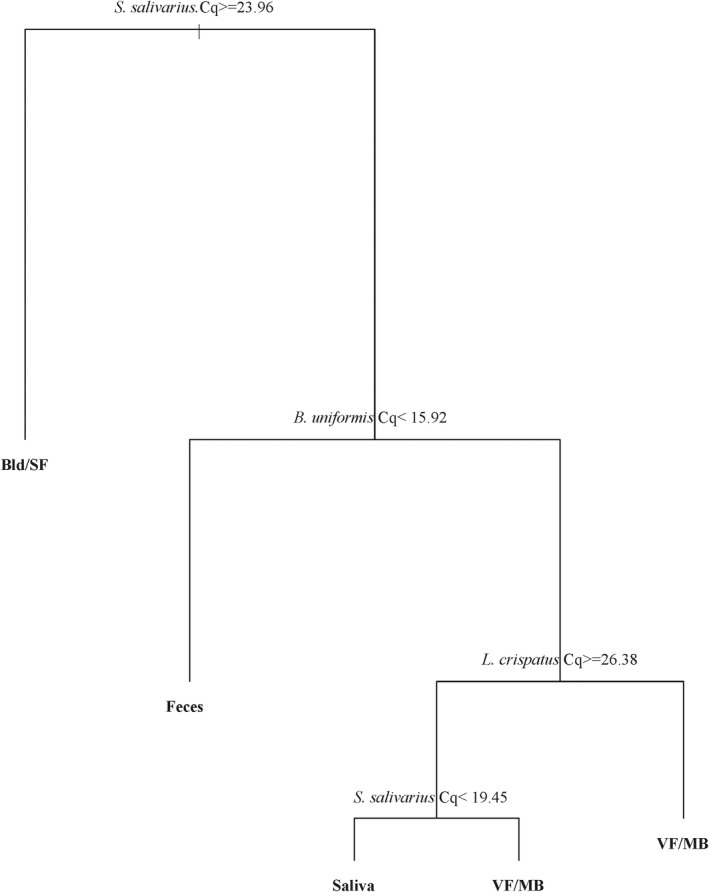
Molecular methods for body fluid identification have been extensively researched in the forensic community over the last decade, mostly focusing on RNA-based methods. Microbial DNA analysis has long been used for forensic applications, such as postmortem interval estimations, but only recently has it been applied to body fluid identification. High-throughput sequencing of the 16S ribosomal RNA gene by previous research groups revealed that microbial signatures and abundances vary across human body fluids at the genus and/or species taxonomic level. Since quantitative PCR is still the current technique used in forensic DNA analysis, the purpose of this study was to design a qPCR multiplex targeting the 16S gene of Bacteroides uniformis, Streptococcus salivarius, and Lactobacillus crispatus that can distinguish between feces, saliva, and vaginal/menstrual secretions, respectively. Primers and probes were designed at the species level because these bacteria are highly abundant within their respective fluid. The validated 16S triplex was evaluated in DNA extracts from thirty donors of each body fluid. A classification regression tree model resulted in 96.5% classification accuracy of the population data, which demonstrates the ability of this 16S triplex to presumptively identify these fluids with high confidence at the quantification step of the forensic workflow using minimal input volume of DNA extracted from evidentiary samples.
在过去的十年中,法医界一直在广泛研究用于体液鉴定的分子方法,这些方法主要集中在基于 RNA 的方法上。微生物 DNA 分析长期以来一直用于法医应用,例如死后间隔时间估计,但直到最近才被应用于体液鉴定。先前的研究小组对 16S 核糖体 RNA 基因进行高通量测序表明,在属和/或种分类水平上,微生物特征和丰度在人体不同体液中存在差异。由于定量 PCR 仍然是法医 DNA 分析中使用的当前技术,因此本研究旨在设计一种靶向 Bacteroides uniformis、Streptococcus salivarius 和 Lactobacillus crispatus 的 16S 基因的 qPCR 多重扩增方法,分别用于区分粪便、唾液和阴道/月经分泌物。由于这些细菌在各自的体液中含量丰富,因此在种水平上设计了引物和探针。经过验证的 16S 三联体在来自每种体液的三十名供体的 DNA 提取物中进行了评估。分类回归树模型对人群数据的分类准确率达到 96.5%,这表明该 16S 三联体在法医工作流程的定量步骤中,使用从证据样本中提取的最小 DNA 量,能够有信心地对这些体液进行推定识别。