Wilson-Anumudu Folasade, Quan Ryan, Cerrada Christian, Juusola Jessie, Castro Sweet Cynthia, Bradner Jasik Carolyn, Turken Michael
Omada Health, Inc, San Francisco, CA, United States.
Evidation Health, Inc, San Mateo, CA, United States.
JMIR Form Res. 2022 Mar 30;6(3):e33057. doi: 10.2196/33057.
Home-measured blood pressure (HMBP) in combination with comprehensive medication support and lifestyle change are the mainstays of evidence-based hypertension (HTN) management. To date, the precise components needed for effective HTN self-management programs have yet to be defined, and access to multicomponent targeted support for HTN management that include telemonitoring remain inaccessible and costly.
The aim of this pilot study was to evaluate the impact of a digital HTN self-management program on blood pressure (BP) control among adults with excess body weight.
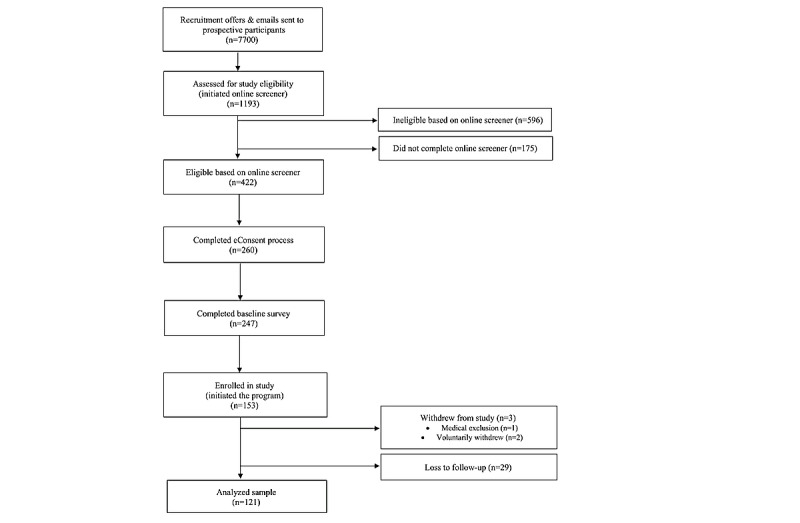
A single-arm, nonrandomized trial was performed to evaluate a digital HTN self-management program that combines comprehensive lifestyle counseling with HTN education, guided HMBP, support for taking medications, and led by either a registered nurse or certified diabetes care and education specialist. A sample of 151 participants were recruited using a web-based research platform (Achievement Studies, Evidation Health Inc). The primary outcome was change in systolic BP from baseline to 3 months, and secondary outcomes included change in diastolic BP and medication adherence.
Participants' mean age was 44.0 (SD 9.3) years and mean BP was 139/85 mm Hg. At follow-up, systolic and diastolic BP decreased by 7 mm Hg (P<.001, 95% CI -9.3 to -4.7) and 4.7 mm Hg (P<.001, 95% CI -6.3 to -3.2), respectively. Participants who started with baseline BP at goal remained at goal. For participants with stage 1 HTN, systolic and diastolic BP decreased by 3.6 mm Hg (P=.09, 95% CI -7.8 to 0.6) and 2.5 mm Hg (P=.03, 95% CI -4.9 to -0.3). Systolic and diastolic BP decreased by 10.3 mm Hg (P<.001, 95% CI -13.4 to -7.1) and 6.5 mm Hg (P<.001, 95% CI -8.6 to -4.4), respectively, for participants with stage 2 HTN. Medication adherence significantly improved (P=.02).
This pilot study provides initial evidence that a digital HTN self-management program improves BP and medication adherence.
家庭自测血压(HMBP)结合全面的药物支持和生活方式改变是循证高血压(HTN)管理的主要方法。迄今为止,有效的高血压自我管理项目所需的确切组成部分尚未明确,获得包括远程监测在内的多组分针对性高血压管理支持仍然难以实现且成本高昂。
本试点研究的目的是评估数字高血压自我管理项目对超重成年人血压(BP)控制的影响。
进行了一项单臂、非随机试验,以评估一个数字高血压自我管理项目,该项目将全面的生活方式咨询与高血压教育、指导下的家庭自测血压、用药支持相结合,并由注册护士或认证糖尿病护理和教育专家主导。使用基于网络的研究平台(成就研究,Evidation Health Inc)招募了151名参与者。主要结局是收缩压从基线到3个月的变化,次要结局包括舒张压变化和用药依从性。
参与者的平均年龄为44.0(标准差9.3)岁,平均血压为139/85 mmHg。随访时,收缩压和舒张压分别下降了7 mmHg(P<0.001,95%置信区间-9.3至-4.7)和4.7 mmHg(P<0.001,95%置信区间-6.3至-3.2)。基线血压达标的参与者在随访时仍保持达标。对于1级高血压患者,收缩压和舒张压分别下降了3.6 mmHg(P=0.09,95%置信区间-7.8至0.6)和2.5 mmHg(P=0.03,95%置信区间-4.9至-0.3)。对于2级高血压患者,收缩压和舒张压分别下降了10.3 mmHg(P<0.001,95%置信区间-13.4至-7.1)和6.5 mmHg(P<0.001,95%置信区间-8.6至-4.4)。用药依从性显著改善(P=0.02)。
这项试点研究提供了初步证据,表明数字高血压自我管理项目可改善血压和用药依从性。