Johns Hopkins University School of Medicine, Department of Emergency Medicine, Baltimore, Maryland.
Johns Hopkins University School of Medicine, Armstrong Institute for Patient Safety and Quality, Baltimore, Maryland.
West J Emerg Med. 2021 Jun 29;22(4):842-850. doi: 10.5811/westjem.2020.10.49759.
Nationally, there has been more than a 40% decrease in Emergency Department (ED) patient volume during the coronavirus disease 2019 (Covid-19) crisis, with reports of decreases in presentations of time-sensitive acute illnesses. We analyzed ED clinical presentations in a Maryland/District of Columbia regional hospital system while health mitigation measures were instituted.
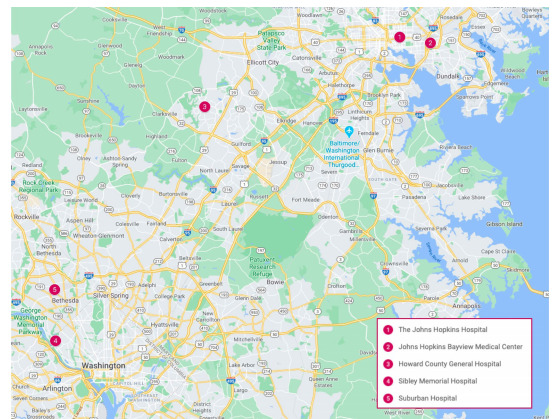
We conducted a retrospective observational cohort study of all adult ED patients presenting to five Johns Hopkins Health System (JHHS) hospitals comparing visits from March 16 through May 15, in 2019 and 2020. We analyzed de-identified demographic information, clinical conditions, and ICD-10 diagnosis codes for year-over-year comparisons.
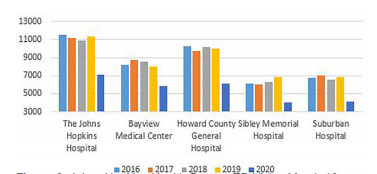
There were 36.7% fewer JHHS ED visits in 2020 compared to 2019 (43,088 vs. 27,293, P<.001). Patients 75+ had the greatest decline in visits (-44.00%, P<.001). Both genders had significant decreases in volume (-41.9%, P<.001 females vs -30.6%, P<.001 males). Influenza like illness (ILI) symptoms increased year-over-year including fever (640 to 1253, 95.8%, P<.001) and shortness of breath (2504 to 2726, 8.9%, P=.002). ICD-10 diagnoses for a number of time-sensitive illnesses decreased including deep vein thrombosis (101 to 39, -61%, P<.001), acute myocardial infarction (157 to 105, -33%, P=.002), gastrointestinal bleeding (290 to 179, -38.3%, P<.001), and strokes (284 to 234, -17.6%, P=0.03).
ED visits declined significantly among JHHS hospitals despite offsetting increases in ILI complaints. Decreases in presentations of time-sensitive illnesses were of particular concern. Efforts should be taken to inform patients that EDs are safe, otherwise preventable morbidity and mortality will remain a problem.
在 2019 冠状病毒病(COVID-19)危机期间,全国范围内急诊部(ED)患者数量下降了 40%以上,有报道称一些需要及时治疗的急性疾病就诊人数减少。在实施健康缓解措施的同时,我们分析了马里兰州/哥伦比亚特区地区医院系统的 ED 临床就诊情况。
我们对 5 家约翰霍普金斯卫生系统(JHHS)医院的所有成年 ED 患者进行了回顾性观察队列研究,比较了 2019 年 3 月 16 日至 5 月 15 日和 2020 年同期的就诊情况。我们分析了逐年比较的人口统计学信息、临床情况和 ICD-10 诊断代码。
与 2019 年相比,2020 年 JHHS ED 就诊人数减少了 36.7%(43088 例比 27293 例,P<.001)。75 岁以上患者就诊量降幅最大(-44.00%,P<.001)。男女就诊量均显著下降(-41.9%,P<.001 女性 vs -30.6%,P<.001 男性)。流感样症状(ILI)较去年同期有所增加,包括发热(640 例至 1253 例,95.8%,P<.001)和呼吸急促(2504 例至 2726 例,8.9%,P=.002)。一些时间敏感疾病的 ICD-10 诊断数量减少,包括深静脉血栓形成(101 例至 39 例,-61%,P<.001)、急性心肌梗死(157 例至 105 例,-33%,P=.002)、胃肠道出血(290 例至 179 例,-38.3%,P<.001)和中风(284 例至 234 例,-17.6%,P=0.03)。
尽管 ILI 投诉有所增加,但 JHHS 医院的 ED 就诊量显著下降。时间敏感疾病就诊人数减少尤其令人关注。应努力告知患者 ED 是安全的,否则可预防的发病率和死亡率仍将是一个问题。