Gutovitz Scott, Pangia Jonathan, Finer Alexis, Rymer Karen, Johnson Dean
Department of Emergency Medicine, Grand Strand Regional Medical Center, Myrtle Beach, South Carolina.
HCA Healthcare, Graduate Medical Education, Brentwood, Tennessee.
J Emerg Med. 2021 Jun;60(6):798-806. doi: 10.1016/j.jemermed.2021.01.002. Epub 2021 Jan 8.
The coronavirus disease 2019 (COVID-19) pandemic precipitated fear of contagion and influenced many people to avoid the emergency department (ED). It is unknown if this avoidance effected overall health or disease mortality.
We aimed to quantify the decreased ED volume in the United States, determine whether it occurred simultaneously across the country, find which types of patients decreased, and measure resultant changes in patient outcomes.
We retrospectively accessed a multihospital, multistate electronic health records database managed by HCA Healthcare to obtain a case series of all patients presenting to an ED during the early COVID-19 pandemic (March 1-May 31, 2020) and the same dates in 2019 for comparison. We determined ED volume using weekly totals and grouped them by state. We also recorded final diagnoses codes and mortality data to describe patient types and outcomes.
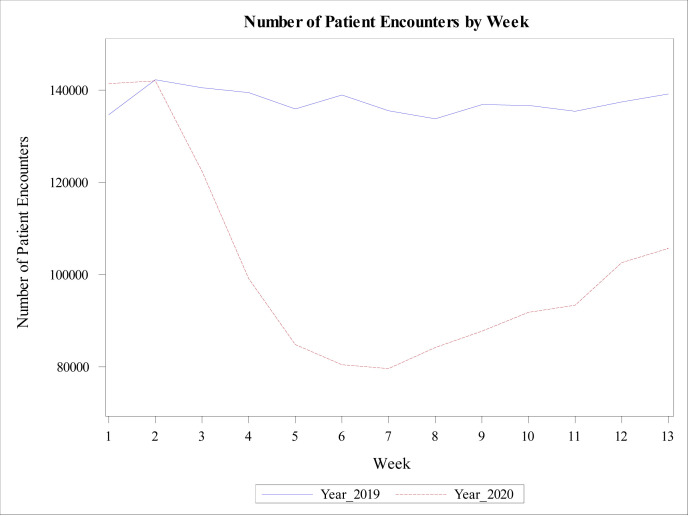
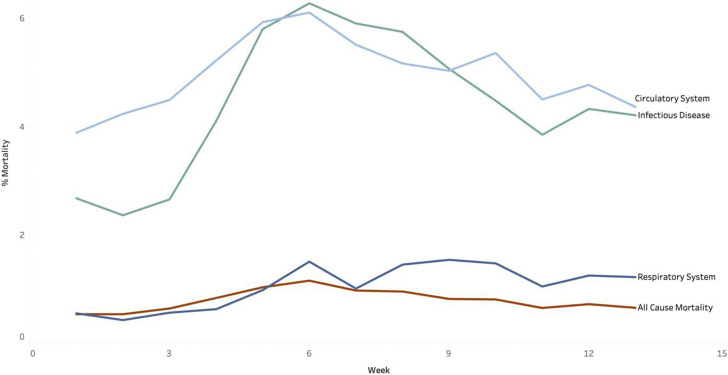
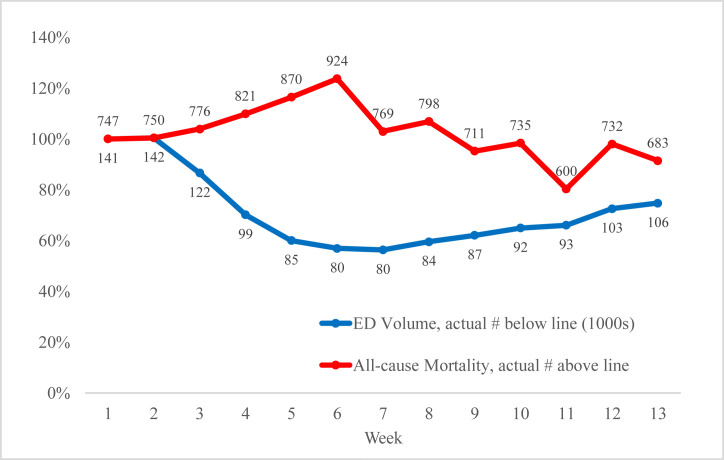
The weekly ED volume from 160 facilities dropped 44% from 141,408 patients (week 1, March 1-7, 2020) to a nadir of 79,618 patients (week 7, April 12-18, 2020), before rising back to 105,667 (week 13, May 24-30, 2020). Compared with 2019, this overall decline was statistically significant (p < 0.001). The decline was universal across disease categories except for infectious disease and respiratory illnesses, which increased. All-cause mortality increased during the pandemic, especially for those with infectious disease, circulatory, and respiratory illnesses.
The COVID-19 pandemic and an apparent fear of contagion caused a decrease in ED presentations across our hospital system. The decline in ED volume was associated with increased ED mortality, perhaps from delayed ED presentations.
2019年冠状病毒病(COVID-19)大流行引发了对感染的恐惧,并影响了许多人避免前往急诊科(ED)。尚不清楚这种回避是否影响了总体健康或疾病死亡率。
我们旨在量化美国急诊科就诊量的下降,确定其是否在全国同时发生,找出哪些类型的患者就诊量下降,并衡量患者结局的相应变化。
我们回顾性访问了由HCA医疗保健公司管理的多医院、多州电子健康记录数据库,以获取在COVID-19大流行早期(2020年3月1日至5月31日)以及2019年相同日期前往急诊科就诊的所有患者的病例系列,以便进行比较。我们使用每周总数确定急诊科就诊量,并按州进行分组。我们还记录了最终诊断代码和死亡率数据,以描述患者类型和结局。
160家医疗机构的每周急诊科就诊量从141,408名患者(第1周,2020年3月1日至7日)下降了44%,降至最低点79,618名患者(第7周,2020年4月12日至18日),然后回升至105,667名患者(第13周,20年5月24日至30日)。与2019年相比,这种总体下降具有统计学意义(p < 0.001)。除传染病和呼吸道疾病就诊量增加外,各疾病类别的就诊量均普遍下降。大流行期间全因死亡率上升,尤其是患有传染病、循环系统疾病和呼吸道疾病的患者。
COVID-19大流行以及明显的感染恐惧导致我们医院系统的急诊科就诊量减少。急诊科就诊量的下降与急诊科死亡率增加有关,这可能是由于急诊科就诊延迟所致。