Paediatric Nephrology Centre, Hong Kong Children's Hospital, Hong Kong SAR.
Department of Paediatrics and Adolescent Medicine, University of Hong Kong, Hong Kong SAR.
J Am Soc Nephrol. 2022 Jun;33(6):1193-1207. doi: 10.1681/ASN.2021111472. Epub 2022 Mar 30.
Long-term outcomes after multiple courses of rituximab among children with frequently relapsing, steroid-dependent nephrotic syndrome (FRSDNS) are unknown.
A retrospective cohort study at 16 pediatric nephrology centers from ten countries in Asia, Europe, and North America included children with FRSDNS who received two or more courses of rituximab. Primary outcomes were relapse-free survival and adverse events.
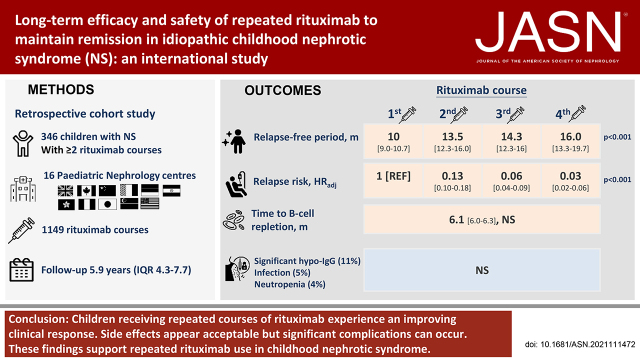
A total of 346 children (age, 9.8 years; IQR, 6.6-13.5 years; 73% boys) received 1149 courses of rituximab. A total of 145, 83, 50, 28, 22, and 18 children received two, three, four, five, six, and seven or more courses, respectively. Median (IQR) follow-up was 5.9 (4.3-7.7) years. Relapse-free survival differed by treatment courses (clustered log-rank test <0.001). Compared with the first course (10.0 months; 95% CI, 9.0 to 10.7 months), relapse-free period and relapse risk progressively improved after subsequent courses (12.0-16.0 months; HR, 0.03-0.13; 95% CI, 0.01 to 0.18; <0.001). The duration of B-cell depletion remained similar with repeated treatments (6.1 months; 95% CI, 6.0 to 6.3 months). Adverse events were mostly mild; the most common adverse events were hypogammaglobulinemia (50.9%), infection (4.5%), and neutropenia (3.7%). Side effects did not increase with more treatment courses nor a higher cumulative dose. Only 78 of the 353 episodes of hypogammaglobulinemia were clinically significant. Younger age at presentation (2.8 versus 3.3 years; =0.05), age at first rituximab treatment (8.0 versus 10.0 years; 0.01), and history of steroid resistance (28% versus 18%; =0.01) were associated with significant hypogammaglobulinemia. All 53 infective episodes resolved, except for one patient with hepatitis B infection and another with EBV infection. There were 42 episodes of neutropenia, associated with history of steroid resistance (30% versus 20%; =0.04). Upon last follow-up, 332 children (96%) had normal kidney function.
Children receiving repeated courses of rituximab for FRSDNS experience an improving clinical response. Side effects appear acceptable, but significant complications can occur. These findings support repeated rituximab use in FRSDNS.
儿童频复发激素依赖型肾病综合征(FRSDNS)多次接受利妥昔单抗治疗后的长期结局尚不清楚。
这项在亚洲、欧洲和北美 16 个儿科肾脏病中心进行的回顾性队列研究纳入了接受 2 次或以上利妥昔单抗治疗的 FRSDNS 患儿。主要结局为无复发生存率和不良事件。
共纳入 346 例患儿(年龄 9.8 岁,IQR:6.613.5 岁;73%为男性),接受了 1149 次利妥昔单抗治疗。分别有 145、83、50、28、22 和 18 例患儿接受了 2、3、4、5、6 和 7 次或以上治疗。中位(IQR)随访时间为 5.9(4.37.7)年。无复发生存率因治疗疗程而异(聚类对数秩检验<0.001)。与第 1 疗程(10.0 个月,95%CI:9.010.7 个月)相比,后续疗程的无复发生存期和复发风险逐渐改善(12.016.0 个月,HR:0.030.13;95%CI:0.010.18;<0.001)。重复治疗后 B 细胞耗竭的持续时间相似(6.1 个月,95%CI:6.0~6.3 个月)。不良事件多为轻度;最常见的不良事件为低丙种球蛋白血症(50.9%)、感染(4.5%)和中性粒细胞减少症(3.7%)。不良事件的发生频率并未随治疗疗程的增加或累积剂量的增加而升高。在 353 次低丙种球蛋白血症发作中仅有 78 次具有临床意义。发病年龄较小(2.8 岁 vs 3.3 岁,=0.05)、首次利妥昔单抗治疗年龄较小(8.0 岁 vs 10.0 岁,=0.01)和存在激素抵抗史(28% vs 18%,=0.01)与显著的低丙种球蛋白血症相关。所有 53 例感染发作均得到缓解,除 1 例乙型肝炎感染和 1 例 EBV 感染患者外。中性粒细胞减少症共发生 42 次,与激素抵抗史相关(30% vs 20%,=0.04)。末次随访时,332 例患儿(96%)肾功能正常。
儿童频复发激素依赖型肾病综合征多次接受利妥昔单抗治疗可获得改善的临床应答。不良事件似乎是可接受的,但可能出现严重并发症。这些发现支持利妥昔单抗在 FRSDNS 中的重复应用。