Department of Clinical Oncology, Guy's Cancer Centre and School of Cancer and Pharmaceutical Sciences, King's College London University, London, United Kingdom.
Amsterdam UMC, Vrije Universiteit Amsterdam, Department of Epidemiology and Data Science, Amsterdam Public Health Research Institute, Amsterdam, the Netherlands.
J Clin Oncol. 2022 Jul 20;40(21):2352-2360. doi: 10.1200/JCO.21.02063. Epub 2022 Mar 31.
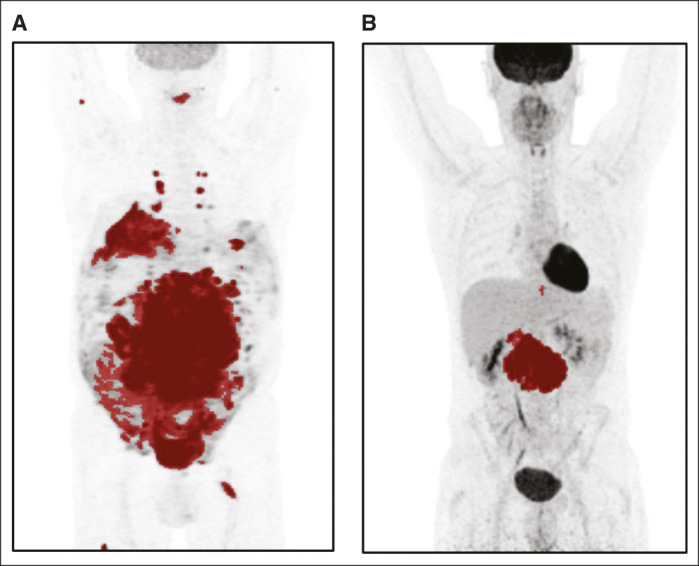
Baseline metabolic tumor volume (MTV) is a promising biomarker in diffuse large B-cell lymphoma (DLBCL). Our aims were to determine the best statistical relationship between MTV and survival and to compare MTV with the International Prognostic Index (IPI) and its individual components to derive the best prognostic model.
PET scans and clinical data were included from five published studies in newly diagnosed diffuse large B-cell lymphoma. Transformations of MTV were compared with the primary end points of 3-year progression-free survival (PFS) and overall survival (OS) to derive the best relationship for further analyses. MTV was compared with IPI categories and individual components to derive the best model. Patients were grouped into three groups for survival analysis using Kaplan-Meier analysis; 10% at highest risk, 30% intermediate risk, and 60% lowest risk, corresponding with expected clinical outcome. Validation of the best model was performed using four studies as a test set and the fifth study for validation and repeated five times.
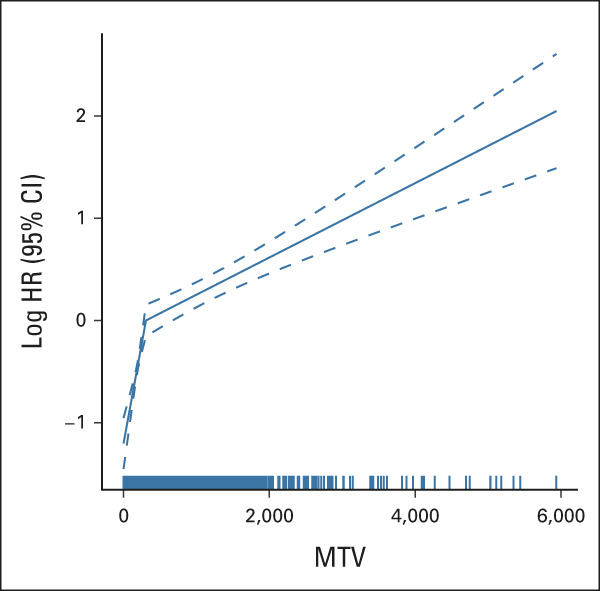
The best relationship for MTV and survival was a linear spline model with one knot located at the median MTV value of 307.9 cm. MTV was a better predictor than IPI for PFS and OS. The best model combined MTV with age as continuous variables and individual stage as I-IV. The MTV-age-stage model performed better than IPI and was also better at defining a high-risk group (3-year PFS 46.3% 58.0% and 3-year OS 51.5% 66.4% for the new model and IPI, respectively). A regression formula was derived to estimate individual patient survival probabilities.
A new prognostic index is proposed using MTV, age, and stage, which outperforms IPI and enables individualized estimates of patient outcome.
基线代谢肿瘤体积(MTV)是弥漫性大 B 细胞淋巴瘤(DLBCL)有前途的生物标志物。我们的目的是确定 MTV 与生存之间的最佳统计关系,并将 MTV 与国际预后指数(IPI)及其各个组成部分进行比较,以得出最佳的预后模型。
纳入了来自五个已发表的弥漫性大 B 细胞淋巴瘤新诊断研究的 PET 扫描和临床数据。将 MTV 的转换与 3 年无进展生存(PFS)和总生存(OS)的主要终点进行比较,以得出进一步分析的最佳关系。将 MTV 与 IPI 类别和各个组成部分进行比较,以得出最佳模型。使用 Kaplan-Meier 分析对生存进行分析,将患者分为三组;最高风险组占 10%,中间风险组占 30%,最低风险组占 60%,与预期的临床结果相对应。使用四个研究作为测试集,第五个研究进行验证和重复五次,对最佳模型进行验证。
MTV 与生存的最佳关系是一个线性样条模型,其中一个结位于 307.9 cm 的 MTV 中位数处。MTV 是 PFS 和 OS 的更好预测因子。最佳模型将 MTV 与年龄作为连续变量以及个体分期作为 I-IV 相结合。MTV-年龄-分期模型的性能优于 IPI,并且更擅长定义高危组(新模型和 IPI 的 3 年 PFS 分别为 46.3%、58.0%和 3 年 OS 分别为 51.5%、66.4%)。还推导出了一个回归公式来估计个体患者的生存概率。
提出了一种使用 MTV、年龄和分期的新预后指数,该指数优于 IPI,并且能够对患者的个体预后进行估计。