Council of State and Territorial Epidemiologists, Atlanta, Georgia.
MMWR Morb Mortal Wkly Rep. 2022 Apr 1;71(13):484-488. doi: 10.15585/mmwr.mm7113a2.
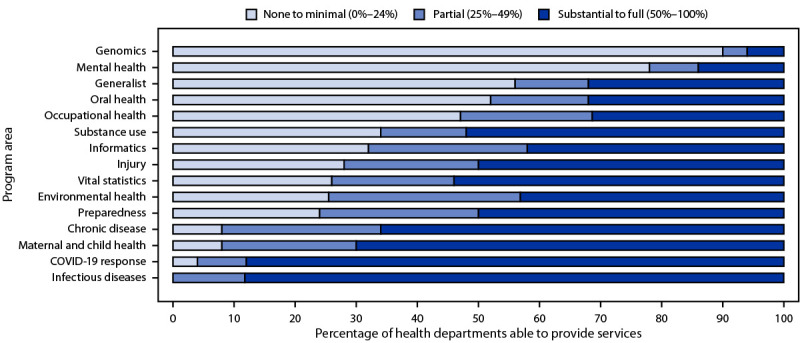
In 2021, during the COVID-19 response, the Council of State and Territorial Epidemiologists (CSTE) conducted its seventh periodic Epidemiology Capacity Assessment (ECA), a national assessment that evaluates trends in applied epidemiology workforce size, funding, and epidemiology capacity at state health departments.* A standardized web-based questionnaire was sent to state epidemiologists in 50 states and the District of Columbia (DC). The questionnaire assessed the number of current and optimal epidemiologist positions; sources of epidemiology activity and personnel funding; and each health department's self-perceived capacity to lead activities, provide subject matter expertise, and obtain and manage resources for the three essential public health services (EPHS) most closely linked to epidemiology. CSTE enumerated 4,136 epidemiology positions across the United States, with an additional 2,196 positions needed to provide basic public health services. From 2017 to 2021, the number of epidemiologists in state health departments increased 23%, an increase primarily accounted for by the number of those supporting the COVID-19 response. The number of staff members decreased in program areas of infectious diseases, chronic diseases, and maternal and child health (MCH). Federal funding supports most epidemiology activities (85%) and epidemiology personnel (83%). Overall capacity to deliver the EPHS has declined, and epidemiology workforce and capacity needs remain unmet. More epidemiologists and sustainable funding are needed to consistently and effectively deliver EPHS. Additional resources (e.g., funding for competitive compensation and pathways for career advancement) are essential for recruitment and retention of epidemiologists to support public health activities across all program areas.
2021 年,在应对 COVID-19 的过程中,州和地方流行病学家理事会(CSTE)进行了第七次定期流行病学能力评估(ECA),这是一项全国性评估,评估了州卫生部门应用流行病学人员规模、资金和流行病学能力的趋势。*向 50 个州和哥伦比亚特区(DC)的州流行病学家发送了标准化的网络问卷。问卷评估了当前和最佳流行病学家职位的数量;流行病学活动和人员资金的来源;以及每个卫生部门在领导活动、提供专题知识专长以及为与流行病学最密切相关的三项基本公共卫生服务(EPHS)获取和管理资源方面的自我感知能力。CSTE 在美国各地列举了 4136 个流行病学职位,还需要增加 2196 个职位来提供基本公共卫生服务。从 2017 年到 2021 年,州卫生部门的流行病学家人数增加了 23%,这主要是由于支持 COVID-19 应对的人数增加。传染病、慢性病和母婴健康(MCH)等项目领域的工作人员人数减少。联邦资金支持大多数流行病学活动(85%)和流行病学人员(83%)。提供 EPHS 的总体能力下降,流行病学人员和能力需求仍然未得到满足。需要更多的流行病学家和可持续的资金来持续有效地提供 EPHS。需要更多的资源(例如,有竞争力的薪酬和职业发展途径的资金)来招聘和留住流行病学家,以支持所有项目领域的公共卫生活动。