Miller Kevin C, Hall Aric C, Cohen-Bucay Abraham, Chen Yi-Bin
Department of Medicine, Massachusetts General Hospital, Boston, MA, United States.
Division of Hematology, Medical Oncology and Palliative Care, University of Wisconsin School of Medicine and Public Health, Madison, WI, United States.
Leuk Res Rep. 2022 Mar 17;17:100302. doi: 10.1016/j.lrr.2022.100302. eCollection 2022.
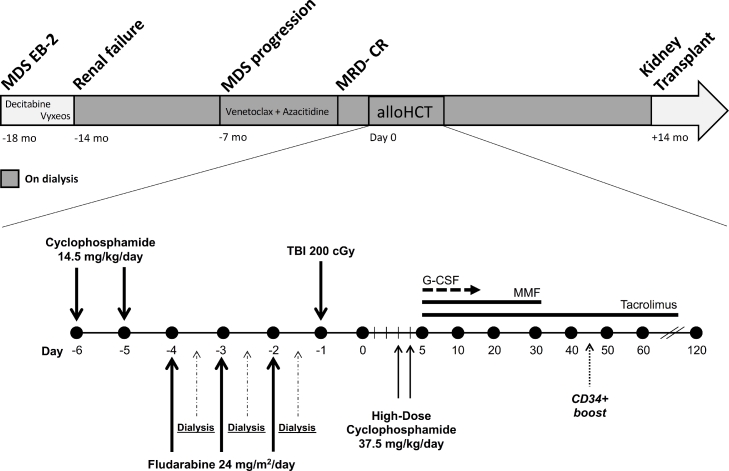
Patients with end-stage renal disease (ESRD) are often excluded from potentially curative allogeneic hematopoietic cell transplantation (alloHCT). Our institution pioneered simultaneous living donor kidney transplantation in patients undergoing alloHCT from the same donor for hematologic malignancies. Herein, we present the case of a 31-year-old woman diagnosed with myelodysplastic syndrome who developed ESRD during cytoreductive induction therapy. She achieved disease control, then successfully underwent a human leukocyte antigen (HLA)-haploidentical alloHCT while on hemodialysis. After rapidly tapering off graft-versus-host disease prophylaxis, fourteen months from her alloHCT she received a kidney transplant from her same haploidentical sibling donor, which obviated the need for further systemic immunosuppression.
终末期肾病(ESRD)患者通常被排除在可能治愈性的异基因造血细胞移植(alloHCT)之外。我们机构率先在因血液系统恶性肿瘤接受来自同一供体的alloHCT的患者中同时进行活体供肾移植。在此,我们报告一例31岁女性,她被诊断为骨髓增生异常综合征,在细胞减灭诱导治疗期间发展为ESRD。她实现了疾病控制,然后在血液透析期间成功接受了人类白细胞抗原(HLA)单倍体相合的alloHCT。在迅速减少移植物抗宿主病预防用药后,alloHCT术后14个月,她接受了来自同一单倍体相合同胞供体的肾移植,从而无需进一步的全身免疫抑制。