Al-Mozaini Maha Ahmed, Islam Mihyar, Noman Abu Shadat M, Karim Atm Rezaul, Farhat Walid A, Yeger Herman, Islam Syed S
Department of Infectious Disease and Immunity, King Faisal Specialist Hospital and Research Centre, Riyadh, Saudi Arabia.
Department of Medicine, Parkview Hospital, Chittagong, Bangladesh.
Front Med (Lausanne). 2022 Mar 10;9:835098. doi: 10.3389/fmed.2022.835098. eCollection 2022.
Patients recovering from severe acute respiratory syndrome coronavirus 2 (SARS-CoV-2) infection demonstrate impaired lung function and those requiring chemotherapy after recovering from SARS-CoV-2 infection have yet to be explored. In this study, we sought to investigate the possible pulmonary functional changes during and after administering chemotherapy in patients with prior SARS-CoV-2 infection.
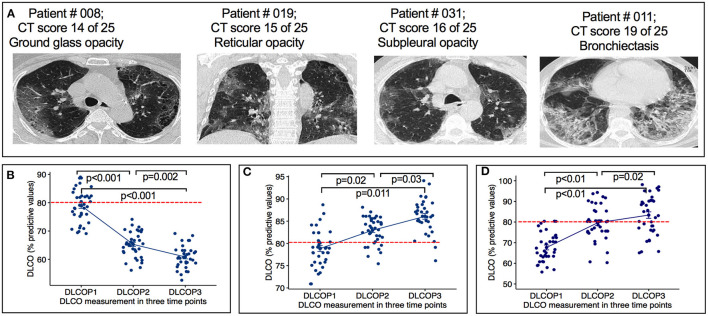
In this study, a total of 37 SARS-CoV-2 infected patients with cancer who were discharged from hospital and received subsequent cytotoxic chemotherapy were enrolled and prospectively followed-up. The following parameters were prospectively measured before (P1), after first chemotherapy cycle (P2), and 10 weeks after the end of chemotherapy (P3), to assess their impact on respiratory complications in terms of diffusion capacity of the lungs for carbon monoxide (DLCO), forced expiratory volume in 1-s (FEV1), forced vital capacity (FVC), 6-min walking distance (6MWD) test and levels of key inflammatory markers.
All patients completed at least 2 cycles of chemotherapy without showing overt respiratory complications. Six patients (16%) complained about dyspnea during chemotherapy or at follow-up period. DLCO was significantly impaired during follow-up period [from P1 78 to P3 60% of predicted values; interquartile range (IQR) 55-89] and in 32 of 37 (86% of patients) from P1 to P2 (65% of predictive value; IQR 58-70; < 0.001). Several patients experienced post-chemotherapy respiratory complications. As expected, all patients from control groups showed persistent improved pulmonary functions.
The risk of pulmonary impairments due to cytotoxic chemotherapy in prior SARS-CoV-2 infected patients is linked to the loss of DLCO. Accordingly, we recommend that for patients with cancer requiring chemotherapy after recovering from prior SARS-CoV-2 infection, pulmonary tests to be performed routinely before and during chemotherapy treatment to monitor the pulmonary performance.
从严重急性呼吸综合征冠状病毒2(SARS-CoV-2)感染中康复的患者表现出肺功能受损,而SARS-CoV-2感染康复后需要化疗的患者情况尚未得到研究。在本研究中,我们试图调查既往感染SARS-CoV-2的患者在化疗期间及化疗后可能出现的肺功能变化。
本研究共纳入37例从SARS-CoV-2感染中康复并出院后接受细胞毒性化疗的癌症患者,并对其进行前瞻性随访。前瞻性测量以下参数:化疗前(P1)、第一个化疗周期后(P2)和化疗结束后10周(P3),以评估其对呼吸并发症的影响,评估指标包括肺一氧化碳弥散量(DLCO)、第1秒用力呼气容积(FEV1)、用力肺活量(FVC)、6分钟步行距离(6MWD)测试以及关键炎症标志物水平。
所有患者至少完成了2个周期的化疗,未出现明显的呼吸并发症。6例患者(16%)在化疗期间或随访期间抱怨有呼吸困难。随访期间DLCO显著受损[从P1时预测值的78%降至P3时的60%;四分位间距(IQR)55 - 89],37例患者中有32例(86%)从P1到P2时DLCO受损(预测值的65%;IQR 58 - 70;P < 0.001)。部分患者出现化疗后呼吸并发症。正如预期的那样,对照组所有患者的肺功能持续改善。
既往感染SARS-CoV-2的患者因细胞毒性化疗导致肺功能损害的风险与DLCO降低有关。因此,我们建议,对于既往感染SARS-CoV-2康复后需要化疗的癌症患者,在化疗前和化疗期间应常规进行肺部检查,以监测肺功能表现。