Department of Orthopedics, Shanghai Sixth People's Hospital, 200233 Shanghai, China.
Jt Dis Relat Surg. 2022;33(1):40-50. doi: 10.52312/jdrs.2022.502. Epub 2022 Mar 28.
In this study, we present a specified hinge positioning method to achieve satisfying and steerable lengthening and angulation to correct forearm multiple hereditary exostoses (MHE) combined with severe radiocapitellar joint dislocation using Ilizarov ring fixators.
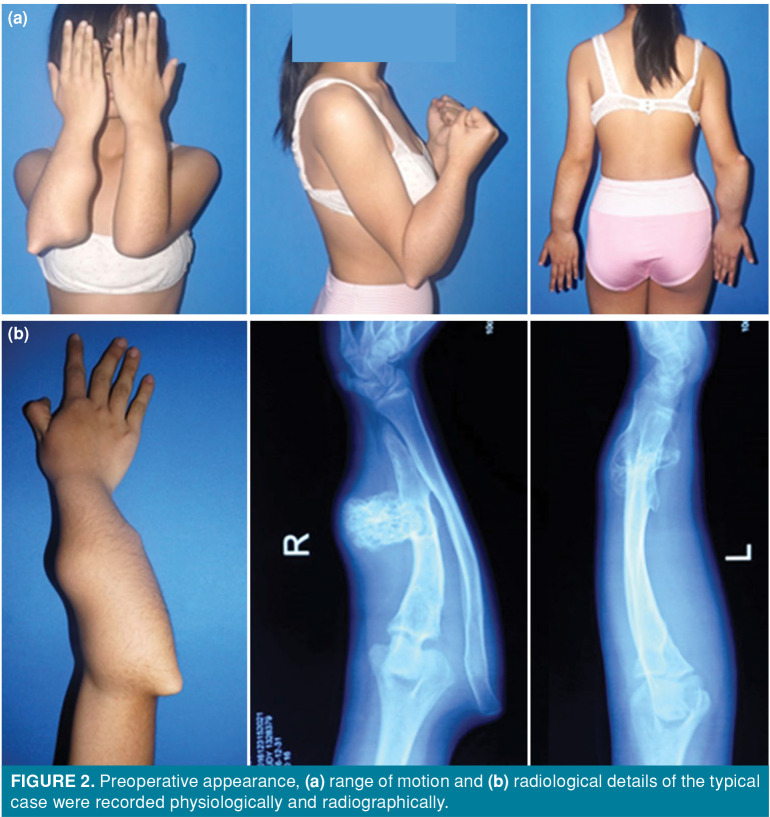
Between January 2014 and December 2018, a total of 30 forearms of 23 patients (11 males, 12 females; mean age: 18.3±6.8 years; range, 8 to 35 years) who suffered from type IIa (n=2) or IIb (n=28) MHE with severe radiocapitellar joint luxation were retrospectively analyzed. All patients were treated with Ilizarov external fixators with our specified hinge positioning method. Range of motion of the elbow, forearm and wrist and Visual Analog Scale (VAS), as well as Disabilities of Arm, Shoulder, and Hand (DASH) score, and radiological parameters, including radial articular angle (RAA), ulnar variance (UV) and carpi slip (CS), were recorded preoperatively and at final follow-up and were compared.
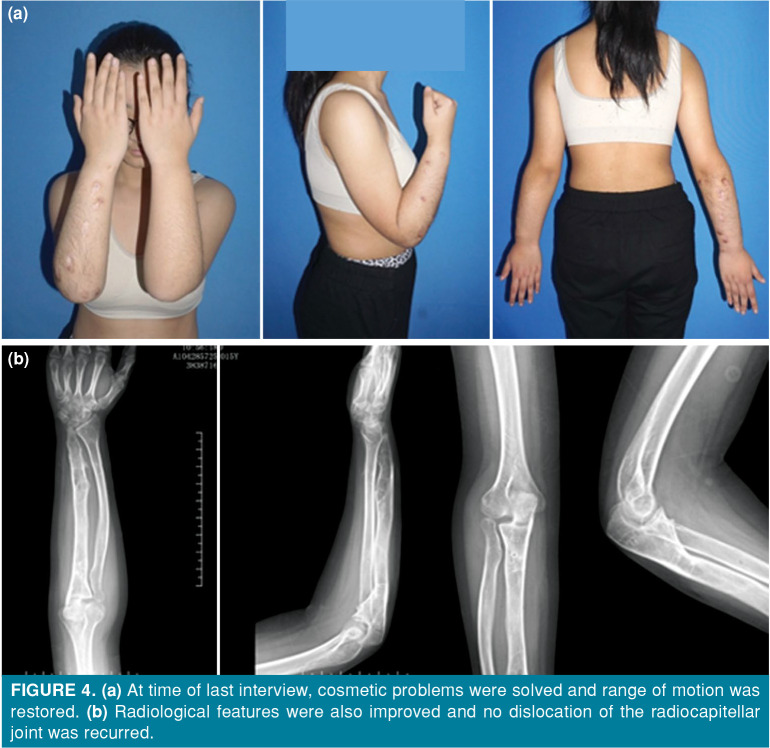
Clinical and radiological outcomes were evaluated. Range of motion of the elbow, forearm and wrist, VAS, DASH and radiological features, including RAA, CS, and UV were significantly improved, except for range of motion of the forearm supination. Temporary nail track infection was seen in two of the forearms and was controlled with oral antibiotics. None of the patients developed radial head dislocation again.
Clinical and radiological outcomes of this novel hinge positioning method are satisfactory in treating MHE with severe radial head dislocation, and this method can be an alternative treatment for MHE by setting a milestone for accurate radiocapitellar joint reduction.
本研究旨在介绍一种特定的铰链定位方法,使用 Ilizarov 环形固定器治疗前臂多发性遗传性外生骨疣(MHE)合并严重桡尺骨小头关节脱位,以实现满意的可调节延长和角度矫正。
2014 年 1 月至 2018 年 12 月,回顾性分析了 23 例(男 11 例,女 12 例;平均年龄 18.3±6.8 岁;8 至 35 岁)2 型 a(n=2)或 2 型 b(n=28)MHE 合并严重桡尺骨小头关节脱位患者的 30 例前臂。所有患者均采用 Ilizarov 外固定架,采用特定的铰链定位方法治疗。术前及末次随访时记录肘关节、前臂和腕关节活动度、视觉模拟评分(VAS)、手臂、肩部和手残疾(DASH)评分及影像学参数,包括桡骨关节角(RAA)、尺侧骨间隙(UV)和腕骨滑动(CS)。
评估临床和影像学结果。肘关节、前臂和腕关节活动度、VAS、DASH 和影像学特征,包括 RAA、CS 和 UV 均显著改善,仅前臂旋后活动度无改善。2 例前臂出现暂时的钉道感染,经口服抗生素控制。所有患者均未再次发生桡骨头脱位。
该新型铰链定位方法治疗严重桡骨小头脱位的 MHE 临床和影像学效果满意,为准确复位桡尺骨小头关节提供了里程碑,可作为 MHE 的一种替代治疗方法。