Fraser Douglas D, Cepinskas Gediminas, Slessarev Marat, Martin Claudio M, Daley Mark, Patel Maitray A, Miller Michael R, Patterson Eric K, O'Gorman David B, Gill Sean E, Higgins Ian, John Julius P P, Melo Christopher, Nini Lylia, Wang Xiaoqin, Zeidler Johannes, Cruz-Aguado Jorge A
Lawson Health Research Institute, London, ON N6C 2R5, Canada.
Department of Pediatrics, Western University, London, ON N6A 3K7, Canada.
Pathophysiology. 2021 May 17;28(2):212-223. doi: 10.3390/pathophysiology28020014.
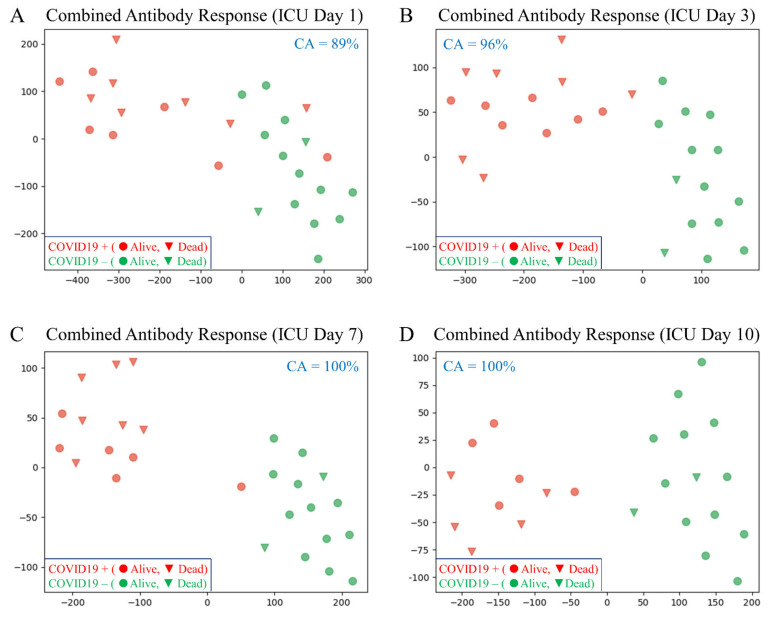
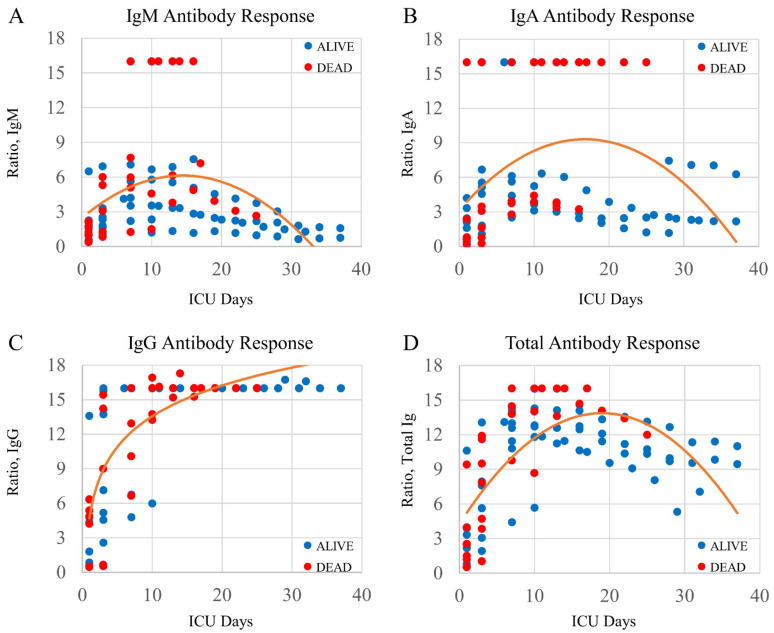
Coronavirus disease 2019 (COVID-19), caused by SARS-CoV-2, is a global health care emergency. Anti-SARS-CoV-2 serological profiling of critically ill COVID-19 patients was performed to determine their humoral response. Blood was collected from critically ill ICU patients, either COVID-19 positive (+) or COVID-19 negative (-), to measure anti-SARS-CoV-2 immunoglobulins: IgM; IgA; IgG; and Total Ig (combined IgM/IgA/IgG). Cohorts were similar, with the exception that COVID-19+ patients had a greater body mass indexes, developed bilateral pneumonias more frequently and suffered increased hypoxia when compared to COVID-19- patients ( < 0.05). The mortality rate for COVID-19+ patients was 50%. COVID-19 status could be determined by anti-SARS-CoV-2 serological responses with excellent classification accuracies on ICU day 1 (89%); ICU day 3 (96%); and ICU days 7 and 10 (100%). The importance of each Ig isotype for determining COVID-19 status on combined ICU days 1 and 3 was: Total Ig, 43%; IgM, 27%; IgA, 24% and IgG, 6%. Peak serological responses for each Ig isotype occurred on different ICU days (IgM day 13 > IgA day 17 > IgG persistently increased), with the Total Ig peaking at approximately ICU day 18. Those COVID-19+ patients who died had earlier or similar peaks in IgA and Total Ig in their ICU stay when compared to patients who survived ( < 0.005). Critically ill COVID-19 patients exhibit anti-SARS-CoV-2 serological responses, including those COVID-19 patients who ultimately died, suggesting that blunted serological responses did not contribute to mortality. Serological profiling of critically ill COVID-19 patients may aid disease surveillance, patient cohorting and help guide antibody therapies such as convalescent plasma.
由严重急性呼吸综合征冠状病毒2型(SARS-CoV-2)引起的2019冠状病毒病(COVID-19)是一场全球医疗保健紧急事件。对重症COVID-19患者进行了抗SARS-CoV-2血清学分析,以确定他们的体液反应。从重症监护病房(ICU)的重症患者中采集血液,这些患者COVID-19检测呈阳性(+)或阴性(-),以检测抗SARS-CoV-2免疫球蛋白:IgM、IgA、IgG和总Ig(IgM/IgA/IgG总和)。各队列情况相似,但与COVID-19阴性患者相比,COVID-19阳性患者的体重指数更高,双侧肺炎发生率更高,缺氧情况更严重(P<0.05)。COVID-19阳性患者的死亡率为50%。在ICU第1天(89%)、第3天(96%)以及第7天和第10天(100%),通过抗SARS-CoV-2血清学反应可确定COVID-19状态,分类准确率很高。在ICU第1天和第3天综合判断时,各Ig同种型对确定COVID-19状态的重要性分别为:总Ig,43%;IgM,27%;IgA,24%;IgG,6%。每种Ig同种型的血清学反应峰值出现在不同的ICU天数(IgM在第13天>IgA在第17天>IgG持续升高),总Ig在ICU第18天左右达到峰值。与存活患者相比,那些死亡的COVID-19阳性患者在ICU住院期间IgA和总Ig的峰值出现得更早或相似(P<0.005)。重症COVID-19患者表现出抗SARS-CoV-2血清学反应,包括那些最终死亡的COVID-19患者,这表明血清学反应减弱并非导致死亡的原因。对重症COVID-19患者进行血清学分析可能有助于疾病监测、患者分组,并有助于指导诸如康复血浆等抗体治疗。