Department of Obstetrics and Gynecology, Reproductive Medicine Center, the First Affiliated Hospital of Anhui Medical University, No 218 Jixi Road, Hefei, 230022, Anhui, China.
NHC Key Laboratory of Study On Abnormal Gametes and Reproductive Tract (Anhui Medical University), No 81 Meishan Road, Hefei, 230032, Anhui, China.
Reprod Biol Endocrinol. 2022 Apr 2;20(1):63. doi: 10.1186/s12958-022-00936-z.
Non-obstructive azoospermia (NOA) is the most severe type of male infertility, affecting 1% of men worldwide. Most of its etiologies remain idiopathic. Although genetic studies have identified dozens of NOA genes, monogenic mutations can also account for a small proportion of idiopathic NOA cases. Hence, this genetic study was conducted to explore the causes of monogenic variants of NOA in a cohort of Chinese patients.
Following the screening using chromosomal karyotyping, Y chromosome microdeletion analyses, and sex hormone assessments, subsequent whole-exome sequencing analysis was performed in 55 unrelated idiopathic NOA patients with male infertility to explore potential deleterious variants associated with spermatogenesis. We also performed Sanger sequencing to demonstrate the variants. Testicular biopsy or microsurgical testicular sperm extraction was also performed to confirm the diagnosis of NOA and identify spermatozoa. Hematoxylin and eosin staining was performed to assess the histopathology of spermatogenesis.
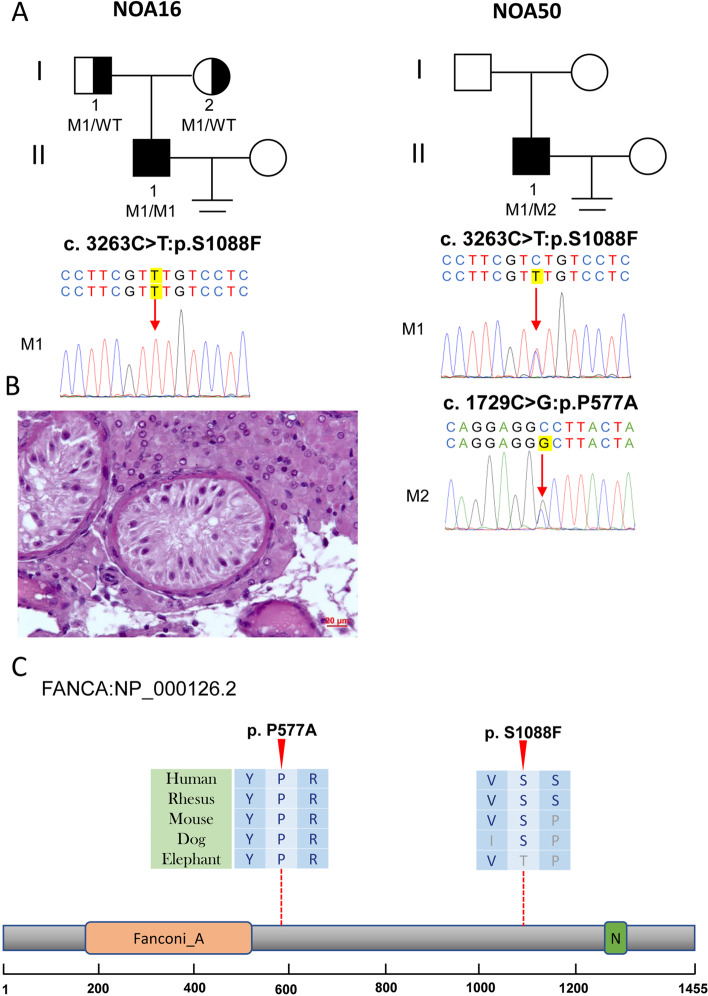
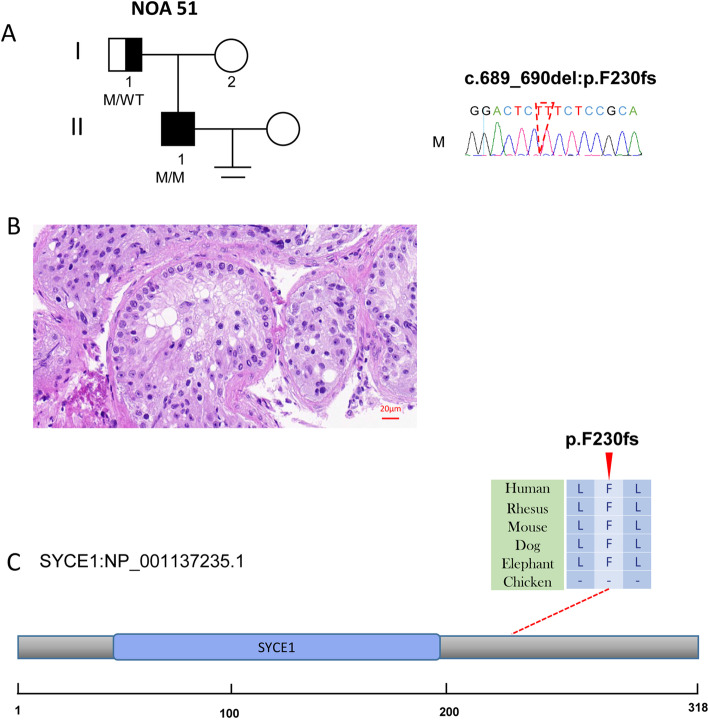
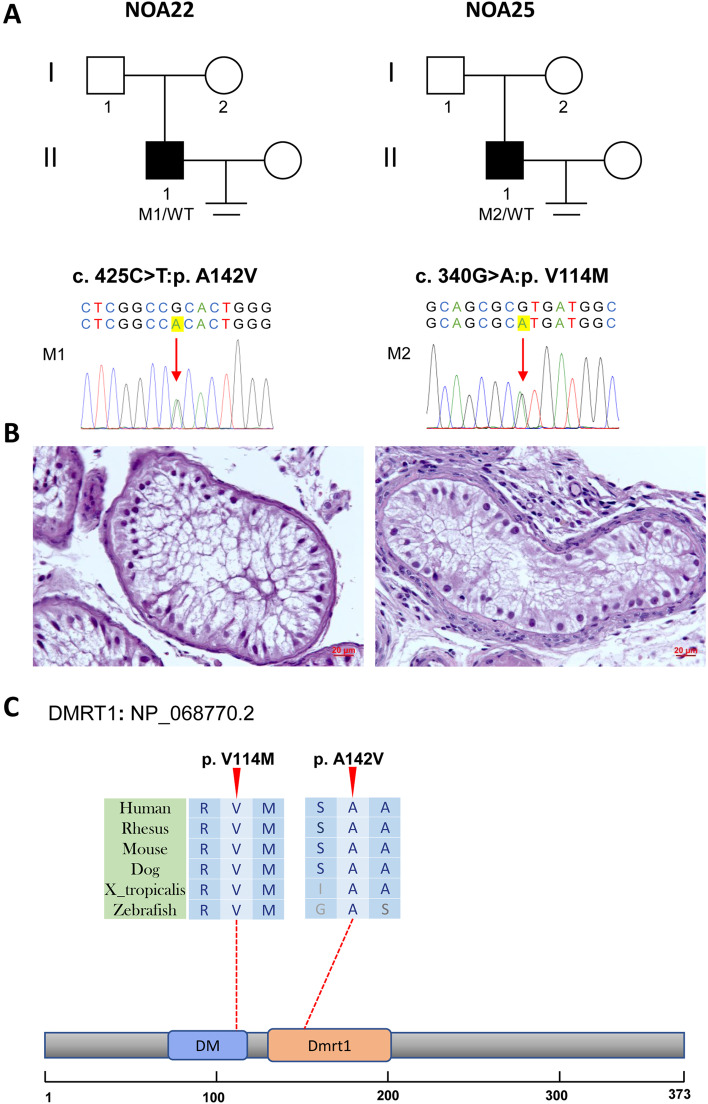
Abnormal testicular pathological phenotypes included Sertoli cell-only syndrome, maturation arrest, and hypospermatogenesis. Using bioinformatics analysis, we detected novel variants in two recessive genes, FANCA (NM_000135, c.3263C > T, c.1729C > G) and SYCE1 (NM_001143763, c.689_690del); one X-linked gene, TEX11 (NM_031276, c.466A > G, c.559_560del); and two dominant genes, DMRT1 (NM_021951, c.425C > T, c.340G > A) and PLK4 (NM_001190799, c.2785A > G), in eight patients, which corresponded to 14.55% (8/55) of the patients.
This study presented some novel variants of known pathogenic genes for NOA. Further, it expanded the variant spectrum of NOA patients, which might advance clinical genetic counseling in the future.
非阻塞性无精子症(NOA)是男性不育症中最严重的类型,影响全球 1%的男性。其大多数病因仍然是特发性的。尽管遗传研究已经确定了数十种 NOA 基因,但单基因突变也可能占特发性 NOA 病例的一小部分。因此,进行这项遗传研究是为了探索中国患者队列中单基因变异导致 NOA 的原因。
在进行染色体核型分析、Y 染色体微缺失分析和性激素评估后,对 55 名特发性非阻塞性无精子症男性不育患者进行全外显子组测序分析,以探讨与精子发生相关的潜在有害变异。我们还进行了 Sanger 测序以证明这些变异。还进行了睾丸活检或微创手术睾丸精子提取以确认 NOA 的诊断并鉴定精子。进行苏木精和伊红染色以评估精子发生的组织病理学。
异常睾丸病理表型包括唯支持细胞综合征、成熟阻滞和少精子症。通过生物信息学分析,我们在两个隐性基因 FANCA(NM_000135,c.3263C> T,c.1729C> G)和 SYCE1(NM_001143763,c.689_690del)、一个 X 连锁基因 TEX11(NM_031276,c.466A> G,c.559_560del)和两个显性基因 DMRT1(NM_021951,c.425C> T,c.340G> A)和 PLK4(NM_001190799,c.2785A> G)中检测到 8 名患者的新变异,占患者的 14.55%(8/55)。
本研究提出了一些导致 NOA 的已知致病性基因的新变异。此外,它扩展了 NOA 患者的变异谱,这可能有助于未来的临床遗传咨询。