Khosla Lakshay, Gong Susan, Weiss Jeffrey P, Birder Lori A
Department of Urology, State University of New York Downstate Health Sciences University, Brooklyn, NY, USA.
Departments of Medicine and Pharmacology and Chemical Biology, University of Pittsburgh School of Medicine, Pittsburgh, PA, USA.
Int Neurourol J. 2022 Mar;26(1):3-19. doi: 10.5213/inj.2142188.094. Epub 2022 Mar 31.
To conduct a systematic review of preclinical and clinical peer-reviewed evidence linking alterations in oxidative stress biomarkers or outcome measures that were also prevalent in specific age-related lower urinary tract (LUT) disorders.
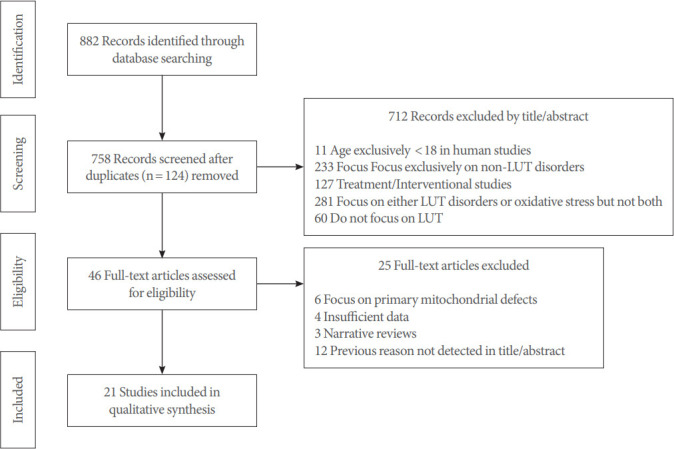
PubMed, Scopus, CINAHL, and Embase were searched for peer-reviewed studies published between January 2000 and March 2021. Animal and human studies that reported on the impact of oxidative stress in age-related LUT disorders through structural or functional changes in the LUT and changes in biomarkers were included. The PRISMA (Preferred Reporting Items for Systematic Reviews and Meta-Analyses) protocol was followed.
Of 882 articles identified, 21 studies (13 animal; 8 human) met inclusion criteria. Across LUT disorders, common structural changes were increased bladder and prostate weights, ischemic damage, nerve damage and detrusor muscle hypertrophy; common functional changes included decreased bladder contraction, increased bladder sensation and excitability, decreased perfusion, and increased inflammation. The disorders were associated with increased levels of biomarkers of oxidative stress that provided evidence of either molecular damage, protective mechanisms against oxidative stress, neural changes, or inflammation. In all cases, the effect on biomarkers and enzymes was greater in aged groups compared to younger groups.
Increased oxidative stress, often associated with mitochondrial dysfunction, plays a significant role in the pathogenesis of age-related LUT disorders and may explain their increasing prevalence. This systematic review identifies potential markers of disease progression and treatment opportunities; further research is warranted to evaluate these markers and the mechanisms by which these changes may lead to age-related LUT disorders.
对临床前和临床同行评审证据进行系统综述,这些证据将氧化应激生物标志物的改变或结局指标与特定年龄相关的下尿路(LUT)疾病中也普遍存在的情况联系起来。
检索了PubMed、Scopus、CINAHL和Embase中2000年1月至2021年3月发表的同行评审研究。纳入通过LUT的结构或功能变化以及生物标志物变化报告氧化应激对年龄相关LUT疾病影响的动物和人体研究。遵循PRISMA(系统评价和Meta分析的首选报告项目)方案。
在识别出的882篇文章中,21项研究(13项动物研究;8项人体研究)符合纳入标准。在各种LUT疾病中,常见的结构变化包括膀胱和前列腺重量增加、缺血性损伤、神经损伤和逼尿肌肥大;常见的功能变化包括膀胱收缩减少、膀胱感觉和兴奋性增加、灌注减少以及炎症增加。这些疾病与氧化应激生物标志物水平升高相关,这为分子损伤、抗氧化应激保护机制、神经变化或炎症提供了证据。在所有情况下,老年组对生物标志物和酶的影响比年轻组更大。
氧化应激增加,通常与线粒体功能障碍相关,在年龄相关LUT疾病的发病机制中起重要作用,并可能解释其患病率的上升。本系统综述确定了疾病进展的潜在标志物和治疗机会;有必要进一步研究以评估这些标志物以及这些变化可能导致年龄相关LUT疾病的机制。