Stanisavljevic Aleksandra, Schrader Joseph M, Zhu Xiaoyue, Mattar Jennifer M, Hanks Ashley, Xu Feng, Majchrzak Mark, Robinson John K, Van Nostrand William E
Department of Biomedical and Pharmaceutical Sciences, University of Rhode Island, Kingston, RI, United States.
George and Anne Ryan Institute for Neuroscience, University of Rhode Island, Kingston, RI, United States.
Front Neurosci. 2022 Mar 15;16:811371. doi: 10.3389/fnins.2022.811371. eCollection 2022.
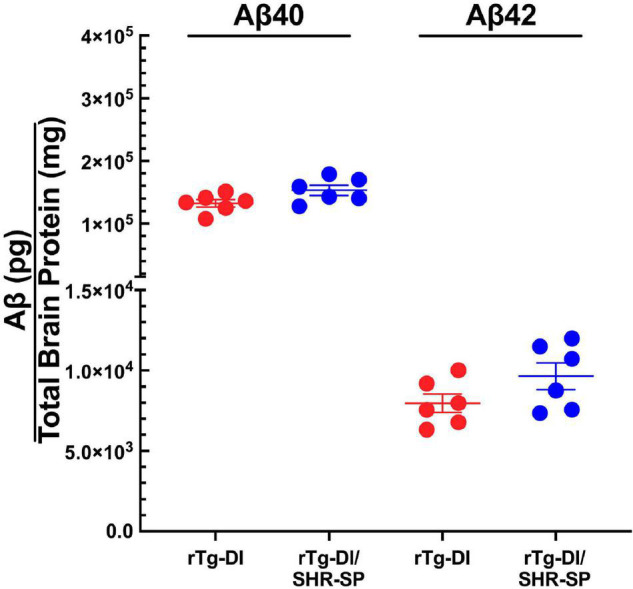
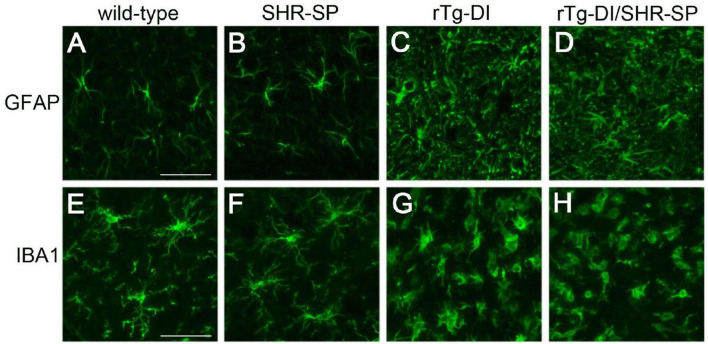
Cerebral amyloid angiopathy (CAA), a common comorbidity of Alzheimer's disease (AD), is a cerebral small vessel disease (CSVD) characterized by deposition of fibrillar amyloid β (Aβ) in blood vessels of the brain and promotes neuroinflammation and vascular cognitive impairment and dementia (VCID). Hypertension, a prominent non-amyloidal CSVD, has been found to increase risk of dementia, but clinical data regarding its effects in CAA patients is controversial. To understand the effects of hypertension on CAA, we bred rTg-DI transgenic rats, a model of CAA, with spontaneously hypertensive, stroke prone (SHR-SP) rats producing bigenic rTg-DI/SHR-SP and non-transgenic SHR-SP littermates. At 7 months (M) of age, cohorts of both rTg-DI/SHR-SP and SHR-SP littermates exhibit elevated systolic blood pressures. However, transgene human amyloid β-protein (Aβ) precursor and Aβ peptide levels, as well as behavioral testing showed no changes between bigenic rTg-DI/SHR-SP and rTg-DI rats. Subsequent cohorts of rats were aged further to 10 M where bigenic rTg-DI/SHR-SP and SHR-SP littermates exhibit elevated systolic and diastolic blood pressures. Vascular amyloid load in hippocampus and thalamus was significantly decreased, whereas pial surface vessel amyloid increased, in bigenic rTg-DI/SHR-SP rats compared to rTg-DI rats suggesting a redistribution of vascular amyloid in bigenic animals. There was activation of both astrocytes and microglia in rTg-DI rats and bigenic rTg-DI/SHR-SP rats not observed in SHR-SP rats indicating that glial activation was likely in response to the presence of vascular amyloid. Thalamic microbleeds were present in both rTg-DI rats and bigenic rTg-DI/SHR-SP rats. Although the number of thalamic small vessel occlusions were not different between rTg-DI and bigenic rTg-DI/SHR-SP rats, a significant difference in occlusion size and distribution in the thalamus was found. Proteomic analysis of cortical tissue indicated that bigenic rTg-DI/SHR-SP rats largely adopt features of the rTg-DI rats with enhancement of certain changes. Our findings indicate that at 10 M of age non-pharmacological hypertension in rTg-DI rats causes a redistribution of vascular amyloid and significantly alters the size and distribution of thalamic occluded vessels. In addition, our findings indicate that bigenic rTg-DI/SHR-SP rats provide a non-pharmacological model to further study hypertension and CAA as co-morbidities for CSVD and VCID.
脑淀粉样血管病(CAA)是阿尔茨海默病(AD)的常见合并症,是一种脑小血管疾病(CSVD),其特征是纤维状淀粉样β(Aβ)在脑血 管中沉积,并促进神经炎症以及血管性认知障碍和痴呆(VCID)。高血压是一种突出的非淀粉样CSVD,已发现其会增加痴呆风险,但有关其对CAA患者影响的临床数据存在争议。为了解高血压对CAA的影响,我们将rTg-DI转基因大鼠(一种CAA模型)与自发性高血压、易中风(SHR-SP)大鼠杂交,产生双基因rTg-DI/SHR-SP大鼠和非转基因SHR-SP同窝仔鼠。在7个月龄时,rTg-DI/SHR-SP大鼠和SHR-SP同窝仔鼠的收缩压均升高。然而,双基因rTg-DI/SHR-SP大鼠和rTg-DI大鼠之间的转基因人淀粉样β蛋白(Aβ)前体和Aβ肽水平以及行为测试均无变化。随后的大鼠队列进一步饲养到10个月龄,此时双基因rTg-DI/SHR-SP大鼠和SHR-SP同窝仔鼠的收缩压和舒张压均升高。与rTg-DI大鼠相比,双基因rTg-DI/SHR-SP大鼠海马和丘脑的血管淀粉样蛋白负荷显著降低,而软脑膜表面血管淀粉样蛋白增加,这表明双基因动物中血管淀粉样蛋白发生了重新分布。rTg-DI大鼠和双基因rTg-DI/SHR-SP大鼠中均有星形胶质细胞和小胶质细胞的激活,而SHR-SP大鼠中未观察到,这表明胶质细胞激活可能是对血管淀粉样蛋白存在的反应。rTg-DI大鼠和双基因rTg-DI/SHR-SP大鼠中均存在丘脑微出血。虽然rTg-DI大鼠和双基因rTg-DI/SHR-SP大鼠之间丘脑小血管闭塞的数量没有差异,但发现丘脑闭塞的大小和分布存在显著差异。皮质组织的蛋白质组学分析表明,双基因rTg-DI/SHR-SP大鼠在某些变化增强的情况下,很大程度上呈现出rTg-DI大鼠的特征。我们的研究结果表明,在10个月龄时,rTg-DI大鼠的非药物性高血压会导致血管淀粉样蛋白重新分布,并显著改变丘脑闭塞血管的大小和分布。此外,我们的研究结果表明,双基因rTg-DI/SHR-SP大鼠提供了一个非药物模型,可进一步研究高血压和CAA作为CSVD和VCID的合并症。