Getaneh Mezgebu, Taye Mengistie, Kebede Damitie, Andualem Dereje
College of Agriculture and Environmental Sciences, Bahir Dar University, P.O. Box 5501, Bahir Dar, Ethiopia.
College of Agriculture and Natural Resource, Dilla University, P.O. Box 419, Dilla, Ethiopia.
Heliyon. 2022 Mar 25;8(3):e09180. doi: 10.1016/j.heliyon.2022.e09180. eCollection 2022 Mar.
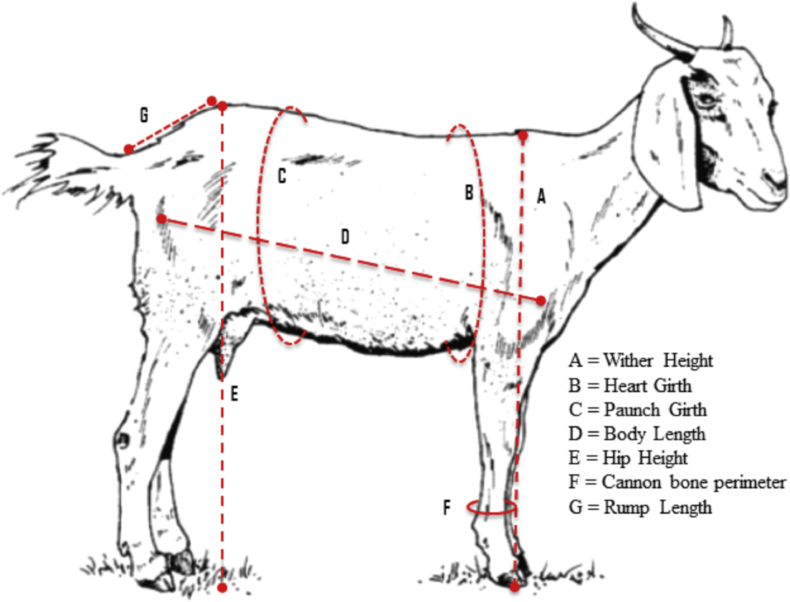
In phenotypic characterization of animal genetic resources, structural indices are essential components to understand the breed structure and body proportions. They are the ethnological characteristics as well as functional traits of animals providing information about the type, aptitude, and production purpose of animals. This study intends to provide information on the structural indices of indigenous goats reared under the smallholder management systems in selected districts of East Gojjam Zone, Amhara region, Ethiopia. Data on body weight and nine morphometric measurements were collected from 706 goats (589 does and 117 bucks) selected using their dentition (≥ One Pair of Permanent Incisor), physiological status (lactating females and intact males), and health condition (healthy). Nineteen structural indices were calculated from morphometric measurements and analyzed using the general linear model (GLM) procedure of the statistical analysis system (SAS, 9.0). Data were analyzed for does and bucks separately. Location had a significant (p < 0.05) influence on pelvic index, transversal and longitudinal pelvic indices, dactyl thoracic index, and relative cannon thickness index of bucks. Except for height slope, pelvic index, baron and crevat, body ratio, areal index, over increase index, weight-1, and weight-2, all other structural indices calculated for does were significantly (p < 0.05) influenced by location. Strong correlations were observed between the structural indices calculated from the linear body measurements. The study revealed that goats in the study area are longilinear and light animals that have dairy biotype. However, further studies are needed to classify the goat types for their production purposes.
在动物遗传资源的表型特征描述中,结构指标是了解品种结构和身体比例的重要组成部分。它们是动物的民族学特征以及功能性状,提供有关动物类型、能力和生产目的的信息。本研究旨在提供埃塞俄比亚阿姆哈拉州东戈贾姆地区选定县小农户管理系统下饲养的本地山羊结构指标的信息。从706只山羊(589只母羊和117只公羊)收集了体重和九项形态测量数据,这些山羊根据其齿列(≥一对永久门齿)、生理状态(泌乳母羊和未阉割公羊)和健康状况(健康)进行选择。从形态测量数据计算出19个结构指标,并使用统计分析系统(SAS,9.0)的通用线性模型(GLM)程序进行分析。数据分别对公羊和母羊进行分析。地点对公羊的骨盆指数、横向和纵向骨盆指数、指胸指数和相对炮骨厚度指数有显著(p<0.05)影响。除了高度斜率、骨盆指数、臀沟和皱襞、身体比例、面积指数、过度增加指数、体重-1和体重-2外,为母羊计算的所有其他结构指标均受地点显著(p<0.05)影响。从线性身体测量计算出的结构指标之间观察到强相关性。研究表明,研究区域的山羊是具有乳用生物型的长线性轻型动物。然而,需要进一步研究根据生产目的对山羊类型进行分类。