From the Department of Radiology, Hospital of the University of Pennsylvania, Philadelphia, PA.
Clin Nucl Med. 2022 Jun 1;47(6):532-536. doi: 10.1097/RLU.0000000000004131. Epub 2022 Apr 5.
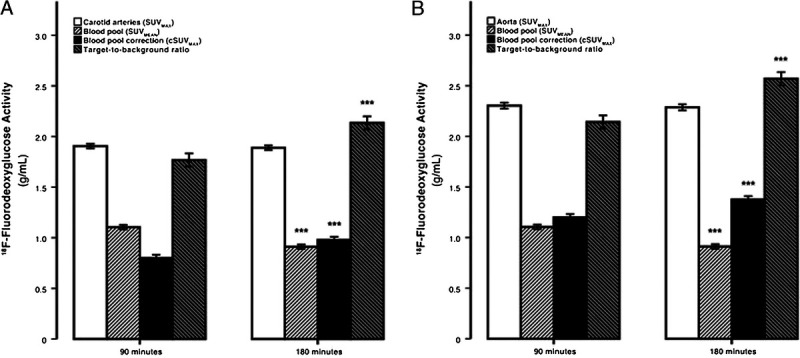
The introduction of FDG in 1976 started a new discipline and enhanced the role of molecular imaging in medicine. While the initial intent with this tracer was to determine brain function in a variety of neuropsychiatric disorders, over time, this powerful approach has made a major impact on managing many other diseases and disorders. During the past 2 decades, FDG PET has been used to detect inflammatory lesions in the atherosclerotic plaques and in other settings. However, the suboptimal spatial resolution of PET limits its ability to visualize plaques that are very small in size. Furthermore, this tracer remains in the blood for an extended period and therefore provides suboptimal results. Target-to-background ratio (TBR) has been suggested to correct for this source of error. Unfortunately, TBR values vary substantially, depending on the timing of image acquisition. Delayed imaging at later time points (3-4 hours) may obviate the need for TBR measurement, but it is impractical with conventional PET instruments. Recently, 18F-sodium fluoride (NaF) has been used for detection and quantification of molecular calcification in the plaques. This tracer is highly specific for calcification and is rapidly cleared from the circulation. In addition, global atherosclerotic burden as measured by NaF PET can be determined accurately either in the heart or major arteries throughout the body. Therefore, the role of FDG PET-based TBR measurement for detection and quantification of atherosclerotic plaques is questionable at this time.
1976 年引入 FDG 开创了一个新的学科,并增强了分子影像学在医学中的作用。虽然最初使用这种示踪剂的目的是确定各种神经精神疾病中的大脑功能,但随着时间的推移,这种强大的方法在治疗许多其他疾病和病症方面产生了重大影响。在过去的 20 年中,FDG PET 已用于检测动脉粥样硬化斑块中的炎症病变和其他病变。然而,PET 的空间分辨率不理想限制了其可视化非常小的斑块的能力。此外,这种示踪剂在血液中停留的时间很长,因此提供的结果不理想。靶标与背景比(TBR)已被建议用于纠正这种误差源。不幸的是,TBR 值会根据图像采集的时间而有很大差异。在稍后的时间点(3-4 小时)进行延迟成像可能不需要进行 TBR 测量,但这在常规 PET 仪器上是不切实际的。最近,18F-氟化钠(NaF)已用于检测和量化斑块中的分子钙化。这种示踪剂对钙化具有高度特异性,并且会迅速从循环中清除。此外,通过 NaF PET 测量的全身动脉粥样硬化负荷可以在心脏或全身主要动脉中准确确定。因此,目前对于基于 FDG PET 的 TBR 测量在检测和量化动脉粥样硬化斑块中的作用存在疑问。