Faculty of Dentistry, Damascus University, Damascus, Syria.
Program of Medical Education, Syrian Virtual University, Damascus, Syria.
Clin Exp Dent Res. 2022 Aug;8(4):883-892. doi: 10.1002/cre2.567. Epub 2022 Apr 6.
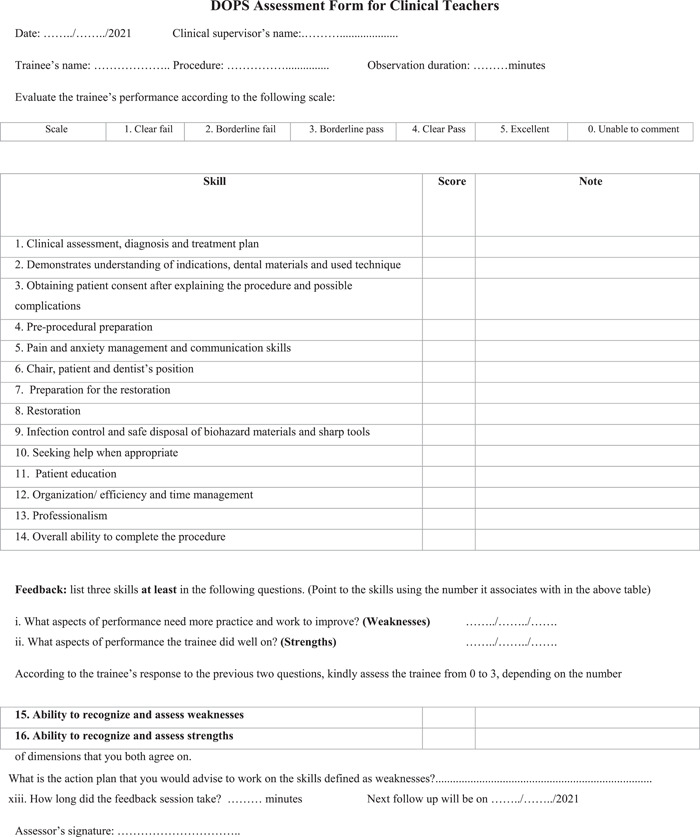
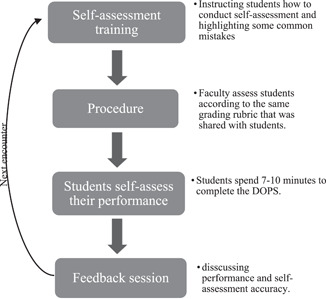
PURPOSE/OBJECTIVES: The current study was undertaken to investigate whether self-assessment of clinical skills of undergraduate dental students could be bridged with faculty assessment by deliberate training over an extended period. A secondary aim was to explore students' perception of self-assessment and its effect on their learning and motivation. MATERIAL AND METHODS: A prospective pilot study was conducted at the Department of Restorative Dentistry at Damascus University. Sixteen students participated in the study, ranging in age between 22 and 23 years. A modified Direct Observation of Procedural Skills form with a grading rubric was used to register and guide students' self-assessment; both were pretested on four students before the study. In total, four clinical encounters were completed by each student. Students were trained on how to conduct proper self-assessment before and after each clinical encounter. A postcourse questionnaire was used to investigate students' perception of self-assessment.
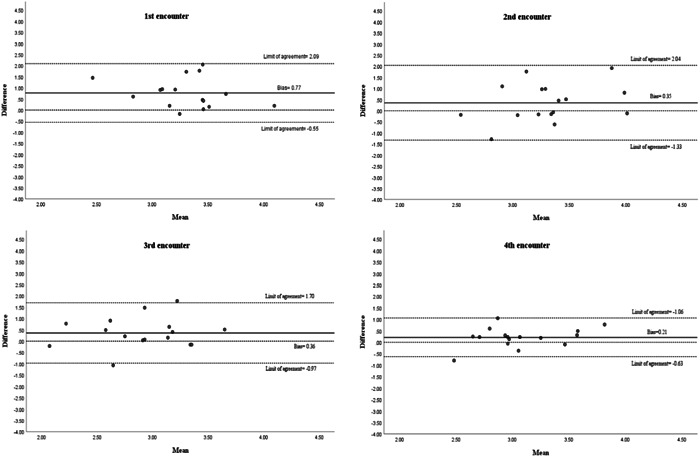
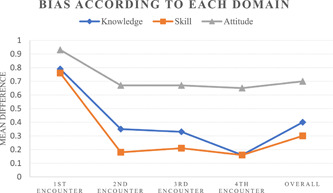
Bias in self-assessment decreased consistently after each encounter, and the difference in bias between the first (bias = 0.77) and the last encounter (bias = 0.21) was significant with a medium effect size (p = .022, d = 0.64). The percentage of disconfirming performance dimensions decreased from 39.7% to 26.9%. Students' ability to exactly pinpoint strengths improved consistently and significantly. However, their ability to pinpoint areas of improvement was volatile and showed no significant difference. Bland-Altman graph plots showed higher levels of agreement between self-assessment and faculty assessment. Moreover, students' perception of self-assessment was very positive overall.
These findings suggest the possibility that the gap between self-assessment and faculty assessment could be bridged through deliberate training. Future longitudinal research using a larger sample size is still required to further explore whether self-assessment can be actively bridged with faculty assessment by deliberate training.
目的/目标:本研究旨在探讨经过长时间的刻意培训,本科生临床技能的自我评估是否可以与教师评估相衔接。次要目的是探讨学生对自我评估的看法及其对学习和动机的影响。
在大马士革大学修复牙科系进行了一项前瞻性试点研究。16 名年龄在 22 岁至 23 岁之间的学生参加了这项研究。使用改良后的直接观察程序技能表和评分量表来记录和指导学生的自我评估;在研究前对四名学生进行了预测试。每个学生总共完成了四次临床接触。在每次临床接触前后,对学生进行了适当自我评估的培训。使用课后问卷调查学生对自我评估的看法。
每次接触后,自我评估的偏差持续降低,第一次(偏差=0.77)和最后一次接触(偏差=0.21)之间的偏差差异具有中等效应量(p=0.022,d=0.64)。不相符的表现维度比例从 39.7%下降到 26.9%。学生准确指出强项的能力持续显著提高。然而,他们指出改进领域的能力不稳定,没有显著差异。Bland-Altman 图显示自我评估和教师评估之间的一致性更高。此外,学生对自我评估的看法总体上非常积极。
这些发现表明,通过刻意培训,自我评估和教师评估之间的差距有可能被弥合。未来仍需要进行更大样本量的纵向研究,以进一步探讨自我评估是否可以通过刻意培训与教师评估积极衔接。