Department of Psychiatry, Massachusetts General Hospital, 100 Cambridge St., Suite 1600, Boston, MA, 02114, USA.
Health Promotion and Resiliency Intervention Research (HPRIR) Program, Massachusetts General Hospital, Boston, MA, USA.
Support Care Cancer. 2022 Jul;30(7):5911-5919. doi: 10.1007/s00520-022-07022-5. Epub 2022 Apr 6.
Group-based mind-body interventions such as the Stress Management and Resiliency Training-Relaxation Response Resiliency Program (SMART-3RP) hold promise for enhancing resiliency among cancer survivors. Mechanisms underlying improvements in psychological outcomes are theoretically established but remain unexamined empirically.
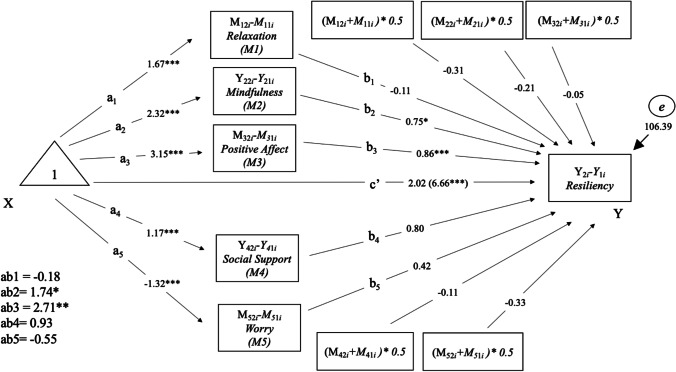
Adult cancer survivors (n = 105) participating in the SMART-3RP completed surveys of resiliency and five hypothesized mediators: coping (ability to relax physical tension and assertive social support-seeking), mindfulness, positive affect, and worry. Pre-post intervention changes were assessed using repeated-measures t-tests. Bivariate correlations between change scores and a more conservative within-person parallel mediation model tested covariance between resiliency and mediators.
Participants experienced moderate to large improvements in all patient-reported outcomes (ds = 1.01-0.46). Increased resiliency was significantly associated with increases in mindfulness, positive affect, and assertive social support-seeking (rs = 0.36-0.50); smaller associations with increased relaxation and decreased worry were not significant. Mindfulness and positive affect explained the largest proportion of variance in resiliency increase in the full multivariate model.
Cancer survivors completing the SMART-3RP had increased resiliency, which was associated with improvements in mindfulness, positive affect, and the ability to assertively seek social support. Enhancing mindfulness and positive affect were critical components for enhancing resiliency. Implications for resiliency interventions with cancer survivors are discussed.
基于团体的身心干预措施,如压力管理和复原力训练-放松反应复原计划(SMART-3RP),有望增强癌症幸存者的复原力。心理结果改善的理论基础已经确立,但尚未在实证研究中得到检验。
参与 SMART-3RP 的成年癌症幸存者(n=105)完成了复原力和五个假设中介因素的调查:应对(放松身体紧张和自信寻求社会支持的能力)、正念、积极情绪和担忧。使用重复测量 t 检验评估干预前后的变化。变化分数之间的双变量相关性和更保守的个体内平行中介模型测试了复原力和中介因素之间的协方差。
所有患者报告的结果(ds=1.01-0.46)都有中度到较大的改善。复原力的增加与正念、积极情绪和自信寻求社会支持的增加显著相关(rs=0.36-0.50);与放松增加和担忧减少相关的较小关联不显著。在全变量模型中,正念和积极情绪解释了复原力增加的最大比例。
完成 SMART-3RP 的癌症幸存者复原力增强,与正念、积极情绪和自信寻求社会支持的能力提高有关。增强正念和积极情绪是增强复原力的关键组成部分。讨论了癌症幸存者复原力干预的意义。