Liu Xuan, Rohr Jason R, Li Xianping, Deng Teng, Li Wenhao, Li Yiming
Key Laboratory of Animal Ecology and Conservation Biology, Institute of Zoology, Chinese Academy of Sciences, Chaoyang, Beijing 100101, China.
Department of Biological Sciences, Environmental Change Initiative, University of Notre Dame, Notre Dame, IN 46556, USA.
Curr Zool. 2020 Oct 27;67(4):393-402. doi: 10.1093/cz/zoaa068. eCollection 2021 Aug.
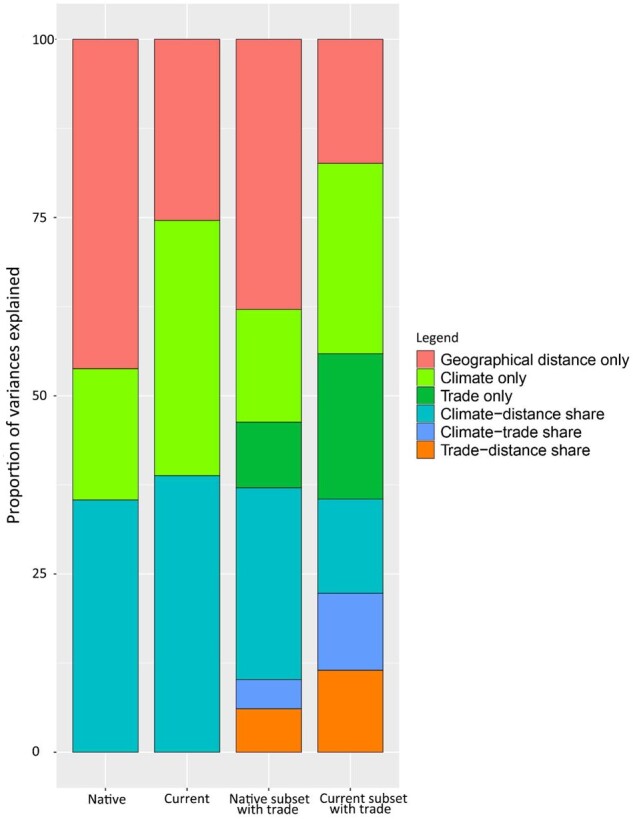
Understanding how alien species assemble is crucial for predicting changes to community structure caused by biological invasions and for directing management strategies for alien species, but patterns and drivers of alien species assemblages remain poorly understood relative to native species. Climate has been suggested as a crucial filter of invasion-driven homogenization of biodiversity. However, it remains unclear which climatic factors drive the assemblage of alien species. Here, we compiled global data at both grid scale (2,653 native and 2,806 current grids with a resolution of 2°×2°) and administrative scale (271 native and 297 current nations and sub-nations) on the distributions of 361 alien amphibians and reptiles (herpetofauna), the most threatened vertebrate group on the planet. We found that geographical distance, a proxy for natural dispersal barriers, was the dominant variable contributing to alien herpetofaunal assemblage in native ranges. In contrast, climatic factors explained more unique variation in alien herpetofaunal assemblage after than before invasions. This pattern was driven by extremely high temperatures and precipitation seasonality, 2 hallmarks of global climate change, and bilateral trade which can account for the alien assemblage after invasions. Our results indicated that human-assisted species introductions combined with climate change may accelerate the reorganization of global species distributions.
了解外来物种如何聚集对于预测生物入侵导致的群落结构变化以及指导外来物种管理策略至关重要,但相对于本地物种而言,外来物种组合的模式和驱动因素仍知之甚少。气候被认为是入侵驱动的生物多样性同质化的关键筛选因素。然而,尚不清楚哪些气候因素驱动外来物种的聚集。在此,我们收集了全球网格尺度(2653个本地网格和2806个当前网格,分辨率为2°×2°)和行政尺度(271个本地国家和297个当前国家及次国家)上关于361种外来两栖动物和爬行动物(爬行类动物)分布的数据,这是地球上受威胁最严重的脊椎动物类群。我们发现,地理距离作为自然扩散障碍的一个指标,是本地范围内外来爬行类动物组合的主要影响变量。相比之下,气候因素在入侵后比入侵前对外来爬行类动物组合的独特变化解释得更多。这种模式是由全球气候变化的两个标志——极端高温和降水季节性,以及双边贸易驱动的,双边贸易可以解释入侵后的外来物种组合。我们的结果表明,人类辅助的物种引入与气候变化相结合可能会加速全球物种分布的重新组织。